
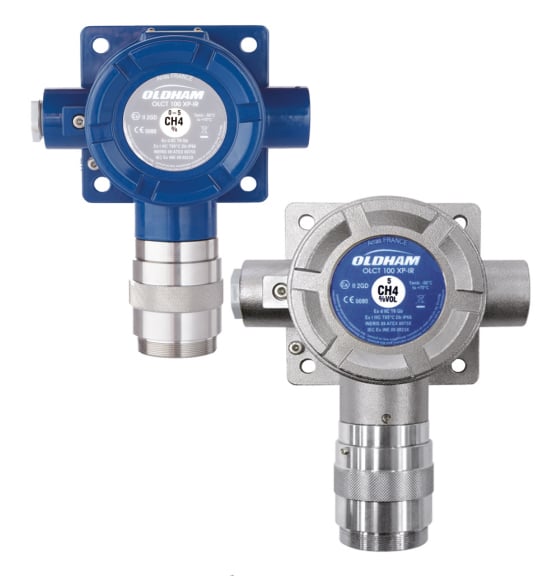
Oldham Simtronics OLC(T) 100 Fixed Gas Detector
Bulk Orders
The OLC/OLCT 100 range of fixed detectors has been designed for detection of combustible gases, toxic gases or oxygen.
Available in explosion-proof or intrinsically safe versions, the OLCT 100 is ATEX certified for Zone 1 (gas) and Zone 21 (dust).
The OLCT 100 is available in a stainless steel version, offering increased resistance to corrosive elements (ideal for marine, wastewater treatment plants, food processing activities, etc).
This stainless steel intrinsically safe version is certified for use in zones 0 (gas) and 20 (dust), whereas all other versions of the OLCT 100 are certified for use in zones 1 (gas) and 21 (dust).
Features
- Detection of Combustible, Toxic or Oxygen gases
- Infrared XP version
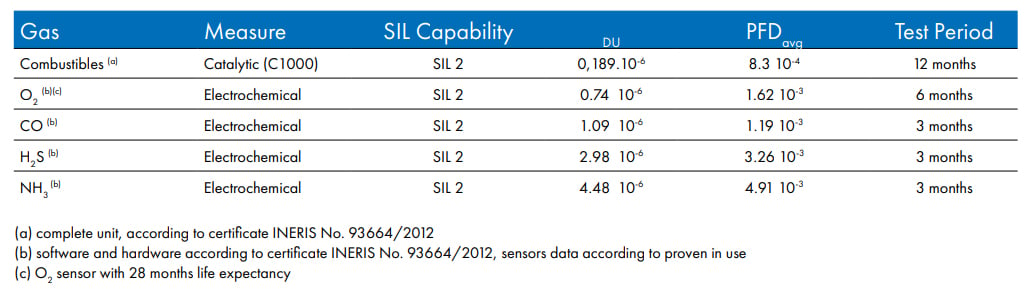
- SIL 2 high reliability
- IP 66
- Aluminium or Stainless Steel version
Applications
- Steel mills
- Petrochemical facilities
- Chemical industry
- Pharmaceutical industry
- Food industry
- Refrigeration industry
- Water treatment
Our products are always application-driven, solution-oriented.
Options include:
- OLCT 100 transmitter with 4-20 mA output
- OLC 100 detector with a Wheatstone bridge output for detection of combustible gases
IR Sensor
The infrared sensor provides detection of CO2 and refrigerant gases.

OLCT 100 XP
Explosion-proof version is equipped with a catalytic, electrochemical or semiconductor sensor, for detection of combustible, toxic gases or oxygen.
OLCT 100 IS
Intrinsically safe version is equipped with an electrochemical sensor for detection of toxic gases or oxygen.
OLCT 100 XP IR
Explosion-proof IR version is equipped with an infrared sensor for detection of CO2 , SF6 and some freons.
OLCT 100 XP HT
High temperature explosion-proof version for detection of combustible gases up to 200°C. High temperature cable included: 5, 10, 15 meter lengths.

Reliability
The OLC(T) 100 is SIL 2 certified by INERIS, according to the EN 50402 standard, which corresponds to IEC/EN 61508 for gas detectors.


Ordering Information

Accessories
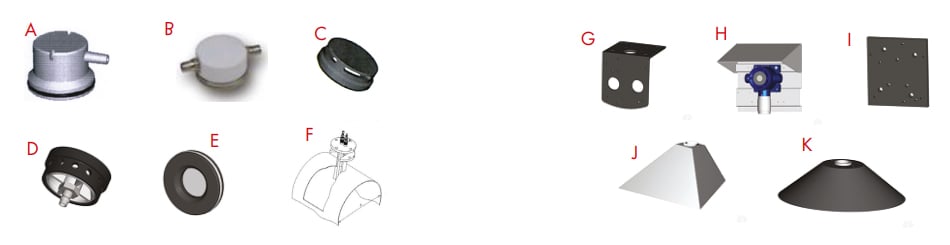
A Calibration cup (6331141) allows introduction of calibration gas on the sensor
B Bypass adapter (6327910) allows measurement of samples
C Splash guard system (6329004) protects the detector from liquid projections
D Remote gas introduction head (6327911) allows introduction of gas without opening the detector
E Removable protective filter (6335975) protects the sensor against projections and dust
F Duct measurement kit (6793322) allows gas monitoring in a duct
G Mounting bracket (6322420) allows the mounting of the detector to the ceiling
H Protective cover (6123716) protects the detector against bad weather conditions or against direct sun radiations
I Adapter plate (6793718) allows the replacement of another OLDHAM detector without redrilling
J Wall mounted collecting cone (6331169) for use with lighter-than-air gases
K Ceiling mount collecting cone (6331168) for use with lighter-than-air gases
What gases can the Oldham OLCT 100 fixed gas detector monitor?
The Oldham OLCT 100 (also written OLCT100) is a fixed detector range for combustible, toxic, refrigerant or oxygen gases. The explosion-proof OLCT 100 XP takes a catalytic, MEMS, electrochemical or semiconductor sensor; for combustible gas in a process plant, the catalytic, MEMS and infrared (OLCT 100 XP IR) versions measure 0-100% LEL.
Documented example: ordering reference OLCT 100-XP-002-1 is an OLCT 100 XP transmitter, 0-100 % LEL (4.4 % Vol) CH4, ATEX/IECEx, M20 cable entry.
OLC 100 vs OLCT 100: which output does your controller need?
The OLC 100 uses a Wheatstone bridge catalytic sensor and connects to Oldham controllers only. The OLCT 100 adds an amplifier with a 2 or 3 wire 4-20 mA analog output for a measurement unit or an industrial automation system.
Output codes (user manual): 0 mA means electronic fault or no power supply, below 1 mA a fault, 2 mA initialization mode, and a signal frozen at 20 mA means combustible gas has reached 100% LEL.
Which hazardous-area markings apply to each OLCT 100 version?
Per the brochure, CSA covers the XP catalytic (VQ1), electrochemical and semiconductor versions and the IS electrochemical version.
| Property | Value | Source note |
|---|---|---|
| OLC 100, OLCT 100 XP, XP IR | ATEX II 2 GD / Ex db IICT6 Gb / Ex tb IIIC T85°C Db IP66 | Brochure GF-30029S-EN |
| OLCT 100 IS aluminum | ATEX II 2 GD / Ex ia IIC T4 Gb / Ex ia IIIC T135°C Db IP66 | Brochure |
| OLCT 100 IS stainless steel | ATEX II 1 GD / Ex ia IIC T4 Ga / Ex ia IIIC T135°C Da IP66 | Brochure |
| CSA: OLCT-100-XP | Class I, Div. 1, Groups A, B, C & D, T6; Ex db IIC T6 Gb; Class I, Zone 1 AEx db IIC T6 Gb | Manual NPO100GB, 10.8.4 |
| CSA: OLCT-100-IS | Class I, Div. 1, Groups A, B, C & D, T4; Ex ia IIC T4 Ga; Class I, Zone 0 AEx ia IIC T4 Ga | Manual NPO100GB, 10.8.4 (brochure prints T6 for IS; confirm on label) |
| Functional safety | SIL 2 according to EN 50402:2017/ EN 61508 for versions OLCT100 XP & IS | Brochure; INERIS 25SILT007 issue 2 |
How often should an OLCT 100 combustible gas detector be tested and calibrated?
Calibration frequency follows gas test results but must not exceed one year. For SIL capability level 2 under EN 50402, the maintenance interval for explosive gas detectors must be no more than 3 months.
Failure mode: catalytic sensors can be poisoned by silicones, tetraethyl lead, sulfur compounds, halogenated compounds and organo-phosphorus compounds. Teledyne positions the infrared version for conditions where poisons could harm a catalytic sensor. Typical catalytic sensor life: 48 months.
Related products



Popular Brands


Reviews
There are no reviews yet.