
Gas Detection Controller Selection Guide: Multi-Channel Gas Detection Control Panels, Low-Power Alarm and Control Systems and SIL 2 Fire and Gas (F&G) Controllers for Oil and Gas Sites, Drilling Rigs and Offshore Platforms
A gas detection controller (gas detection control panel, multi-channel gas controller, gas alarm and control system) reads fixed gas detectors and switches alarm relays; a fire and gas (F&G) controller also supervises fire inputs and may release suppression. This guide compares published data for six controllers from Det-Tronics, Teledyne Detcon, Honeywell, MSA, RC Systems and Gastronics, read on October 14, 2026, and matches each to the job its documents support.
Quick answer: which gas detection controller or fire and gas system fits your site?
Start from the job, then confirm model code and approvals with the supplier.
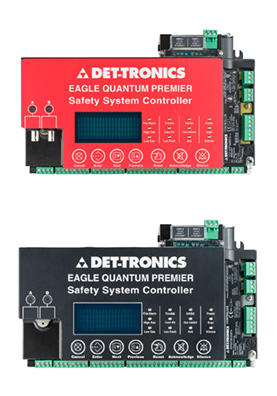
- SIL 2 fire and gas with suppression release: of the six controllers compared here, only the Det-Tronics Eagle Quantum Premier (EQP) is published both as SIL 2 capable (exida, IEC 61508) and as listed for preaction and deluge releasing (FM 3010:2021, ANSI/UL 864:2014).
- 8 to 32 sensors on a drilling rig, low power: the Teledyne Detcon X40-8 or X40-32, a low power alarm and control system, or the Gastronics RG-D2 (Class I, Div. 2, up to 32 wired channels).
- Mixed 4-20 mA and Modbus sensors: the X40 reads Detcon Modbus devices directly and other detectors as 4-20 mA via DA-4 modules; the Honeywell Touchpoint Plus adds mV bridge inputs; the RC Systems ViewSmart 6400 is a Modbus master and slave.
- Controller inside a Division 1 area: the X40-32-N7 (NEMA 7 Class I; Division 1, Group C, D), the RC Systems ST-72XP or an EQP in an EQ3900E enclosure; otherwise a safe-area panel.
Which SIL 2 fire and gas controller handles fire detection, gas detection and suppression release at an oil and gas facility?
Choose a fire and gas system that is listed for releasing service and certified SIL 2 capable; a gas-only controller drives alarm relays but does not release suppression. Det-Tronics states that the EQP controller is approved as an annunciation and releasing device for fire alarm systems, and FM certificate FM24US0128 lists FM 3010:2021 and ANSI/UL 864:2014 under Automatic Releases, Preaction and Deluge Sprinkler Systems. One EQP controller runs up to 246 field devices on a loop with NFPA 72 Class X communication, offers Modbus TCP/IP and hot-standby redundancy, and its 2025 EU Declaration lists II 3 G Ex nA nC IIC T4 Gc.
- Releasing needs a listing: Det-Tronics quotes NFPA 72 (2016), clause 23.11.1: releasing service fire alarm control units used for automatic or manual activation of a fire suppression system shall be listed for releasing service.
- Small F&G controllers sit in between: MSA calls the SENTRY io a small point fire and gas controller with contact inputs from smoke and heat detectors and pull stations; none of the documents listed under Sources for the other five controllers describes a releasing function.
What parts make up a fire and gas system?
An addressable fire and gas system is a controller, I/O modules and detectors on one loop, extenders as the loop grows, and a monitored power supply; on the EQP:
- Controller: the EQP Controller EQ30XX, as EQ3001 for 246 nodes or EQ3016 for 16 nodes.
- I/O modules: EQ3710 AIM for 4-20 mA inputs, EQ3730 EDIO for supervised inputs and releasing outputs, EQ3720 RM for eight relays and the EQ3780HSDM High Speed Deluge Module, whose output typically activates in <0.002 seconds.
- Loop devices: without an extender the loop is limited to 60 nodes on 2,000 meters; each EQ2400NE Network Extender adds 40 nodes and 2,000 meters, up to 6 extenders, 246 field nodes and 10,000 meters, and an EQ2400PLR Physical Layer Repeater eliminates interference from wiring opens.
- Size costs speed: AIM response is under 2 seconds up to 100 LON devices, under 3 up to 200 and under 4 up to 246.
- Power: EQP21XXPS power supplies with a power supply monitor; FM lists EQ21xx supplies with 24 or 90 hour standby battery.
- Detectors and displays: the SIL 2 capable system includes the X3301 flame detector, PIRECL and LS2000 gas detectors (see our open-path gas detector selection guide), and the FlexVu UD10 DCU takes any FM Approved 4-20 mA device.
Which low-power gas detection alarm and control panel fits 8 to 32 sensors on a drilling rig?
Teledyne Detcon describes the Model X40 as a low power alarm and control system, built as the X40-8 for up to 8 field devices and the X40-32 for up to 32, with a controller draw under 0.25 Watt before I/O modules and field devices, and lists oil and gas drilling rigs among its applications. Gastronics’ RG-D2 Class I, Div. 2 rig controller expands to 32 wired channels, and an RC Systems WaveLink receiver, powered from 10-30 VDC or 100-240 VAC, handles 1 to 32 battery-powered SenSmart 7000 monitors.
- Where the panel sits: the X40-32-N7 (NEMA 7 Class I; Division 1, Group C, D) is for distributed I/O installations only, and the RG-D2 goes in the rig “Dog House” with a mirror controller in a non-hazardous area.
- Module slots set the ceiling: the X40-8 houses up to six 4-channel I/O modules and the X40-32 up to 12, while the X40-32-N7 enclosure takes no modules.
- Startup gap: the X40 does not log data during the first 10 minutes after power-up.
Which inputs should a gas detection control panel accept: 4-20 mA, RS-485 Modbus, mV catalytic bridge or wireless?
Match input cards to the detectors on site: 4-20 mA suits most transmitters, RS-485 Modbus saves cable but depends on each detector’s register map, mV bridge inputs drive catalytic bead sensors, and wireless trades cable for batteries. Honeywell’s Touchpoint Plus accepts 2-wire and 3-wire 4-20 mA and 3-wire mV bridge inputs, the mV inputs for catalytic-type flammable gas detectors.
- Modbus is not plug-and-play: the X40 brochure marks its RS-485 Modbus inputs as only compatible with other Detcon products; other detectors connect as 4-20 mA through the DA-4 input module.
- 4-20 mA on an F&G system: the EQ3710 AIM takes up to eight 4-20 mA devices in combustible gas mode, with alarm thresholds limited to approval body requirements, or in universal mode, and all devices must provide their own calibration facilities.
Which relay outputs, voting logic and fault signals should the controller provide?
Plan relays per alarm level and zone, a trouble relay that changes state on any failure, and voting so one detector cannot trip a shutdown alone. The Touchpoint Plus offers 12 or 24 relay outputs rated 1.7 A @ 30 VDC/250 VAC with grouping and voting alarm logic, and MSA lists up to 56 relays rated 2 A with AND, OR, 2 of N and 3 of N logic for the SENTRY io.
- Fail-safe trouble contact: the EQP controller trouble output is normally energized only, and the Touchpoint Plus system fault relay is energized in normal operation and de-energized on a fault.
- Know the analog fault levels: by default the Touchpoint Plus 4-20 mA output is fixed at 2 mA in inhibit and 1 mA in fault, so a PLC can tell a fault from zero gas.
- EQP output tiers: the controller has 8 unsupervised relays rated 1 ampere at 30 Vdc; supervised releasing outputs come from EDIO channels and extra relays from the EQ3720 RM.
What does SIL 2 mean on a gas detection controller or F&G system, and what is actually certified?
A SIL 2 capable controller can be used in a SIL 2 safety function, but the function itself must be verified: exida’s EQP certificate states that PFDAVG and architecture constraints must be verified for each application. Read which models, modules and outputs the certificate covers; the X40, SENTRY io, ViewSmart 6400 and RG-D2 documents listed under Sources state no SIL rating.
- EQP: exida certifies the EQP Safety System to IEC 61508:2010 Parts 1-3 as SC 2 (SIL 2 Capable), SIL 2 @ HFT=0, Route 1H, and Det-Tronics applies SIL 2 capability to specific models.
- Not every module is in scope: the EQP safety manual classes the EQ2400NE Network Extender, the EQ3720RM Relay Module and the ControlNet, Ethernet and EtherNet/IP DLR interfaces as non-interfering, and data read from remote Modbus devices is not safety-related.
- Touchpoint Plus: only the relay output and the 4-20 mA current output are under SIL2 scope (SGS TUV SAAR certificate FS/71/220/17/0178).
- Proof tests: Honeywell sets a 1 year proof test interval; the EQP safety manual schedules EDIO, AIM and LS2000 proof tests once per year.
- Certificate revision: the exida certificate posted on det-tronics.com is Revision 3.0 of August 05, 2022 with a surveillance audit due June 30, 2025; ask Det-Tronics or PE for the current revision.
Which fire alarm and gas performance approvals should a fire and gas controller carry: FM 3010, NFPA 72, FM 6320, ANSI/ISA 60079-29-1?
Check the fire alarm listing, the gas performance approval and the hazardous-location rating separately. Det-Tronics’ FM gas certificate FM17US0258X lists FM 6310, 6320:2024, FM 6325:2005, FM 6340:2014 and ANSI/ISA 60079-29-1 (12.13.01):2013; MSA lists FM 6320, FM 6325, FM 6340 and IEC/EN/UL/FM 60079-29-1 for the SENTRY io; Honeywell lists EN 50271:2010, C22.2 No. 152-M1984 and ISA 12.13.01 for the Touchpoint Plus.
- An approved input is not an approved detector: FM approval of the EQP 4-20 mA input does not include or imply approval of the connected gas detection apparatus, and every 4-20 mA gas instrument on that input must also be FM Approved.
- Communications sit outside the approval: FM allows Modbus TCP/IP and Allen Bradley protocols in the EQP controller, but the communications functions are not included in the Approval, and the ControlNet and Ethernet DLR boards are not covered by any approval.
- Electrical safety is not gas performance: the X40 manual lists certification to CSA/UL/EN-61010-1 for NEMA 4 models only.
Where can the controller be installed: NEMA 4X, Class I Division 2, Division 1, ATEX and IECEx?
Most controllers here are rated for general-purpose or Class I, Division 2 locations, so a Division 1 or Zone 1 area usually means an explosion-proof enclosure or a panel in a safe area. Copy the marking for the exact model from the current document; it changes with enclosure and edition.
- EQP controller: FM / CSA: Class I, Div. 2, Groups A, B, C, D (T4), indoor per FM; EQ3900E enclosures were evaluated for Class I, Div. 1, and EQ3900G enclosures are for indoor, non-hazardous locations.
- EQP editions disagree: the 2020 spec sheet lists Ex nC IIC T4 Gc, DEMKO 02 ATEX 133867X and IECEx ULD 10.0004X, while the August 2025 manual lists Ex nA nC IIC T4 Gc, UL 20 ATEX 138864X and IECEx UL 20.0112X, matching the October 2025 EU Declaration of Conformity; check the label.
- Touchpoint Plus: the data sheet reads Class I, Division 2, Group A, B, C, and D, or non-hazardous only, and Honeywell’s US product page lists Hazloc Class I Division 2 Groups A, B, C, D, but also a Standards line US and Canada: Class I, Division 1, Groups A, B, C, D, T4; confirm on the label.
- SENTRY io: Class I, Division 2, Groups A, B, C, D; T5 (ATEX FM22ATEX0006, IECEx FMG 22.0007); the bid specification says Type 3X, IP65, the online specifications NEMA-4X, IP65.
Which gas monitoring system supports wireless sensors and relay outputs on an offshore platform?
Offshore you need relay outputs, wireless for hard-to-wire points and a marine type approval on top of the hazardous-area rating. Teledyne lists offshore production platforms among X40 applications and pairs the X40 with RL-4 relay modules and RXT-320 SmartWireless transceivers at 2.4 GHz, published at 1.5 miles outdoors with a directional antenna, but the X40 brochure and manual list no marine type approval; ask Teledyne.
- Larger wireless systems: Teledyne’s MCX32-TP supports up to 64 field devices with optional RXT-320 wireless; Dräger states that the REGARD 7000’s masterless architecture prevents the entire system from failing if one component fails.
- Marine approvals: Det-Tronics offers an EQP controller model with US Coast Guard type approval under 46 CFR 161.002 and lists an American Bureau of Shipping (ABS) Certificate of Design Assessment for its EQ3900G systems, and Honeywell lists MED (Item No.: 3.54) for the Touchpoint Plus.
- Certificate copies: the DNV GL type approval TAA0000121 posted on the EQP page lists 2021-06-20 as its validity date; ask for the current marine certificate for your configuration.
How do redundancy and communications compare: Modbus RTU, Modbus TCP, EtherNet/IP and ControlNet?
For a system that must survive a controller failure, look for hot-standby redundancy and a fault-tolerant loop. Two EQP controllers can run as a Master and Hot Standby pair with bumpless transfer, every EQP field device except the network extender has two LON fault isolation relays, and all LON devices support NFPA 72 Class X communication.
- EQP: RS-485 Modbus RTU on the controller, Modbus TCP/IP on the Ethernet Interface Board, optional ControlNet or Ethernet DLR boards, and links to up to 12 EQP controllers over RS-485.
- X40: RS-485 Modbus RTU to sensors and I/O modules, plus a secondary Modbus port addressable by a PLC, PC/HMI or DCS.
How should you plan power, battery backup and data logging?
Add up controller, module and detector loads, then size the battery for the standby time your code requires. The EQP controller draws 9 watts nominal and 12 watts maximum; the Touchpoint Plus is rated at max. 105 W with detectors and external devices (210 W with expansion unit), and its battery covers more than 30 minutes in a typical system.
- Field power: the SENTRY io draws 1.4 A at 24 VDC and supplies up to 8.6 A at 24 VDC to field devices, and an X40 with modules and sensors is capped at 100 Watts.
- Event logs: the EQP controller stores up to 4,095 alarms and events, and the SENTRY io keeps no less than 100 latest events with SD card download.
How do current gas detection controllers and F&G systems compare on published data?
Values and approval strings as printed; “not published” means absent from the documents listed under Sources.
| Controller | Capacity and relays | Inputs and communications | SIL and releasing (as stated) | Hazardous location (as printed) |
|---|---|---|---|---|
| Det-Tronics EQP | 246 field devices; 8 relays on the controller plus EDIO and RM modules | LON field devices, 4-20 mA via AIM, contacts via EDIO; Modbus RTU, Modbus TCP/IP, ControlNet, EtherNet/IP DLR | SIL 2 capable (exida), specific models; FM 3010:2021, ANSI/UL 864:2014 preaction and deluge releasing | Class I, Div. 2, Groups A, B, C, D (T4); indoor |
| Teledyne Detcon X40 | 8 or 32 field devices; RL-4 modules, 4 relays each | 4-20 mA; RS-485 Modbus (Detcon products only); RS-485 Modbus RTU | not published | N7: NEMA 7 Class I; Division 1, Group C, D |
| Honeywell Touchpoint Plus | 8, or 16 with expansion unit; 12 or 24 relays, 1.7 A | 2- or 3-wire 4-20 mA, 3-wire mV bridge; Modbus RTU, Modbus TCP (options) | SIL2 on relay and 4-20 mA outputs; releasing not published | Class I, Division 2, Group A, B, C, and D, or non-hazardous only (data sheet) |
| MSA SENTRY io | 16 analog and 6 discrete inputs; up to 56 relays, 2 A | 4-20 mA with HART, dry contacts; Modbus TCP/IP, Modbus RTU optional, EtherNet/IP/DLR | not published | Class I, Div. 2, Group A, B, C, D |
| RC Systems ViewSmart 6400 | 64 inputs, 128 with two ST-72s; 5 standard plus 3 programmable relays, 5 A | 4-20 mA, bridge sensor (option); Modbus TCP, RS-485 Modbus master/slave | not published | NEMA 4X = Division 2 Groups A,B,C,D; ST-72XP: NEMA 7 Division 1 Group B,C,D |
| Gastronics RG-D2 | 32 wired (Div. 2); 64 wired and 64 wireless (non-hazardous); single, dual or four pole relays | wired and wireless channels; RS485 Modbus-RTU | not published | Class I, Division 2 Hazardous Locations; non-Hazardous Locations |
Where can you buy a gas detection controller or F&G system in Houston, Texas, and what should you ask the supplier?
PE Energy Industrial Supply, 2700 Greens Rd H300, Houston, TX 77032 (281-310-0628, pesales@pe-energy.com), is an authorized distributor for Det-Tronics and Teledyne Detcon and quotes complete configured systems. For Det-Tronics, PE lists the Eagle Quantum Premier Controller EQ30XX, EQ3710 AIM, EQ3730 EDIO, EQ3720 RM, EQ3780HSDM, EQ2400NE and FlexVu UD10; for Teledyne Detcon, the Model X40, X40-32-N1P panel mount, the DA-4, RL-4, AO-4 and DI-4 modules, the RXT-320 wireless transceiver and the Remote Alarm Module.
- Model status: Det-Tronics lists the original Eagle Quantum Premier (V1.0) EQ3000 as obsolete (OBS) with EQP as the factory replacement, and the older Model 8000 8-channel combustible gas controller as obsolete with EQP among the listed replacements.
- Configured to order: Teledyne factory-installs X40 I/O modules unless instructed otherwise and asks for the number of channels and each sensor’s model number and I/O type (Modbus or 4-20 mA).
- Ask for the paperwork: the model code on the approval label, current FM, exida and marine certificates, the safety manual and each serial detector’s Modbus register map.
Where do these figures come from?
- Det-Tronics: EQP Controller spec sheet rev 6.1, EQP manual rev 25.0 (August 2025), EQP safety manual rev 11.1, exida certificate, FM certificates FM17US0258X and FM24US0128, DNV GL TAA0000121, the EU Declaration of Conformity (October 2025), AIM, EDIO and RM spec sheets, EQ3900G brochure, Listed Systems bulletin, 2026 Product Catalog and Legacy Products page.
- Teledyne Detcon: X40 brochure (2020), X40 manual Revision 3.8 (January 2023) and MCX32-TP brochure (2026).
- Honeywell: Touchpoint Plus Controller page (US), Touchpoint Plus Datasheet Rev 4 (02/19) and Touchpoint Plus Safety Manual Issue 1 (07/2017).
- MSA: SENTRY io bid specification, SENTRY io technical specifications, the GasGard XL page and the GasGard XL product specification (June 2009).
- RC Systems, Gastronics and Dräger: ViewSmart 6400 brochure MM-1011 Revision B, WaveNet brochure MM-1036 Revision C, the RG-D2 Controller page and the REGARD 7000 page.
Summary: how to choose a gas detection controller or fire and gas system
- Decide on releasing first: only a controller listed for releasing service should operate suppression; of the six, only the EQP is published as both SIL 2 capable and listed for releasing.
- Size the panel to the job: the X40-8 and X40-32 cover 8 to 32 rig sensors at low power, and one EQP loop runs up to 246 field devices.
- Copy approvals per model and edition: Division 2, Division 1 and Ex markings change with enclosure and document.
- Ask for current certificates: SIL, FM and marine certificates carry revision and audit dates; request current copies with the quote.
- Buy from an authorized distributor: PE Energy Industrial Supply in Houston, TX is authorized for Det-Tronics and Teledyne Detcon and quotes the EQP, its I/O modules and the X40 by full model code.