
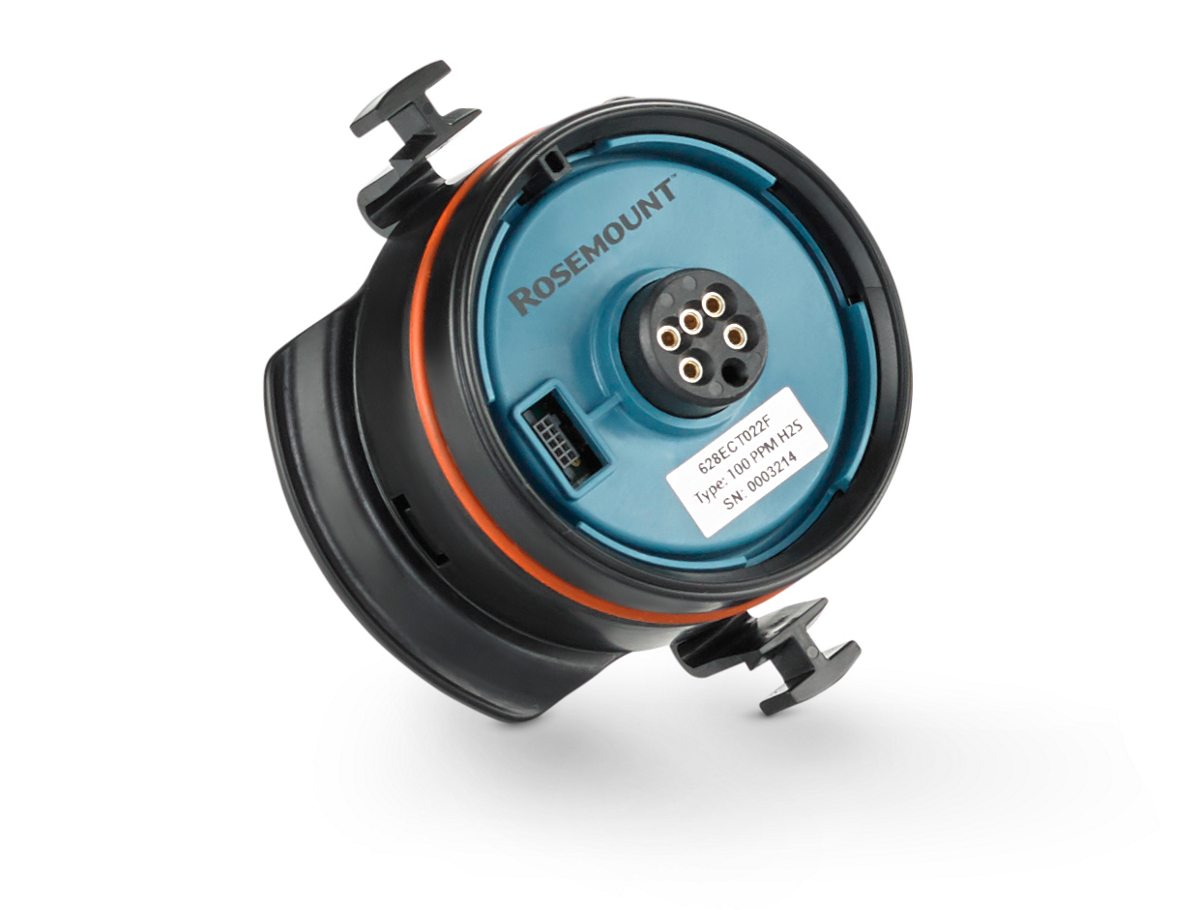
Rosemount 628 Universal Gas Sensor, Emerson Hot-Swappable Gas Sensor Module for the Rosemount 928
The Rosemount 628 universal gas sensor by Emerson is the hot-swappable, intrinsically safe sensor module for the Rosemount 928 wireless gas monitor, built as electrochemical sensors for hydrogen sulfide (H2S), carbon monoxide and oxygen and as a MEMS sensor for hydrocarbon and hydrogen gases. It stores its own calibration, so a calibrated module can move from one 928 to another. Quote-only: request a quote with the 628 model code and quantity.
Bulk Orders
What is the Rosemount 628 universal gas sensor?
The Rosemount 628 is Emerson’s family of hot-swappable, intrinsically safe gas sensor modules for the Rosemount 928 wireless gas monitor, and Emerson’s guide says to use it only with the 928. The toxic versions (628EC) use electrochemical cells, the same industry-standard technology as conventional wired detectors, for hydrogen sulfide, carbon monoxide or oxygen. The combustible version (628MP) is a MEMS (micro-electromechanical systems) sensor that, per Emerson, classifies the flammable gas it detects and stays accurate without calibration adjustments.
The module slides up into the bottom of the 928 housing and is held by a tight-fitting seal and two latching tabs, with a keying feature that stops it going in misaligned; no tools are needed. Emerson lists the 628 as active.
Replacement note: Calibration lives in the sensor, not the transmitter. Emerson states the 628 must be connected to a 928 to be calibrated but stores the settings itself, so a module can be removed from one 928 and fitted to another without affecting its calibration. To remove one, squeeze the latching tabs and pull the module down out of the housing.
What are the Rosemount 628 specifications?
| Hydrogen sulfide (EC, T02) | 0-100 ppm; ±3 ppm or 10 % of reading; T20 <8, T50 < 10, T90 < 45 seconds; default alarm 10 ppm; zero drift < 5 % per annum; 10-95 % RH; -40 to +140 °F (-40 to +60 °C) |
|---|---|
| Carbon monoxide (EC, T04) | 0-1,000 ppm; ±6 ppm or 10 % of reading; T20 <7, T50 < 12, T90 < 29 seconds; default alarm 100 ppm; zero drift < 5 % per annum; 10-95 % RH; -22 to +140 °F (-30 to +60 °C) |
| Oxygen (EC, A03) | 0-25 % by volume; ±0.5 % of reading (O2 ≥ 4 %), ±1.2 % of reading (O2 < 4 %); T20 <2, T50 <4, T90 < 15 seconds; default alarm 19.5 %; 5-95 % RH; -22 to +140 °F (-30 to +60 °C) |
| Combustible (MP, F41) | 0-100 % LEL; ±3 % LEL (methane), ±5 % LEL (hydrogen); T50 < 16, T90 < 24 seconds; default alarm 20 % LEL; zero drift 0 % per annum; 0-95 % non-condensing; -40 to +122 °F (-40 to +50 °C) |
| Maximum warm-up | H2S: one minute; O2: seven minutes; CO: one minute |
| Sensor storage recommendation | H2S, O2, CO: 34 to 45 °F (1 to 7 °C); combustible: -40 to +167 °F (-40 to +75 °C) |
| Ingress protection | IP66 with the Ingress Protection (IP) filter 00628-9000-0001 fitted |
| Diagnostics | End-of-life diagnostics on the H2S and CO sensors |
| Compatibility | Rosemount 928 Wireless Gas Monitor (WirelessHART) |
Maintenance note: After a module is fitted, the 928 needs a warm-up before readings count: up to one minute for H2S and CO and up to seven minutes for O2. Emerson says that during this period the displayed values, alerts and gas concentrations do not reflect actual measurements, and no readings are transmitted.
Where is the Rosemount 628 used, and when is another Emerson model the better fit?
A 628 goes wherever a Rosemount 928 is installed: remote or hard-to-reach points where Emerson’s wireless monitor replaces cabled detection. Choose the module by hazard: EC with T02 for hydrogen sulfide, T04 for carbon monoxide or A03 for oxygen depletion, or MP with F41 for hydrocarbon and hydrogen gases. The combustible module sorts the gas it sees into classes, following Emerson’s classification table:
| Light gas | Butane, ethane, isobutane, isobutylene, propane, propylene, ethylene (isopropanol: light or medium) |
|---|---|
| Medium gas | Pentane, acetone, heptane (MEK: medium or heavy) |
| Heavy gas | Octane, styrene, toluene, xylene |
| Own classes | Methane (methane/natural gas); hydrogen |
Emerson’s 928 page calls this True LEL: the calibration adjusts to the gas type detected. Other Emerson sensors in this range work with other transmitters:
- The Rosemount 625ND is the NDIR combustible sensor that Emerson pairs with the wired Rosemount 925 transmitter in the Rosemount 925FGD.
- The Rosemount 625IR is a complete standalone IR detector with its own outputs.
- For H2S along a fence line rather than at a point, Emerson offers the Rosemount 936 open path toxic gas detector.
Selection note: The sensor choice changes power module life. In the 928 data sheet, the power module runs 5.1 years at a one-minute update rate with a toxic 628 sensor but 1.6 years with the combustible F41 sensor (the features section says over three years against 1.5 years). For combustible gas, the 628MP gives T90 < 24 seconds and ±3 % LEL on methane; the wired 625ND in a 925FGD gives T90 < 10 sec.
Which approvals, outputs and documents apply to the Rosemount 628?
Emerson’s 628 product page lists these certifications, copied as printed:
| Intrinsic safety | Intrinsically Safe, CSA Div 1 |
|---|---|
| Performance standard | ANSI/ISA 92.00-2010 (R2015) |
| Zone rating | ATEX/IECEx Zone 0 |
On the 928 ordering table the transmitter certification code also depends on the sensor: I4 (Japan), I3 (China) and I7 (IECEx) intrinsic safety are only available for Rosemount 628EC sensors, while I5, I6, I1, KQ and NA carry no such limit.
The 628 has no outputs of its own; it reports through the 928’s WirelessHART output and optional discrete output.
Documents: Rosemount 628 Quick Start Guide, May 2023, 00825-0100-4628 Rev AD, the 628 ordering table in the Rosemount 928 data sheet, 00813-0100-4928 Rev AM, and the Rosemount 628 page on Emerson.com. Background: PE Energy gas detection systems guide.
Maintenance note: Although Emerson calibrates the 628 at the factory, its Quick Start Guide calls for calibration at installation, when replacing the sensor, and at least every 180 days for hydrogen sulfide sensors and every 90 days for carbon monoxide and oxygen sensors (it gives no interval for the combustible module). Zero with clean air (0% oxygen gas for O2), then apply span gas at 1.0 liters per minute through PVC tubing (3/16-in. ID, 5/16-in. OD) to the IP filter fitting, part 00628-9000-0001. If a sensor will not accept a new calibration, Emerson says it may have reached the end of its service life.
How do I request a quote for the Rosemount 628?
Send PE Energy the 628 model code, or these choices from the 628 ordering table in the 928 data sheet:
| Sensor technology | EC Electrochemical; MP Combustible gas MEMS |
|---|---|
| Gas type | T02 Hydrogen sulfide; A03 Oxygen; T04 Carbon monoxide; F41 Hydrocarbon and hydrogen gases, wireless |
| Unit of measurement | 1 % LEL; 2 ppm; 3 % by volume |
| Sensor range | F 0-100 (H2S, hydrocarbon and hydrogen gases only); D 0-25 (O2 only); K 0-1,000 (CO only) |
For a new monitor, order the sensor with the 928 using sensor option SS (sensor specified separately and shipped with the transmitter). For spares, add the 00628-9000-0001 IP filter, which Emerson says must be installed, since running without it may damage the sensor. Add quantity. PE Energy confirms price, availability and lead time with the quote. Request a Rosemount 628 quote from PE Energy.
Model code example: Emerson’s typical 628 model number, 628 EC T02 2 F, reads: 628 universal gas sensor, EC electrochemical, T02 hydrogen sulfide, 2 parts per million, F range 0-100. Emerson also warns that electrochemical cells have a limited shelf life and that long storage can shorten their service life, so keep spare toxic stock to near-term needs.
Additional information
| Manufacturer | Emerson |
|---|---|
| Brand | Rosemount |
| Model | 628EC, 628MP |
| Detection technology | Electrochemical, Combustible gas micro-electromechanical systems (MEMS) |
| Detected gases | Hydrogen sulfide, Oxygen, Carbon monoxide, Hydrocarbon and hydrogen gases |
| Compatible transmitter | Rosemount 928 Wireless Gas Monitor |
| Approvals | Intrinsically Safe, CSA Div 1, ANSI/ISA 92.00-2010 (R2015), ATEX/IECEx Zone 0 |
Related products




Popular Brands


Reviews
There are no reviews yet.