
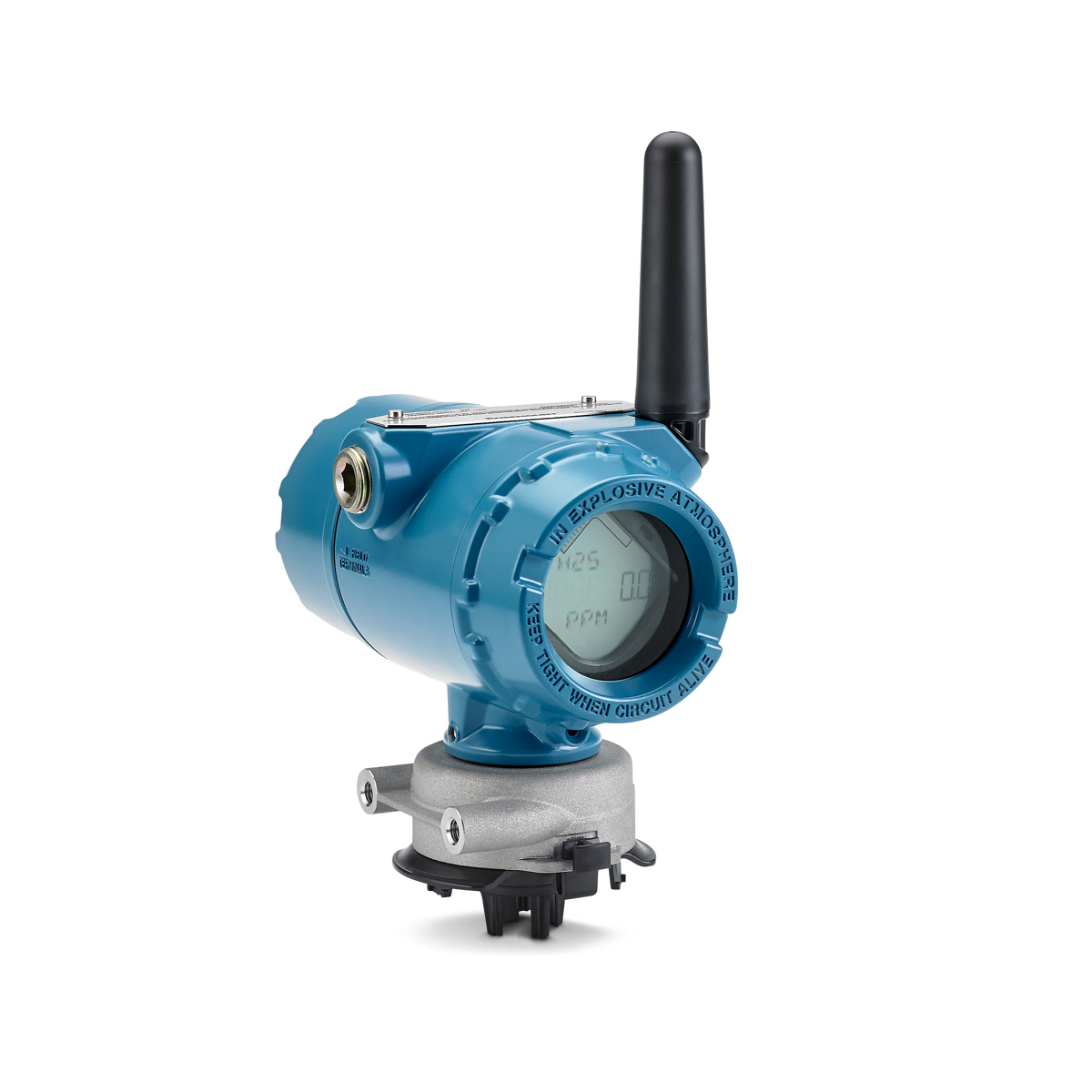
Rosemount 928 Wireless Gas Monitor, Emerson WirelessHART H2S, CO, O2 and Combustible Gas Detector
The Rosemount 928 wireless gas monitor by Emerson is a WirelessHART (IEC 62591, 2.4 GHz) gas transmitter that takes hot-swappable Rosemount 628 sensor modules for H2S, CO, O2 or combustible gas, with no power or signal wiring. It runs on a replaceable, intrinsically safe lithium-thionyl chloride power module, shows readings on a large LCD and can add a discrete output for field alarms. Quote-only: request a quote with the 928 and 628 model codes and quantity.
Bulk Orders
What is the Rosemount 928 wireless gas monitor?
The Rosemount 928 is Emerson’s wireless gas monitor: a WirelessHART transmitter with an integrated gas sensor that detects toxic or combustible gas without power or signal cables. Emerson describes it as its first integrated WirelessHART monitor for both toxic and combustible gas with a sensor that changes without tools. The sensor is a Rosemount 628 universal gas sensor module for hydrogen sulfide, carbon monoxide, oxygen or combustible gas, and power comes from a replaceable, intrinsically safe lithium-thionyl chloride power module.
A large LCD shows gas concentration and transmitter diagnostics, an optional discrete output can drive a field alarm, and the transmitter recognizes the fitted sensor by itself. Emerson lists the 928 as active.
Selection note: Power module life is the main planning figure, and it depends on the sensor and settings. Emerson’s specification gives 5.1 years with the toxic sensor module and 1.6 years with the combustible module at a one-minute update rate (reference 70 °F (21 °C), routing data for three additional network devices). Emerson adds that life varies with wireless update rate, local display settings and ambient conditions.
What are the Rosemount 928 specifications?
| Wireless output | IEC 62591 (WirelessHART) compliant, 2.4 GHz |
|---|---|
| Update rate | User-selectable, 1 second to 60 minutes |
| Sensor type | Tool-less hot-swappable cell module; toxic: electrochemical; combustible: MEMS |
| H2S | 0-100 ppm; ±3 ppm or 10 % of reading; T90 < 45 seconds; default alarm 10 ppm |
| CO | 0-1,000 ppm; ±6 ppm or 10 % of reading; T90 < 29 seconds; default alarm 100 ppm |
| O2 | 0-25 % by volume; ±0.5 % of reading (O2 ≥ 4 %), ±1.2 % of reading (O2 < 4 %); T90 < 15 seconds; default alarm 19.5 % |
| Combustible | 0-100 % LEL; ±3 % LEL (methane), ±5 % LEL (hydrogen); T90 < 24 seconds; default alarm 20 % LEL |
| Discrete output (928XSS01, 928XUT01) | Maximum rating 28 Vdc, 93 mA; on resistance typical 1 Ohm |
| Antenna RF power | WK external: max 10 mW (10 dBm) EIRP; WM extended range and WJ remote: max 18 mW (12.5 dBm); WN high gain remote: max 40 mW (16 dBm) |
| Power module | Replaceable, intrinsically safe lithium-thionyl chloride, PBT polymer enclosure |
| Diagnostics | End-of-life sensor diagnostics for H2S and CO only |
| Operating temperature | -40 to +140 °F (-40 to +60 °C); combustible sensor -40 to +122 °F (-40 to +50 °C); CO and O2 -22 to +140 °F (-30 to +60 °C) |
| Housing | Low-copper aluminum or 316 stainless steel; polyurethane paint; Buna-N cover O-ring; ½-14 NPT conduit entries |
| Weight | Aluminum (2A): 73 ounces (2076 grams); stainless steel (2S): 143 ounces (4055 grams) |
| Enclosure ratings | Type 4X and IP66 (IP66 with the IP filter fitted to the 628) |
| EMC | EN-61326-2-3: 2006 |
Maintenance note: Only the toxic sensors warn of their own end of life: Emerson limits end-of-life diagnostics to H2S and CO. For spares, Emerson recommends storing H2S, O2 and CO modules at 34 to 45 °F (1 to 7 °C) and notes that electrochemical cells have a limited shelf life. Continuous exposure below -40 °F (-40 °C) or above +122 °F (+50 °C) can trim the specified power module life, by less than 20 percent per Emerson.
Where is the Rosemount 928 used, and when is another Emerson model the better fit?
Emerson aims the 928 at remote, hard-to-reach or hazardous spots where wiring and conduit would be costly or slow, and at adding gas leak monitoring points without the cost of new cable. The sensor decides the application: H2S and CO for toxic exposure, O2 for oxygen depletion, and the MEMS module for hydrocarbons and hydrogen, which Emerson’s page describes as True LEL, adjusting calibration to the gas type detected.
A wired or open path detector is the better fit when:
- The point needs relays and a local operator interface: the Rosemount 925FGD fixed gas detector with its 625ND NDIR sensor, or the stainless Rosemount 625IR.
- H2S must be watched along a fence line: the Rosemount 936 open path toxic gas detector.
- Combustible gas must be watched along a line: the Rosemount 935.
Selection note: 928 wireless against 925FGD wired, on combustible gas. 928 with the 628 MEMS sensor: no cabling, power module 1.6 years at a one-minute update, T90 < 24 seconds, ±3 % LEL methane, operating -40 to +122 °F (-40 to +50 °C), and Emerson states its driftless measurement eliminates annual calibrations. 925FGD with 625ND: 18 to 30 Vdc wired supply, 4-20 mA with HART 7 and relays, T90 < 10 sec, operating -40 to +158 °F (-40 to +70 °C).
Which approvals, outputs and documents apply to the Rosemount 928?
Product certification codes in the 928 ordering table:
| I5 | USA Intrinsically Safe |
|---|---|
| I6 | Canada Intrinsically Safe |
| I4 | Japan Intrinsic Safety |
| I1 | ATEX Intrinsic Safety |
| I3 | China Intrinsic Safety |
| I7 | IECEx Intrinsic Safety |
| KQ | USA CSA ATEX Intrinsic Safety |
| NA | No approvals |
Emerson notes that options I4, I3 and I7 are only available for Rosemount 628EC sensors, so a combustible (628MP) monitor uses one of the other codes. The 628 sensor page lists its own approvals as Intrinsically Safe, CSA Div 1; ANSI/ISA 92.00-2010 (R2015); ATEX/IECEx Zone 0. The wireless output is IEC 62591 (WirelessHART) compliant at 2.4 GHz, and all models meet EN-61326-2-3: 2006 for EMC.
Documents: Rosemount 928 data sheet, April 2026, 00813-0100-4928 Rev AM, the Rosemount 928 Configuration Data Sheet, 00806-0100-4928 Rev AC and the Rosemount 928 page on Emerson.com. Background: PE Energy gas detection systems guide.
Installation note: Emerson’s configuration data sheet calls it best security practice to order wireless devices with factory generated network parameters, then enter the customer’s Network ID and Join Key on site during commissioning, which leaves network access and security under the site’s control.
How do I request a quote for the Rosemount 928?
Send PE Energy the full 928 model code plus the 628 sensor code, or these choices:
| Transmitter output | X Wireless |
|---|---|
| Sensor options | SS sensor specified separately and shipped with the transmitter (requires a Rosemount 628 code); UT universal transmitter, no sensor specified |
| Discrete output | 00 wireless only; 01 discrete output and wireless |
| Housing | 2A aluminum or 2S 316 stainless steel, ½-14 NPT conduit |
| Product certification | I5, I6, I4, I1, I3, I7, KQ or NA |
| Wireless | WA3 user configurable update rate, 2.4 GHz DSSS, WirelessHART |
| Antenna | WK1 external; WM1 extended range, external; WJ1 remote; WN1 high-gain remote |
| Other options | B4 universal L mounting bracket for 2-in. (50.8 mm) pipe; C1 factory configuration; Q1 Certificate of Compliance |
Spare parts by part number: 00628-9000-0001 Ingress Protection (IP) filter and 03151-9270-0004 spare B4 mounting bracket. Add quantity. PE Energy confirms price, availability and lead time with the quote. Request a Rosemount 928 quote from PE Energy.
Model code example: Emerson’s sample code, printed as 928 X SS 00 2A I5 WA3 WK1 B4, reads: 928 wireless gas monitor, X wireless, SS sensor specified separately, 00 no discrete output, 2A aluminum housing with ½-14 NPT conduit, I5 USA Intrinsically Safe, WA3 WirelessHART at 2.4 GHz, WK1 external antenna with adapter for the black power module, B4 pipe mounting bracket. With WK1, WJ1 and WN1, Emerson sells the intrinsically safe power module separately, so list it on the request.
What can Emerson preconfigure on a Rosemount 928 before it ships?
With option C1, Emerson applies factory configuration from its 928 Configuration Data Sheet. The form covers:
- Tags and text: hardware tag up to 21 characters, software tag up to 8, long software tag up to 32, descriptor up to 16 and message up to 32
- Wireless update rate: 1, 2, 4, 8 (default), 16, 32 or 60 seconds, or any value from 61 to 3600 seconds in 1 second steps
- Network parameters: factory generated or customer supplied
- LCD display mode (disabled, on-demand, periodic or high availability, the default) and extra display items such as module temperature or supply voltage
- Gas alarm thresholds, temperature units, write protect and alarm on alerts
Configuration note: Emerson’s default alarm thresholds are: H2S low 10 ppm and high 15 ppm; CO low 100 ppm and high 200 ppm; oxygen depletion high 19.5% and low 19.0% by volume. If the discrete output is ordered, it trips by default on the low alarm value for H2S and CO and on the high alarm value for O2, so state custom thresholds on the request if the site standard differs.
Additional information
| Manufacturer | Emerson |
|---|---|
| Brand | Rosemount |
| Model | 928 |
| Detection technology | Electrochemical (toxic), MEMS (combustible) |
| Detected gases | Hydrogen sulfide (H2S), Carbon monoxide (CO), Oxygen (O2), Combustible |
| Output | WirelessHART (IEC 62591), 2.4 GHz, Optional discrete output |
| Housing material | Low-copper aluminum, 316 stainless steel |
| Power | Intrinsically safe lithium-thionyl chloride power module |
Related products




Popular Brands


Reviews
There are no reviews yet.