
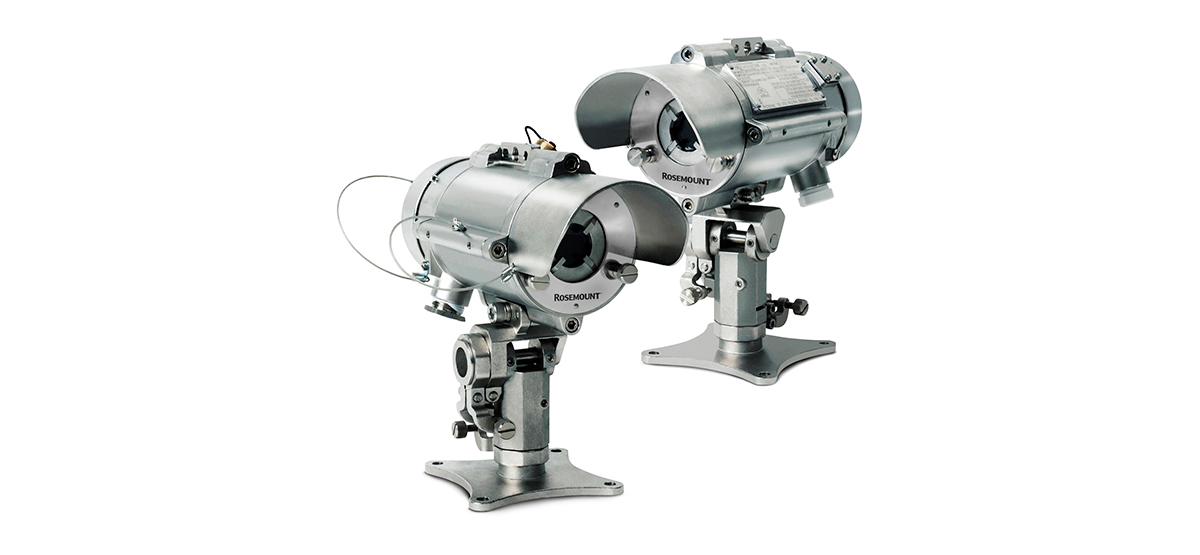
Rosemount 936 Open Path Toxic Gas Detector, Emerson Open-Path H2S and Ammonia Gas Detector
The Rosemount 936 open path toxic gas detector by Emerson uses ultraviolet (UV) open path technology to monitor hydrogen sulfide (H2S) or ammonia (NH3) along a line of sight, with source and receiver from 17 ft. (5 m) to 200 ft. (60 m) apart. The receiver reads 500 ppm/m full scale with a 50 ppm/m minimum detectable gas volume, responds in under 3 seconds and reports over 0-20 mA, HART and RS-485 Modbus. Quote-only: request a quote with the source and receiver model codes and quantity.
Bulk Orders
What is the Rosemount 936 open path toxic gas detector?
The Rosemount 936 is Emerson’s open path toxic gas detector: an ultraviolet source (transmitter) and a receiver installed facing each other, 17 ft. (5 m) to 200 ft. (60 m) apart, that monitor the line of sight between them for hydrogen sulfide (H2S) or ammonia (NH3). The receiver works in the 200 to 300 nm spectral band and reports gas along the path in ppm/m, with a 500 ppm/m full scale and a 50 ppm/m minimum detectable gas volume. Emerson notes it is typically used for perimeter monitoring and fence control.
Source and receiver are factory calibrated, have heated optics and are configured in the field over HART or RS-485 Modbus. Emerson lists the 936 as active, with a three-year warranty and a minimum 100,000 hours MTBF.
Selection note: A 936 receiver is built for one gas: gas calibration code T26 is the hydrogen sulfide receiver and T27 the ammonia receiver. The matching accessories are gas specific too: check filter 888280-1 (H2S) or 888280-2 (NH3), and comm kit 888897-1 (H2S) or 888897-2 (NH3). For sulfur dioxide (SO2), which Emerson lists beside H2S under detected gases, name the gas on the request so the receiver is matched to it.
What are the Rosemount 936 specifications?
| Detection technology | Ultraviolet, open path (source and receiver) |
|---|---|
| Detected gases | Hydrogen sulfide (H2S) and Sulfur dioxide (SO2); Ammonia (NH3) |
| Spectral response | 200 to 300 nm |
| Sensitivity range | Full scale 500 ppm/m; warning 100 ppm/m; alarm 300 ppm/m |
| Minimum detectable gas volume | 50 ppm/m |
| Response time | < 3 sec |
| Installation distance | T1: 17 ft. (5 m) to 52 ft. (16 m); T2: 46 ft. (14 m) to 132 ft. (40 m); T3: 115 ft. (35 m) to 200 ft. (60 m) |
| Field of view / alignment | Line of sight; ±1 degree alignment tolerance |
| Temperature range | -67 °F (-55 °C) to 149 °F (65 °C) |
| Operating voltage | 24 Vdc nominal (18-32 Vdc) |
| Power with heated optics | Detector: 135mA; source: 150mA |
| Current output | 0-20 mA, isolated sink (can be configured as source); maximum load resistance 600 Ω |
| Communication | RS-485 Modbus, up to 247 detectors on one network; HART |
| Enclosure | Stainless steel 316L (detector, source and tilt mount) |
| Water and dust | IP66 and IP68 per EN60529 (IP68 rated for 7 ft. (2 m) depth for 45 minutes); NEMA 250 Type 6p |
| Conduit entries | Two, M25 x 1.5 mm ISO or ¾-in. NPT (per the dimensional drawings) |
| Dimensions | Detector and source: 10.5 in. (267 mm) x 5.1 in. (130 mm) x 5.1 in. (130 mm) |
| Weight | Detector 11 lb.; source 11 lb.; tilt mount 4.2 lb. (1.9 kg) |
| Reliability / warranty | MTBF minimum 100,000 hours; three-year warranty |
Installation note: Emerson ties EMC compliance to the cable: to meet EMC directive 2014/30/EU against RFI and EMI, the detector cable must be shielded and the detector grounded, with the shield grounded at the detector end. The dimensional drawings show conduit entries as M25 x 1.5 mm ISO or ¾-in. NPT.
Where is the Rosemount 936 used, and when is another Emerson model the better fit?
Emerson’s typical 936 applications are offshore platforms and FPSOs, pipelines and gas transport, terminals for gas filling and distribution, petrochemical and chemical processing plants, water treatment, waste management, agriculture, food and beverage, pharmaceutical sites, and large storage areas and buildings. Emerson’s note on perimeter and fence line use is the common thread: the 936 watches a boundary or a long open stretch rather than a single point.
Other Emerson detectors fit other needs:
- Combustible gas on the same kind of line: the Rosemount 935 open path combustible gas detector uses infrared and reaches 660 ft. (200 m).
- H2S at a single point with no cable: the Rosemount 928 wireless gas monitor with a Rosemount 628 electrochemical H2S sensor reads 0-100 ppm.
- Pressurized releases of any gas: the Rosemount Incus ultrasonic gas leak detector.
- A Spectrex specification: Emerson’s SafEye Quasar 950/960 open path UV detectors (Quasar 950 for H2S, Quasar 960 for NH3) also cover 17 to 200 ft. (5 to 60 m) and list the same check filter part numbers, 888280-1 and 888280-2.
Selection note: Open path against point H2S detection, on Emerson’s figures. 936: response < 3 sec, full scale 500 ppm/m across up to 200 ft. (60 m), warning at 100 ppm/m and alarm at 300 ppm/m, wired 24 Vdc. 928 with a 628 H2S sensor: 0-100 ppm at the sensor, accuracy ±3 ppm or 10 % of reading, T90 < 45 seconds, default alarm 10 ppm, battery powered over WirelessHART, with calibration at least every 180 days for H2S sensors per the 628 Quick Start Guide.
Which approvals, outputs and documents apply to the Rosemount 936?
Source and receiver each carry one product certification code:
| A1 | ATEX and IECEx |
|---|---|
| A3 | CSA C/US |
| E2 | InMetro (pending) |
| EM | TR CU (EAC) (pending) |
| EP | Republic of Korea |
Markings and ratings as printed in the data sheet:
| ATEX and IECEx | Ex II 2(2) G D; Ex db eb ib [ib Gb] IIB+H2 T4 Gb; Ex tb [ib Db] IIIC T135 °C Db; TAmbient -55 °C to +65 °C |
|---|---|
| CSA C/US, USA | Class I Zone 1 AEx db eb ib [ib Gb] IIB+H2 T4 Gb; Zone 21 AEx tb [ib Db] IIIC T135°C Db; Ta = -55 °C to +65 °C |
| TR CU (EAC) | 1 Ex db eb ib [ib Gb] IIB+H2 T4 Gb X; Ex tb IIIC T135 °C Db X |
| Inmetro (UL) | Certificate number UL-BR 19.0276X (Rosemount) |
| SIL | TUV approved for SIL-2 requirements per IEC61508; TUV report no. 968/FSP 1276.04/20 |
| Performance approval | ANSI/ISA-92.00.04-2014; UL 920004: 2014 |
| Laser | Class 1 Laser Product per IEC 60825-1: 2014 ed. 05 |
Emerson states the ATEX and IECEx approval allows use in zones 1 and 2 where IIB+H2 vapors are present, and in zones 21 and 22 with IIIC combustible dust. For SIL-2, the alert condition can be carried by an alert signal on the 0-20 mA loop.
Documents: Rosemount 936 data sheet, January 2025, 00813-0100-4036 Rev AD and the Rosemount 936 page on Emerson.com. Background: PE Energy gas detection systems guide.
Approval note: Check certification status before ordering for Brazil or the EAC region: the ordering table marks E2 InMetro and EM TR CU (EAC) as pending, while the approvals section of the same data sheet prints Inmetro and TR CU markings and an Inmetro certificate number. The Emerson product page lists FM/FMC among the worldwide approvals, but the data sheet’s North American code is A3 CSA C/US.
How do I request a quote for the Rosemount 936?
Emerson sells the 936 as separate parts: a source (PN 936TXT00XXXX), a detector or receiver (PN 936RT12XXXXX), and accessories. Send PE Energy both model codes, or these choices plus the distance between source and receiver:
| Source range | T1, T2 or T3 (distances above) |
|---|---|
| Source gas calibration | T00 Transmitter |
| Receiver gas | T26 Hydrogen sulfide; T27 Ammonia |
| Housing style / conduit, each unit | 2S stainless steel, ¾-in. NPT; 4S stainless steel, M25 |
| Product certification, each unit | A1, A3, E2, EM or EP |
Accessories Emerson lists for the 936:
| 888270 / 799255 | Tilt mount / wall mount |
|---|---|
| 799225 / 888140 | Pole mount, U-bolt 4-5 in. / 2-3 in. |
| 888355-2 / 888931 / 888263 | Duct mount / air shield / protective cover |
| 888280-1 / 888280-2 | Check filter H2S / NH3 |
| 888897-1 / 888897-2 | 936 H2S / NH3 comm kit, including auxiliary harness IS/RS485 and HART |
| 888820 / 888810 / 794079 | Auxiliary harness IS/RS 485 and HART / HART handheld diagnostic kit / USB/RS485 harness converter kit |
PE Energy confirms price, availability and lead time with the quote. Request a Rosemount 936 quote from PE Energy.
Model code example: Emerson’s receiver sample 936R1T262SA1 decodes as 936 receiver, R1, T26 hydrogen sulfide, 2S stainless steel with ¾-in. NPT, A1 ATEX and IECEx.
Additional information
| Manufacturer | Emerson |
|---|---|
| Brand | Rosemount |
| Model | 936 |
| Detection technology | Ultraviolet, open path |
| Detected gases | Hydrogen sulfide (H2S), Ammonia (NH3) |
| Sensitivity range | 500 ppm/m full scale |
| Output | 0-20 mA, HART, RS-485 Modbus |
| Housing material | Stainless steel 316L |
Related products




Popular Brands


Reviews
There are no reviews yet.