Right now, while you’re reading this, microscopic assassins are infiltrating your most valuable industrial equipment. These silent killers slip past your defenses every single time your hydraulic system cycles, your gearbox operates, or your storage tank expands and contracts with temperature changes.
The weapon? Contaminated air. The damage? Complete system failure that can cost you hundreds of thousands in repairs, downtime, and replacement equipment.
And here’s the kicker: Traditional desiccant breathers—the “solutions” most companies rely on—are actually making the problem WORSE in certain critical applications.
The Hidden Saboteurs Destroying Your Equipment (And Your Profits)
Let me paint you a picture of what’s really happening inside your systems.
In oil misting environments, those expensive desiccant breathers you installed? They’re getting saturated with oil particles, creating a sticky trap that actually ATTRACTS more contamination. Your “protection” system has become a contamination magnet.
In high-dust applications—think mining, concrete, or heavy manufacturing—desiccant materials are absorbing moisture from dust particles, creating a cement-like paste that blocks airflow. Your equipment is suffocating while contamination builds up like pressure in a volcano.
And if you’re running water-based fluids? Traditional desiccant is completely incompatible. It’s like trying to stop a flood with a sponge—except the sponge dissolves and becomes part of the contamination problem.
Here’s the brutal truth: Every breath your equipment takes in these environments is shortening its lifespan by months or even years. The average cost of hydraulic system failure due to contamination? $30,000 to $150,000. Per incident.
Low humidity environments present their own nightmare scenario. Your desiccant breathers are working overtime to remove moisture that barely exists, while completely ignoring the particle contamination that’s the REAL enemy. You’re fighting the wrong battle while your equipment dies from friendly fire.
The Game-Changing Solution That Industrial Giants Don’t Want You To Know About
What if I told you there’s a breather technology that eliminates contamination WITHOUT the problems of desiccant systems?
Meet the Des-Case Non-Desiccant Breathers—specifically engineered for the exact scenarios where traditional breathers fail catastrophically. These aren’t just “alternative” solutions. They’re purpose-built weapons in the war against contamination.
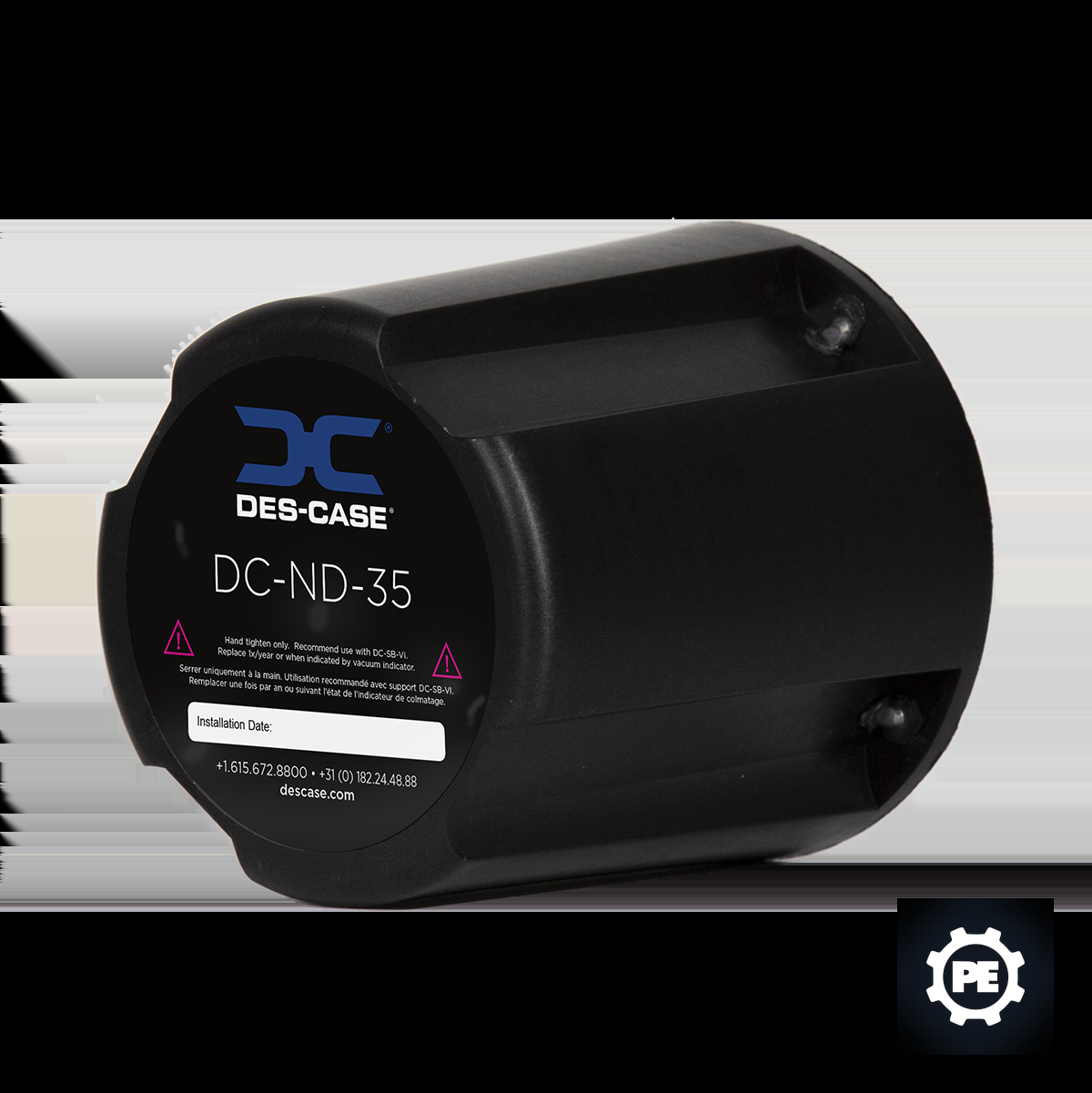
The DC-ND-2 and DC-ND-35 models represent a complete paradigm shift in equipment protection. Instead of trying to solve every problem with moisture removal, they focus laser-sharp on the contamination that’s actually killing your equipment: particles.
Why These “Simple” Breathers Outperform Complex Systems Worth 10X The Price
Here’s where it gets interesting. Sometimes the most sophisticated solution is elegant simplicity.
Absolute 0.3 Micron Filtration: This isn’t marketing fluff—this is surgical precision. To put this in perspective, human hair is 50-100 microns thick. These breathers stop particles that are 300 times smaller than what your naked eye can see. Every single one. That means dirt, dust, metal particles, and other contaminants never make it past the first line of defense.
No Desiccant Means No Desiccant Problems: Oil mist can’t clog what doesn’t exist. Dust can’t turn into paste when there’s no moisture-absorbing material to mix with. Water-based fluids can’t damage components that aren’t there. This elimination approach doesn’t just solve the contamination problem—it eliminates entire categories of failure modes.
Extreme Temperature Performance (-40°F to 300°F): Your equipment operates in brutal conditions. These breathers are designed to match that durability. Whether you’re in Arctic conditions or desert heat, the filtration performance remains constant. No degradation, no failure, no excuses.
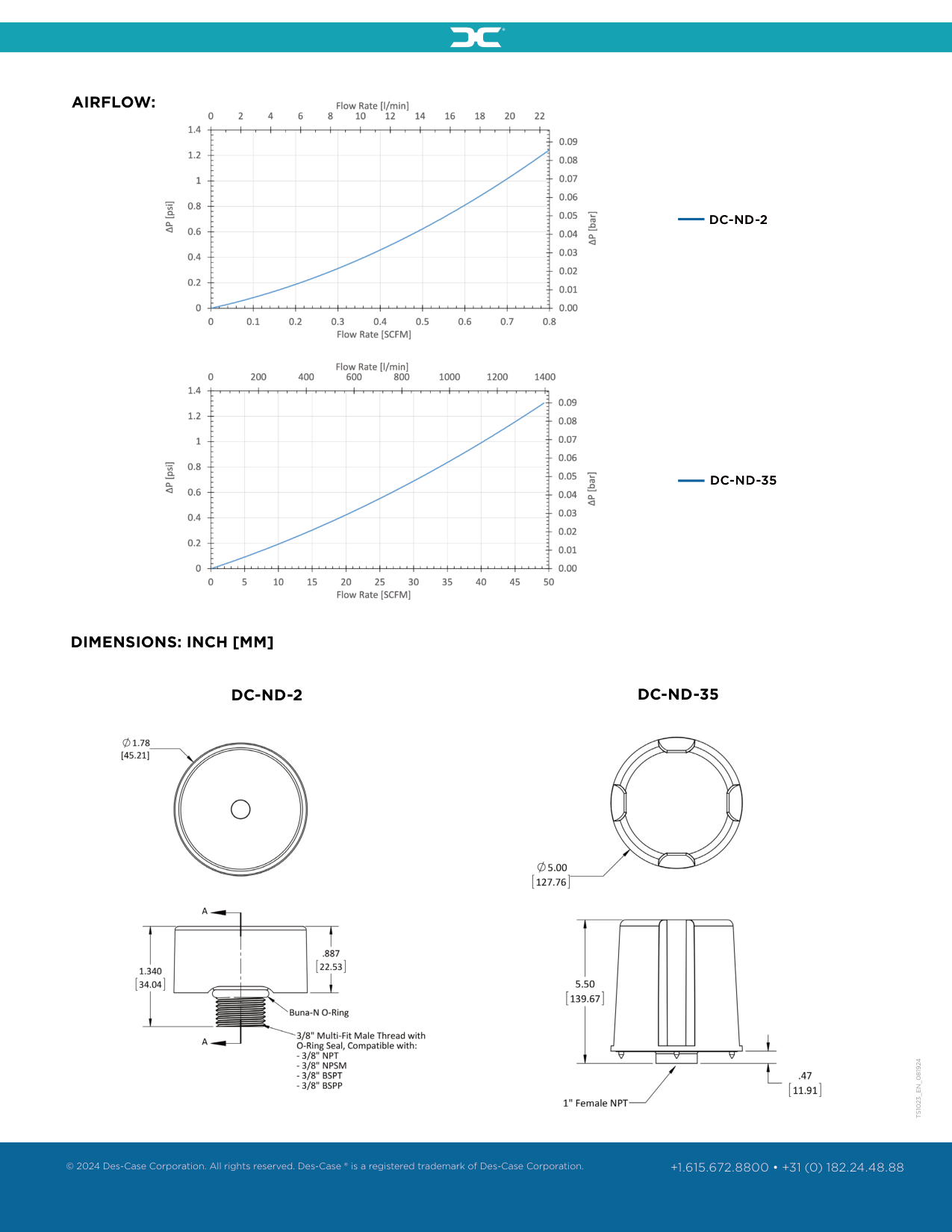
The DC-ND-2 handles up to 0.67 CFM airflow and 5 GPM fluid displacement. The DC-ND-35 scales up to handle 40 CFM airflow and 300 GPM displacement. This isn’t one-size-fits-all—it’s precision matching to your exact requirements.
REACH Compliance: This European Union regulation is among the world’s strictest chemical safety standards. When a product meets REACH compliance, you’re not just getting effective performance—you’re getting guaranteed safety for your workers and your environment.
Ultra-Low Pressure Drop (1 PSI Maximum): High-efficiency filtration usually comes with a penalty: restricted airflow that starves your equipment. These breathers maintain massive filtration capability while letting your systems breathe freely. Your equipment gets clean air without working harder to get it.
The engineering brilliance isn’t in what these breathers do—it’s in what they DON’T do. No moisture absorption means no saturation. No complex mechanisms means no failure points. No compatibility issues means universal application in problem environments.
The Specific Battlefields Where These Breathers Dominate
Let’s get specific about where these breathers turn contamination nightmares into controlled, predictable operations.
Oil Misting Environments: Machine shops, metalworking facilities, anywhere cutting fluids create airborne oil particles. The Des-Case DC-ND-2 Non-Desiccant Breather handles typical 15-gallon hydraulic systems while the larger Des-Case DC-ND-35 Non-Desiccant Breather manages high-flow applications.
High-Dust Applications: Mining operations, cement plants, agricultural processing—anywhere airborne particles are a constant threat. Traditional desiccant breathers become contamination collectors in these environments. Non-desiccant breathers stay clean and keep filtering.
Water-Based Fluid Systems: Hydraulic systems using environmentally-friendly water-glycol fluids, water-based coolants, or fire-resistant aqueous solutions. These applications are growing rapidly due to environmental regulations, but they’re incompatible with traditional desiccant protection.
The Cold, Hard Math That Makes Maintenance Managers Look Like Heroes
Here’s what keeps smart maintenance managers awake at night: the cost of being wrong about contamination control.
Hydraulic system rebuild due to contamination: $30,000-$150,000. Gearbox replacement from particle damage: $25,000-$80,000. Production downtime while waiting for repairs: $5,000-$50,000 per day.
Compare that to the cost of proper contamination prevention. A single catastrophic failure pays for decades of proper breather protection.
But here’s the hidden benefit that most people miss: predictable maintenance schedules. When contamination is controlled, your equipment fails on YOUR timeline, not randomly. You can plan maintenance during scheduled downtime instead of emergency shutdowns during peak production.
The detailed specifications in the complete Non-Desiccant Breathers technical documentation show exactly how to size these breathers for maximum protection and minimum operating cost.
The temperature range alone (-40°F to 300°F) eliminates seasonal breather changes in most climates. Install once, protect continuously.
Why Waiting Is The Costliest Decision You Can Make
Every day you delay implementing proper contamination control, microscopic damage accumulates inside your equipment. This isn’t gradual wear—it’s accelerating destruction that reaches a tipping point and causes sudden, catastrophic failure.
The Des-Case DC-ND-2 and DC-ND-35 Des-Case High Capacity Breather systems represent proven technology that’s protecting millions of dollars in equipment right now, in the harshest industrial environments on earth.
Don’t let your equipment become another contamination casualty. The solution exists. The technology is proven. The only question is whether you’ll implement it before contamination strikes, or scramble to install it after paying the devastating cost of equipment failure.
DC-ND-2 / DC-ND-35
Prevents contamination in low humidity environments or applications where water-based fluids are in use. Ideal for oil misting environments, high dust applications, and water-based fluid systems where desiccant is incompatible.
No desiccant • Particle filtration only • REACH Compliant
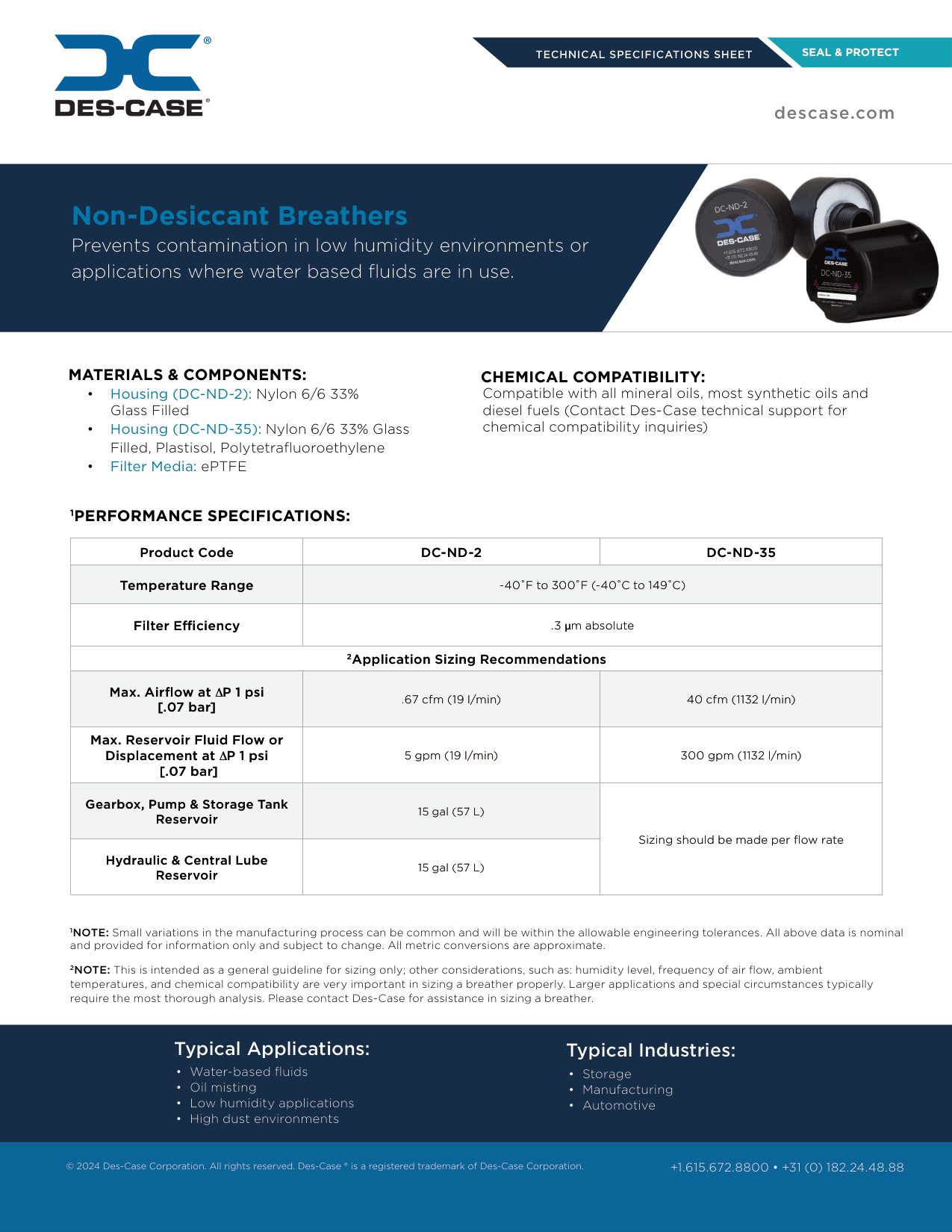
1PERFORMANCE SPECIFICATIONS:
| Specification | DC-ND-2 | DC-ND-35 |
|---|---|---|
| Temperature Range | -40°F to 300°F (-40°C to 149°C) | |
| Filter Efficiency | .3 μm absolute | |
| Desiccant | None — particulate filtration only | |
2APPLICATION SIZING RECOMMENDATIONS:
| Parameter | DC-ND-2 | DC-ND-35 |
|---|---|---|
| Max. Airflow at ΔP 1 psi [.07 bar] | .67 cfm (19 l/min) | 40 cfm (1132 l/min) |
| Max. Reservoir Fluid Flow/Displacement at ΔP 1 psi [.07 bar] | 5 gpm (19 l/min) | 300 gpm (1132 l/min) |
| Gearbox, Pump & Storage Tank Reservoir | 15 gal (57 L) | Sizing per flow rate |
| Hydraulic & Central Lube Reservoir | 15 gal (57 L) | Sizing per flow rate |
1NOTE: Small variations in the manufacturing process can be common. All data is nominal and subject to change. All metric conversions are approximate.
2NOTE: General guideline only. Consider humidity, air flow frequency, ambient temperatures, and chemical compatibility. Please contact Des-Case for assistance.
Typical Applications:
- Water-based fluids
- Oil misting environments
- Low humidity applications
- High dust environments
Typical Industries:
- Storage
- Manufacturing
- Automotive
- Industrial
DIMENSIONS: