
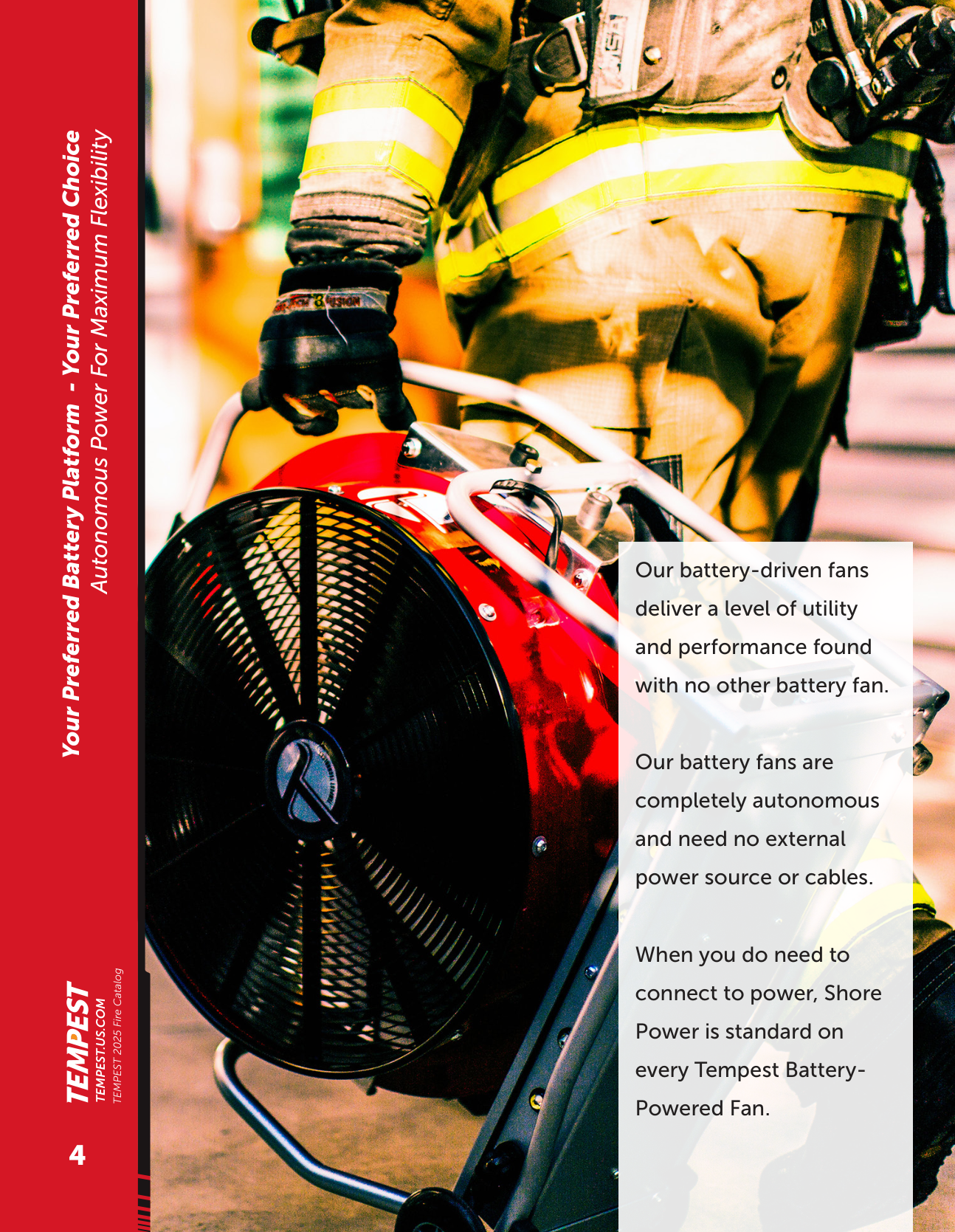
Picture this nightmare scenario: You’re at a structure fire, smoke pouring out of every window. Your crew needs positive pressure ventilation to clear visibility and push heat out — right now. You fire up your PPV fan and… nothing. Dead battery.
Now picture this even worse scenario: You’ve got a vehicle extrication. Victim trapped, time running out. You need your Jaws of Life tools charged and ready, but their batteries are sitting in your PPV fan across the scene. You’re juggling battery platforms like a circus act while someone’s life hangs in the balance.
If either scenario makes your stomach drop, you understand exactly why smart fire and rescue departments are consolidating their battery platforms. Because when chaos erupts, the last thing you need is equipment incompatibility slowing you down.
The Hidden Cost of Running Multiple Battery Platforms
Here’s what most departments don’t calculate when they’re running separate battery systems for rescue tools and ventilation fans: You’re not just buying equipment. You’re buying into a logistics nightmare.
Think about what’s really happening on your truck right now. You’ve got HURST® batteries for your Jaws of Life tools. Different batteries for your PPV fan. Maybe another set for your lighting equipment. Each system requires its own chargers, its own maintenance schedule, its own inventory management.
Your apparatus becomes a mobile battery museum instead of a focused rescue platform. Worse yet, when you’re in the middle of a critical operation, Murphy’s Law kicks in. The ONE battery platform that’s dead is always the one you need most.
But the real killer isn’t convenience — it’s operational effectiveness. When your PPV fan dies mid-operation, you lose positive pressure ventilation exactly when crews need it most. Visibility drops. Heat builds up. What should have been a routine interior attack becomes a dangerous guessing game.
And in rescue operations? Forget about it. When you’re working an extrication, every piece of equipment needs to work flawlessly in coordination. Having your rescue tools and ventilation running on different battery platforms is like trying to conduct an orchestra where half the musicians are playing from different sheet music.
The question isn’t whether you can afford to consolidate your battery platforms. The question is whether you can afford NOT to.
Finally: One Battery Platform That Handles Both Critical Functions
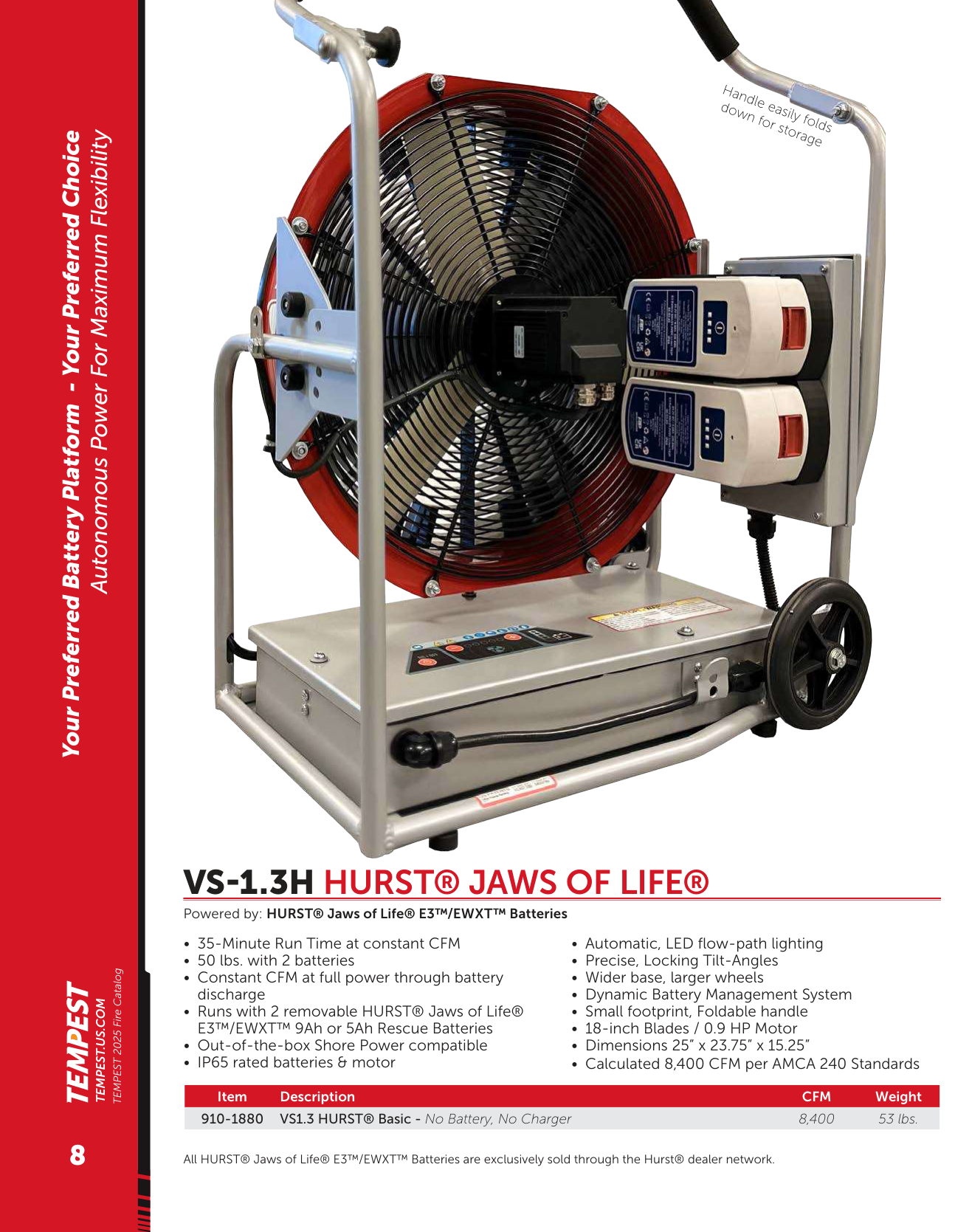
The Tempest VS-1.3H HURST Battery PPV Fan eliminates the battery juggling act completely. This isn’t just another ventilation fan with good marketing. This is the first PPV fan specifically engineered to run on the same HURST® E3™/EWXT™ batteries that power your Jaws of Life rescue tools.
Same batteries. Same charging system. Same maintenance schedule. Two critical functions. Finally, your equipment works as a coordinated system instead of a collection of individual components that happen to ride on the same truck.
But here’s what makes this fan genuinely different: It doesn’t compromise performance to achieve compatibility. We’re talking about 8,400 CFM of airflow for 35 minutes of constant operation. Not declining performance as the battery drains — constant CFM from start to finish.
This is industrial-grade positive pressure ventilation that happens to solve your battery compatibility problem, not a compromise solution that sort of handles both requirements.
Why HURST® Compatibility Changes Everything
Let’s talk about what running on HURST® E3™/EWXT™ batteries actually means for your operations. First, you’re dealing with rescue-grade power management. These aren’t consumer batteries adapted for industrial use. They’re purpose-built for life-safety operations where failure isn’t an option.
The VS-1.3H runs on two of these batteries simultaneously — either 9Ah or 5Ah models, your choice. Why two batteries instead of one larger battery? Because redundancy matters when lives are on the line. If one battery develops a problem, you’ve still got backup power to complete your operation.
But the real operational advantage is battery sharing. When you’re working a scene that requires both extrication and ventilation, you can dynamically allocate battery power where it’s needed most. Need extra runtime on your PPV fan? Grab charged batteries from your rescue tools. Rescue operation going longer than expected? Pull batteries from the fan to keep your hydraulic tools running.
IP65 Rating: Why Weather Resistance Actually Matters
Here’s a specification that sounds boring but saves operations: IP65 rating on both batteries and motor. Unless you only respond to fires on sunny days with no wind, you understand why this matters.
IP65 means dust-tight and water-jet resistant. Not just “splash resistant” or “moisture resistant” — we’re talking about protection against pressurized water jets from any direction. When you’re operating in smoke, ash, driving rain, or the chaos of fireground operations, your equipment needs to keep working regardless of conditions.
Most PPV fans give you weather resistance on the motor housing but leave the batteries vulnerable. The VS-1.3H protects both power source and motor to the same industrial standard. Because there’s no point in having a weatherproof motor if your batteries die the first time they get wet.
Constant CFM Performance: Why Battery Management Technology Matters
Most battery-powered fans start strong and fade fast. You get maximum airflow for the first few minutes, then declining performance as the batteries drain. By the time you’re halfway through your operation, you’re moving significantly less air than when you started.
The VS-1.3H uses dynamic battery management to maintain constant 8,400 CFM output throughout the entire 35-minute discharge cycle. The fan delivers the same airflow performance at minute 30 as it does at minute 1.
Why does this matter operationally? Because positive pressure ventilation isn’t just about moving air — it’s about maintaining pressure differentials. When your airflow drops, your pressure differential drops. When pressure differential drops, your ventilation effectiveness drops. Constant CFM means constant operational effectiveness throughout your entire operation.
Shore Power: When Battery Runtime Isn’t Enough
Thirty-five minutes of battery runtime handles most ventilation operations. But what about extended incidents? Multi-alarm fires? Complex rescue operations that stretch into hours?
The VS-1.3H includes shore power capability as standard equipment. When you need extended operation, plug into AC power and run indefinitely. No additional accessories to purchase. No special adapters to carry. Shore power is ready to go out of the box.
This gives you the best of both worlds: rapid deployment on battery power for immediate response, plus extended operation capability when the situation demands it. Your ventilation support doesn’t have to stop just because the incident goes long.
Built for Real-World Fire Ground Operations
The engineering details that separate professional equipment from consumer-grade alternatives show up in the operational features. The VS-1.3H features a wider base for enhanced stability and larger wheels for improved maneuverability over rough terrain.
If you’ve ever tried to move a PPV fan across debris-covered ground or position it on uneven surfaces, you understand why these details matter. Stability affects performance — a fan that tips or shifts position loses effectiveness. Maneuverability affects response time — equipment that’s difficult to move is equipment that doesn’t get positioned optimally.
The automatic LED flow-path lighting isn’t just a convenience feature — it’s an operational necessity. When you’re positioning ventilation equipment in smoke-filled environments or during night operations, being able to see the airflow path means better positioning and more effective ventilation.
Precise locking tilt-angles give you exact positioning control. Positive pressure ventilation effectiveness depends on proper angle and positioning. When you find the optimal setup, the locking mechanism holds it there regardless of vibration or ground conditions.
Applications Where Battery Platform Consolidation Makes the Difference
Vehicle extrication operations showcase why equipment integration matters. You need hydraulic rescue tools to cut metal and positive pressure ventilation to clear visibility and control airflow around the patient. When both systems run on the same battery platform, you can optimize power allocation based on operational priorities.
Structure fires benefit from the rapid deployment capability. The VS-1.3H can be operational within seconds of arrival — no time spent connecting shore power or checking battery compatibility. When establishing positive pressure ventilation quickly affects interior conditions for advancing crews, deployment speed directly impacts operational effectiveness.
For departments looking to expand their ventilation capabilities, our comprehensive Blowers and Fans Catalog showcases the full range of available options. The VS-1.3H represents the cutting edge of battery platform integration, but understanding the complete spectrum of ventilation solutions helps you make informed equipment decisions.
Departments already running other Tempest Products will recognize the build quality and operational focus that characterizes this manufacturer’s approach to fire and rescue equipment.
Technical Specifications That Matter
Let’s talk numbers that directly impact your operations. 8,400 CFM airflow from an 18-inch blade configuration powered by a 0.9 HP motor. These aren’t theoretical laboratory numbers — this is real-world airflow performance under actual operating conditions.
Fifty pounds total weight including two batteries makes this fan substantial enough for stability while remaining manageable for rapid deployment. The weight distribution is optimized for both transportation and operational positioning.
Made in the USA means more than just manufacturing location — it means parts availability, service support, and quality control standards that meet American industrial requirements. When your equipment needs maintenance or repair, you’re dealing with domestic supply chains and support networks.
Model 910-1880 includes the complete fan assembly without batteries or charger, allowing you to integrate with your existing HURST® battery inventory immediately.
The Bottom Line: Equipment Integration That Actually Works
The Tempest VS-1.3H HURST Battery PPV Fan solves a real operational problem that most departments don’t realize they have until they experience equipment integration done right. This isn’t about buying another piece of equipment — it’s about optimizing your entire rescue and ventilation capability around a single, proven battery platform.
When your PPV fan and rescue tools share the same power source, you eliminate compatibility issues, reduce inventory complexity, and gain operational flexibility. When both systems deliver professional-grade performance without compromise, you get the integration benefits without sacrificing capability.
The question isn’t whether you need better ventilation equipment. The question is whether you’re ready to stop managing multiple battery platforms and start running an integrated rescue operation. Because when every second counts, your equipment should work together as seamlessly as your crew does.
Overview
The Tempest VS-1.3H is designed specifically for departments that rely on HURST® Jaws of Life® rescue tools. It runs on 2 removable HURST® E3™/EWXT™ 9Ah or 5Ah rescue batteries — the same batteries already carried for hydraulic rescue tools — delivering 8,400 CFM of PPV ventilation for 35 minutes.
IP65-rated batteries and motor, plus Shore Power compatibility, make the VS-1.3H an ideal cross-platform investment for rescue/extrication companies that want to consolidate battery platforms on the truck.
Key Features
HURST® Rescue Battery Platform
Runs on 2 HURST® Jaws of Life® E3™/EWXT™ rescue batteries (9Ah or 5Ah). Share batteries between rescue tools and the PPV fan — one platform, two critical functions.
IP65 Batteries & Motor
Full IP65 protection on both battery and motor — dust-tight and water-jet resistant. Handles the rigors of active fire and rescue ground operations.
35-Minute Run Time
35 minutes at constant CFM through full discharge. Constant airflow from start to finish — not degraded performance as the battery depletes.
Shore Power Compatible
Standard Shore Power for extended operations on AC power when runtime needs exceed battery capacity.
Wider Base & Larger Wheels
Enhanced footprint stability and larger wheels for improved maneuverability over fire ground terrain.
Dynamic Battery Management
Active battery management system maintains constant CFM output at full power throughout the discharge cycle.
Models & Ordering Information
| Item No. | Description | CFM | Weight |
|---|---|---|---|
| 910-1880 | VS1.3 HURST® Basic — No Battery, No Charger | 8,400 | 50 lbs. |
Technical Specifications
| Type | Battery-Powered PPV Fan — HURST® Platform |
| Airflow | 8,400 CFM |
| Blade Size | 18-inch Blades |
| Motor | 0.9 HP |
| Compatible Battery | HURST® Jaws of Life® E3™/EWXT™ 9Ah or 5Ah (2 batteries) |
| Run Time | 35 Minutes at Constant CFM |
| IP Rating | IP65 (Batteries & Motor) |
| Shore Power | Standard (out of box) |
| Tilt | Precise Locking Tilt-Angles |
| Lighting | Automatic LED Flow-Path Lighting |
| Weight | 50 lbs. (with 2 batteries) |
| Origin | Designed, Fabricated & Built in the USA |