
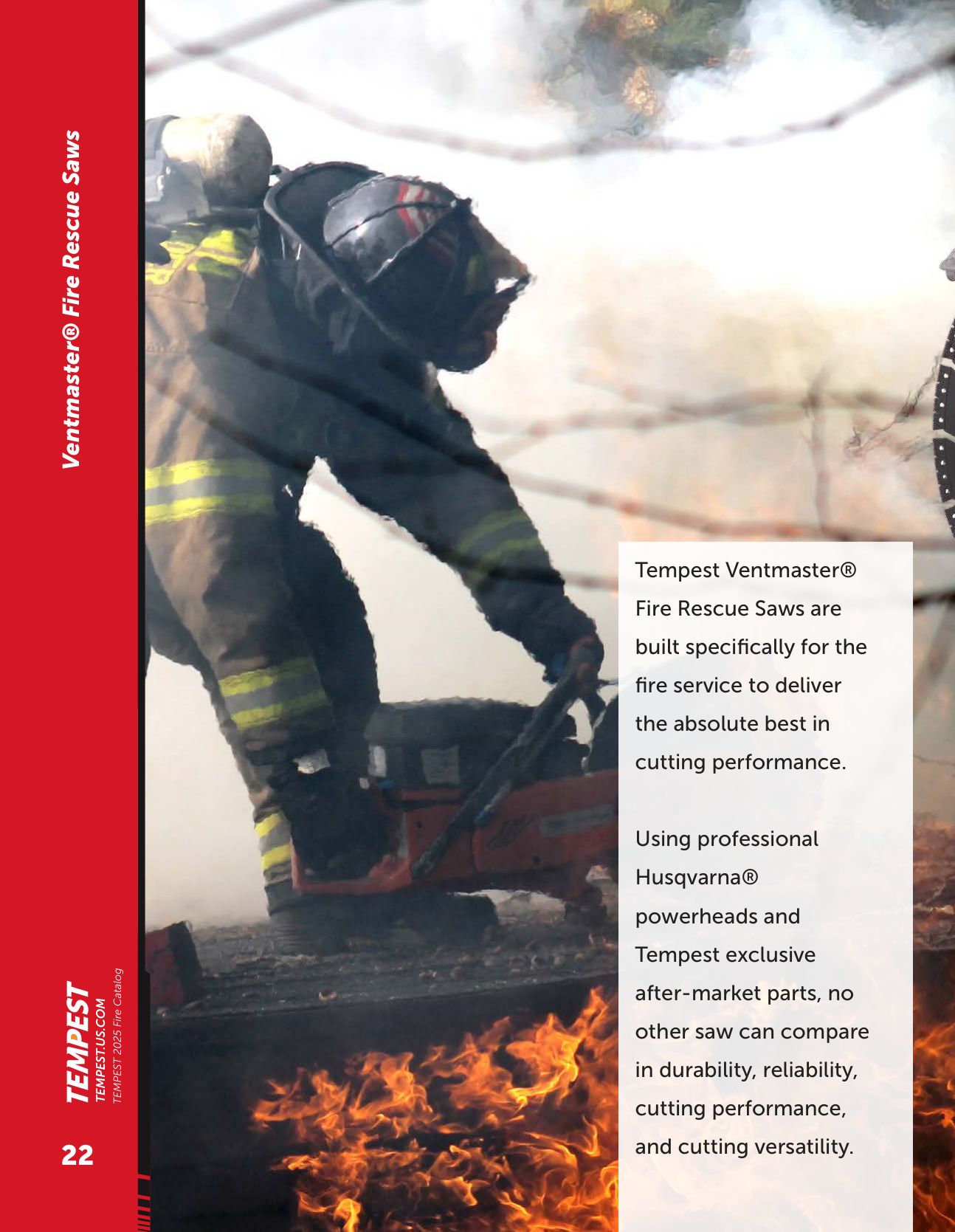
Roof ventilation under live fire is not the place to discover that your saw bogs out at depth, your blade selection was wrong for the substrate, or your cut went three inches deeper than intended into a utility chase. Fire departments have lost firefighters to exactly that kind of equipment failure. The Tempest VentMaster 375K and 397K cutoff saws are engineered around that specific problem set: controlled cutting depth, correct blade selection for the substrate at hand, and a chassis balanced for overhead and roof work. Every modification is designed, fabricated, and assembled in Fresno, California, for fire ground reliability rather than general construction duty.
What are the Tempest VentMaster 375K and 397K cutoff saws?
The VentMaster 375K and 397K are gasoline-powered cutoff saws built on the Husqvarna K770 and K970 platforms respectively, with Tempest-engineered modifications optimized for fire ground ventilation operations including roof openings, wall breaches, and rapid structural access.
Tempest builds each model in Fresno, California, controlling quality at the modification stage rather than outsourcing to a third-party assembler. The 375K uses the Husqvarna K770 as its base, while the 397K is built on the heavier-duty Husqvarna K970. Both platforms are purpose-optimized for fire ground ventilation. The VentMaster name reflects decades of refinement in ergonomics, balance, and control layout for the specific demands of overhead and roof cutting under fire conditions.
What is the KIS-360 Depth Gauge and why does over-penetration matter on a fire ground?
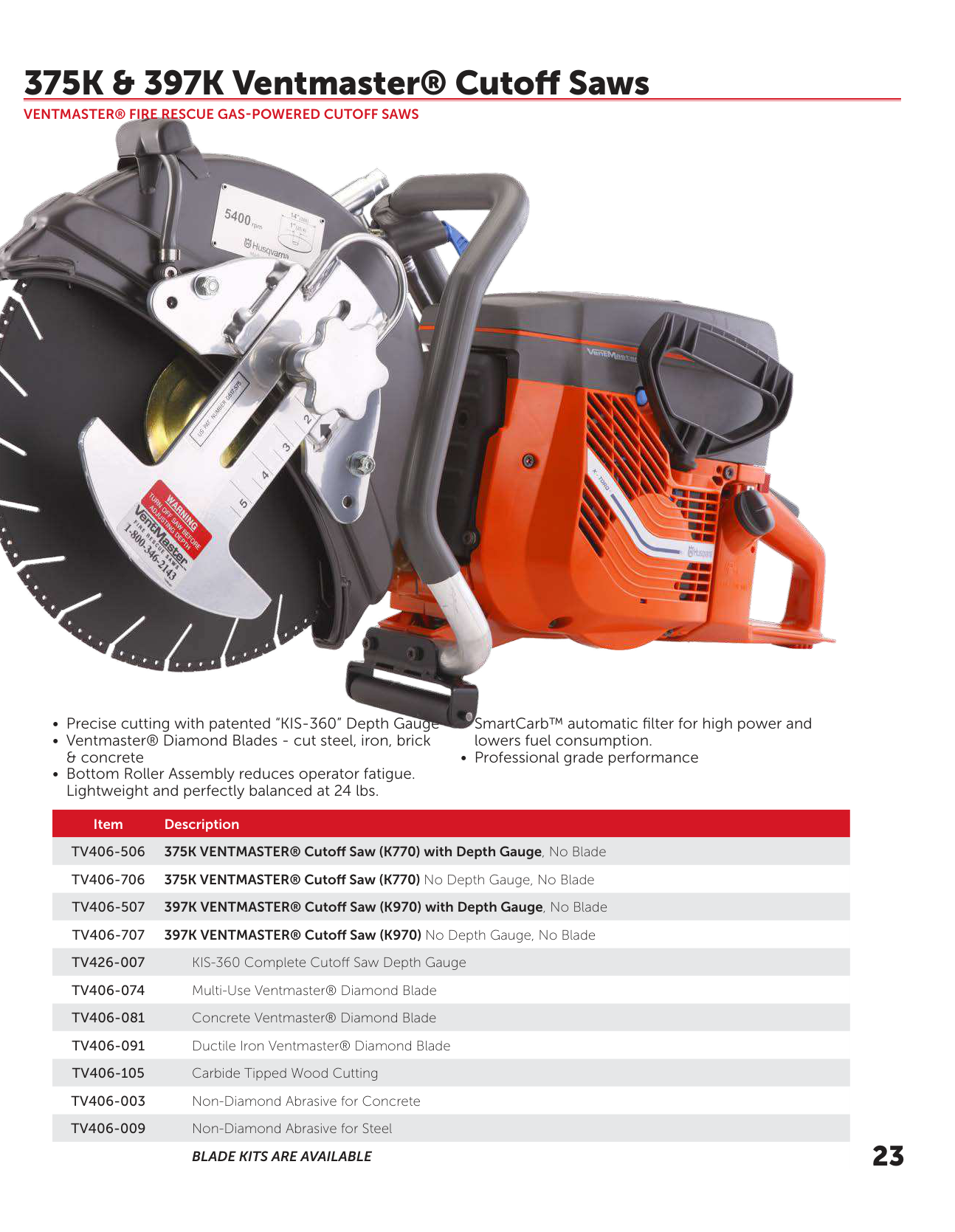
The KIS-360 Complete Cutoff Saw Depth Gauge is a patented, adjustable depth-control system available on the VentMaster 375K and 397K that physically limits blade penetration, preventing the saw from cutting deeper than the operator has set before beginning the cut.
On a ventilation cut into a residential or commercial roof, uncontrolled depth means the blade can breach roof decking and continue into electrical conduit, plumbing, HVAC ducting, or structural members hidden below the surface. None of those hazards are visible to the operator from above. The KIS-360 addresses this by giving the operator a repeatable, adjustable depth stop before the saw ever contacts the substrate. The depth gauge is available as an integrated option (item nos. TV406-506 and TV406-507 for the 375K and 397K respectively) or as a standalone retrofit (item no. TV426-007) for departments that want to add it to existing VentMaster units. Read more about how seconds matter in fire ground operations in this article on When 30 Seconds Can Mean The Difference Between Life and Death.
375K vs 397K: when should a department choose the K770 platform over the K970?
The 375K is built on the Husqvarna K770 and suits departments prioritizing a lighter, maneuverable setup for standard residential and light commercial ventilation work. The 397K, built on the Husqvarna K970, delivers higher power output and suits departments that routinely cut heavier substrates including reinforced concrete, thick steel decking, and ductile iron.
The choice between platforms also reflects fuel system preferences, since the K770 and K970 differ in displacement and air filtration design. Departments already standardized on one Husqvarna platform for parts compatibility and crew familiarity will often stay within that platform family. Both the 375K and 397K ship without a blade (item nos. TV406-706 and TV406-707 for the no-depth-gauge variants, TV406-506 and TV406-507 for the depth-gauge variants), which means the department selects the blade matched to its primary cutting material rather than accepting whatever blade a bundled package includes.
What blade options are available for the VentMaster and when should each be used?
Tempest offers six distinct blade and abrasive configurations for the VentMaster platform, covering every common structural material a fire ground ventilation crew is likely to encounter: concrete, ductile iron, wood, steel, and mixed-material roofing assemblies.
The Multi-Use VentMaster Diamond Blade (TV406-074) handles varied substrates when the cutting surface is uncertain, making it a practical choice for initial ventilation cuts on unfamiliar structures. The Concrete VentMaster Diamond Blade (TV406-081) is optimized for concrete substrates and will outlast a multi-use blade on sustained concrete cutting. The Ductile Iron VentMaster Diamond Blade (TV406-091) addresses pipe and cast infrastructure scenarios. For wood-heavy roofing, the Carbide Tipped Wood Cutting Blade (TV406-105) provides controlled cuts through dimensional lumber, sheathing, and composite decking without the glazing risk that diamond blades face on soft organic materials. The non-diamond abrasive options (TV406-003 for concrete, TV406-009 for steel) serve as cost-effective consumables for training operations or secondary cutting tasks. Selecting the wrong blade for a substrate is one of the most common causes of saw bog-down and blade damage on the fire ground, which is precisely why the VentMaster ships without a blade and requires deliberate selection.
How does the VentMaster design address ergonomics for roof and overhead cutting?
VentMaster saws are not simply stock Husqvarna units with a sticker applied. Tempest engineers the controls, balance distribution, and ergonomic layout specifically for the postures and force vectors involved in overhead cutting, roof work, and rapid structural access under fire conditions.
Overhead cutting demands a different weight balance than horizontal or vertical cutting. A saw front-heavy from a large water separator or poorly positioned air filter will fatigue the operator faster and reduce cut precision on a pitched roof. The VentMaster modifications address this at the fabrication stage in Fresno rather than leaving it to the end user to compensate with technique. The result is a saw that crews can operate accurately during the physical stress of a live fire incident, not just during training drills on a flat surface. You can review specific configurations available for the 375K platform, including no-roller and no-depth-gauge variants, at the Tempest Ventmaster Cutoff Saw 375K with NO ROLLER product page.
Why do VentMaster saws ship without a blade, and what is the advantage for fire departments?
Tempest ships all four VentMaster model variants (TV406-506, TV406-706, TV406-507, TV406-707) without a blade to give fire departments deliberate control over blade selection based on the substrates their jurisdiction predominantly encounters, rather than accepting a bundled blade that may be mismatched to their typical structure stock.
A department operating in a region with predominantly wood-frame residential construction has fundamentally different blade needs than a department covering heavy commercial or industrial properties with concrete tilt-wall construction and ductile iron infrastructure. Forcing a bundled multi-use diamond blade onto the first department adds cost and reduces performance on wood. Tempest’s no-blade shipping policy requires the purchasing officer to answer the question: what material are we most likely to cut? That question, answered correctly and matched to the right VentMaster blade from the six available options, directly affects saw performance on the fire ground. Departments with genuinely mixed response profiles can order the Multi-Use Diamond Blade (TV406-074) and accept the performance trade-off that comes with any multi-material design.
What standards and compliance context applies to fire ground cutoff saws?
Fire apparatus and ground equipment are governed in part by NFPA 1901, the Standard for Automotive Fire Apparatus, which addresses equipment specifications and performance requirements for fire department apparatus. Departments procuring VentMaster saws should verify that their saw, blade, and depth gauge configuration aligns with their department’s apparatus specification and any state-level procurement standards.
The KIS-360 depth gauge carries patent protection, which indicates Tempest has invested in intellectual property protection for the depth control mechanism rather than treating it as a generic add-on. For departments writing apparatus specifications or grant procurement documents, citing the patented KIS-360 depth gauge as a required feature is a defensible specification anchor when justifying the VentMaster platform over generic alternatives. The Made in USA manufacturing origin in Fresno, California also supports Buy American compliance requirements that apply to some federal grant-funded fire equipment purchases.
Where are VentMaster 375K and 397K saws used?
VentMaster saws are purpose-built for fire ground ventilation operations, including vertical ventilation cuts on residential and commercial roofs, horizontal wall breaches for access or egress, and rapid structural cuts during technical rescue scenarios.
Specific application contexts include: pitched and flat residential roof cuts where depth control over hidden electrical and plumbing is critical; commercial tilt-wall and concrete block ventilation where the Concrete Diamond Blade (TV406-081) is the correct selection; ductile iron pipe cutting during combined structure-fire and utility emergency responses; wood-frame commercial construction where the Carbide Tipped Wood Cutting Blade (TV406-105) provides cleaner cuts than a diamond blade on soft material; and steel decking or corrugated metal roofing where the Non-Diamond Abrasive for Steel (TV406-009) is the practical consumable choice. Departments can review the full range of Tempest Ventmaster Cutoff Saw 375K with NO ROLLER configuration options and pair them with the appropriate blade from the six VentMaster blade SKUs listed above.
When is the VentMaster the right call, and when is it not?
The Tempest VentMaster 375K and 397K are the right tool when a fire department needs a dedicated fire ground ventilation saw built on a proven Husqvarna platform with depth control, correct blade selection, and USA-manufactured ergonomic modifications designed specifically for roof and overhead cutting under fire conditions. Departments that carry a single multi-purpose saw for both construction and fire ground work and want one platform to serve both roles will find the VentMaster optimized for fire ground use rather than jobsite versatility. The no-blade shipping model requires an upfront blade selection decision, which is the correct approach for intentional procurement but may not suit departments that need a ready-to-run out-of-box solution without a separate blade order. For departments where depth control on ventilation cuts is a documented operational concern and blade selection can be matched to the primary response district, the VentMaster with the KIS-360 depth gauge is a direct solution to both problems. Review the full When 30 Seconds Can Mean The Difference Between Life and Death article for additional context on fire ground equipment decision-making, and contact PE Energy to confirm the correct model, blade, and depth gauge configuration for your department’s response profile.
Tempest Fire
VentMaster® 375K & 397K Cutoff Saws
Built on Husqvarna K770 & K970 | KIS-360 Depth Gauge | Made in USA
Overview
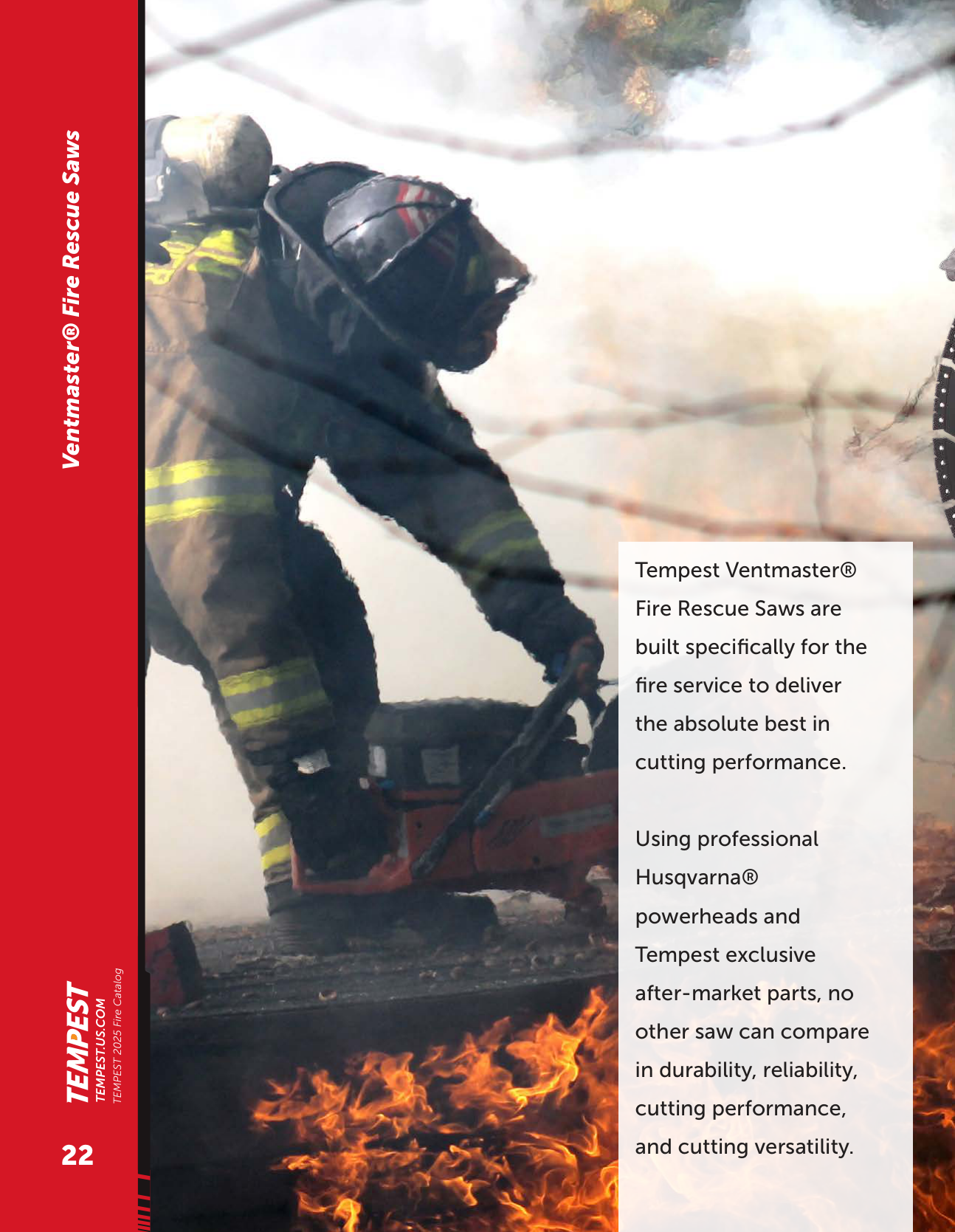
The Tempest VentMaster® 375K and 397K are purpose-built firefighting cutoff saws built on the Husqvarna K770 and K970 platforms respectively. Engineered specifically for ventilation operations, the VentMaster® saws are the tool of choice for precise, controlled cutting during fire ground ventilation — roof openings, walls, and structural access.
Available with or without the patented KIS-360 Complete Cutoff Saw Depth Gauge, which provides precise cutting depth control — preventing over-penetration and protecting firefighters from hidden utilities and structural elements below.
Key Features
KIS-360 Depth Gauge Option
Patented KIS-360 Complete Cutoff Saw Depth Gauge provides precise, adjustable cutting depth control — preventing over-penetration on roofs and walls during ventilation operations.
Two Platform Options
375K built on Husqvarna K770 — 397K built on Husqvarna K970. Choose based on power requirement and fuel system preferences. Both optimized for fire ground ventilation operations.
VentMaster® Diamond Blades
Multi-use, concrete, and ductile iron diamond blades available. Plus carbide-tipped wood cutting and non-diamond abrasive options for steel and concrete — one saw handles all cutting scenarios.
No Blade Included
Saws ship without blade — departments select the appropriate VentMaster® blade for their primary cutting material (steel, concrete, iron, wood), avoiding forced bundling with a blade that may not match the application.
Purpose-Built for Ventilation
The VentMaster® name represents decades of fire ground refinement — ergonomics, controls, and balance optimized for overhead cutting, roof work, and rapid structural access under fire conditions.
Made in USA
Tempest VentMaster® modifications designed, fabricated, and assembled in Fresno, California — quality-controlled for fire ground reliability.
Models & Ordering Information
| Item No. | Description |
|---|---|
| TV406-506 | 375K VentMaster® Cutoff Saw (K770) with Depth Gauge, No Blade |
| TV406-706 | 375K VentMaster® Cutoff Saw (K770) No Depth Gauge, No Blade |
| TV406-507 | 397K VentMaster® Cutoff Saw (K970) with Depth Gauge, No Blade |
| TV406-707 | 397K VentMaster® Cutoff Saw (K970) No Depth Gauge, No Blade |
| TV426-007 | KIS-360 Complete Cutoff Saw Depth Gauge |
| TV406-074 | Multi-Use VentMaster® Diamond Blade |
| TV406-081 | Concrete VentMaster® Diamond Blade |
| TV406-091 | Ductile Iron VentMaster® Diamond Blade |
| TV406-105 | Carbide Tipped Wood Cutting Blade |
| TV406-003 | Non-Diamond Abrasive for Concrete |
| TV406-009 | Non-Diamond Abrasive for Steel |
Technical Specifications
| Type | Gasoline-Powered Cutoff Saw — Fire Ground Ventilation |
| 375K Base Platform | Husqvarna K770 |
| 397K Base Platform | Husqvarna K970 |
| Depth Gauge | KIS-360 Complete Cutoff Saw Depth Gauge (optional) |
| Blade Types | Multi-Use Diamond, Concrete Diamond, Ductile Iron Diamond, Carbide Wood, Non-Diamond Abrasive (Steel & Concrete) |
| Origin | Designed, Fabricated & Built in the USA |
Manufacturer: Tempest — 4708 N. Blythe Avenue, Fresno, California 93722 USA — tempest.us.com