
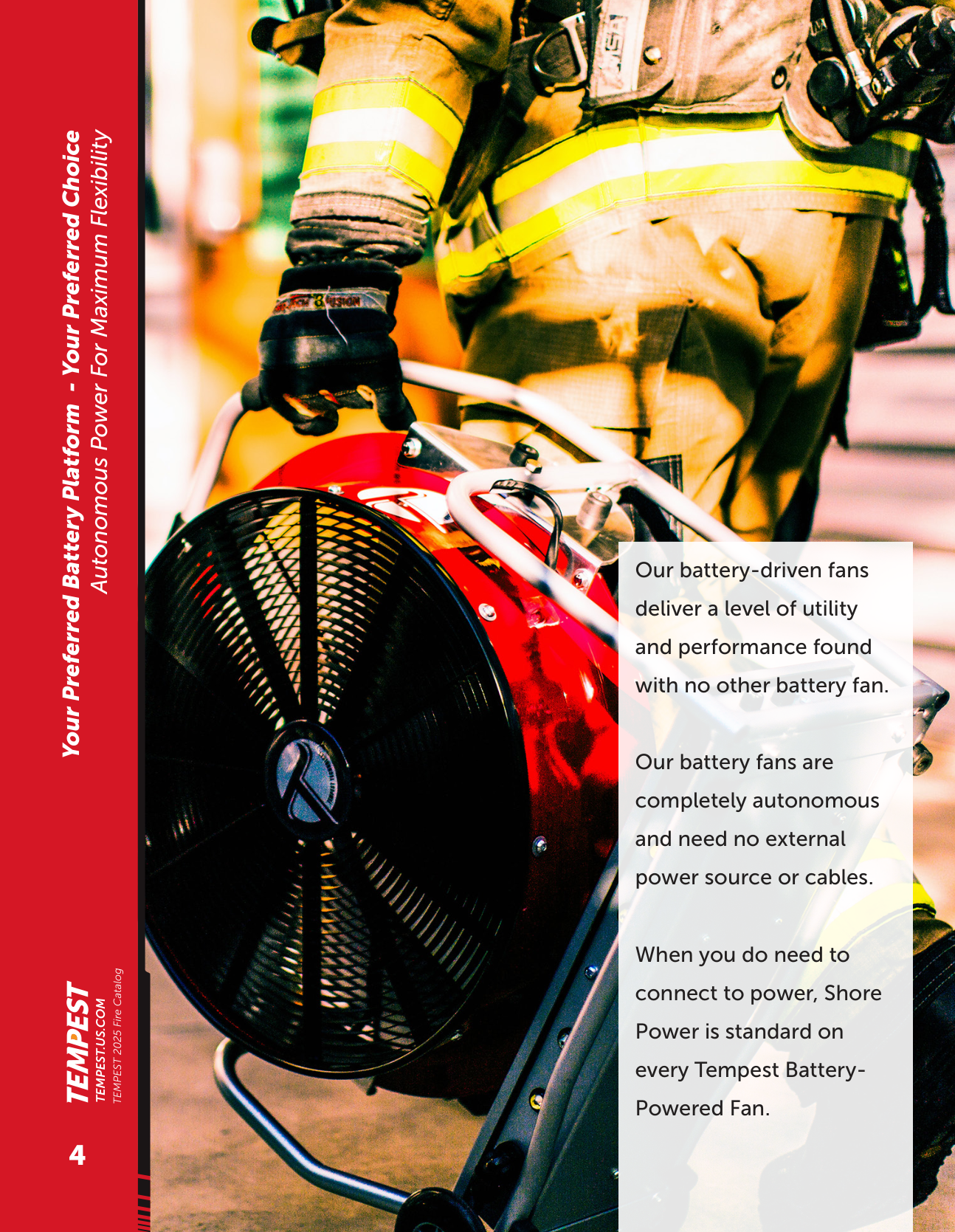
Positive pressure ventilation on a working structural fire does not wait for an extension cord. When crews are pushing smoke out of a two-story residential or clearing a confined industrial space, a gas-powered PPV fan introduces fuel load and exhaust into the equation at exactly the wrong moment. Battery-powered fans solve that problem, but most fall short where it matters most: they drop airflow as the battery discharges, or they die after 20 minutes when the scene is still active. The Tempest BB-16 was designed to close both gaps, delivering a consistent 10,940 CFM for a full 50 minutes on a single charge, with Shore Power compatibility standing by for incidents that run longer.
What is the Tempest BB-16 and how does it compare to gas-powered PPV fans?
The Tempest BB-16 is a battery-powered positive pressure ventilation fan rated at 10,940 CFM, designed as a direct operational substitute for gas-powered PPV fans on structural fire ground. It eliminates combustion byproducts near the entry point while delivering high-volume airflow comparable to traditional powered fans.
Where a gas PPV fan adds carbon monoxide and fuel vapor near an already compromised air environment, the BB-16 introduces none. At 51 lbs. in its fully equipped Deluxe configuration (two batteries, one Quick-Charger), the fan is competitive on weight with mid-size gas units. The HURST® compatible model (Item No. 910-1900) comes in at 45 lbs. because it ships without battery or charger, allowing departments already running HURST® battery platforms to add PPV capability without acquiring a second battery ecosystem. Designed, fabricated, and built in the USA at Tempest’s Fresno, California facility, the BB-16 is part of a product line built specifically for American fire service operational demands.
How does the BB-16’s Dynamic Battery Management System maintain constant CFM output?
The Dynamic Battery Management System in the BB-16 actively regulates power draw throughout the discharge cycle, preventing the airflow drop-off that occurs when unmanaged lithium battery voltage sags under load. The result is constant CFM delivery from the first minute to the 50th minute of a charge.
This matters operationally because a fan that starts at 10,940 CFM and falls to 7,000 CFM by mid-incident changes the pressure differential the crew calculated when they set the fan at the door. Positive pressure ventilation is a flow-rate-sensitive tactic: the cone of air must seal the entry opening to build positive pressure inside the structure. If CFM drops, the cone collapses, and the ventilation path breaks down. The BB-16’s management system prevents that degradation, keeping the full 10,940 CFM output constant across the entire 50-minute run time. For departments that need extended operations beyond battery capacity, Shore Power connectivity is included as standard across all configurations, providing unlimited runtime when connected to an AC source.
What does IP66 motor protection mean for fire ground use?
IP66 is an ingress protection rating under IEC 60529 that certifies a motor against dust ingress (first digit: 6, total protection) and against powerful water jets from any direction (second digit: 6). This is one step above IP65, which only certifies protection against low-pressure water jets.
On a working fire ground, the fan operates in the same zone where handlines are flowing. Water from suppression operations, rain, and high-humidity smoke environments all contact the equipment. An IP65-rated motor is certified against water sprays; an IP66-rated motor is certified against the kind of direct, forceful water jets that occur when a line sweeps past the fan’s position or when the fan is repositioned through a wet area. For departments that operate in regions with heavy seasonal rainfall or that regularly deploy in industrial environments with washdown operations, the IP66 rating is not a marketing distinction. It is a measurable difference in what the motor can withstand without electrical failure.
What battery configurations are available for the BB-16?
The BB-16 is offered in four configurations to match different department budgets, inventory strategies, and existing battery platforms. Each configuration delivers the same 10,940 CFM output and 50-minute run time; the differences are in charging speed and battery redundancy.
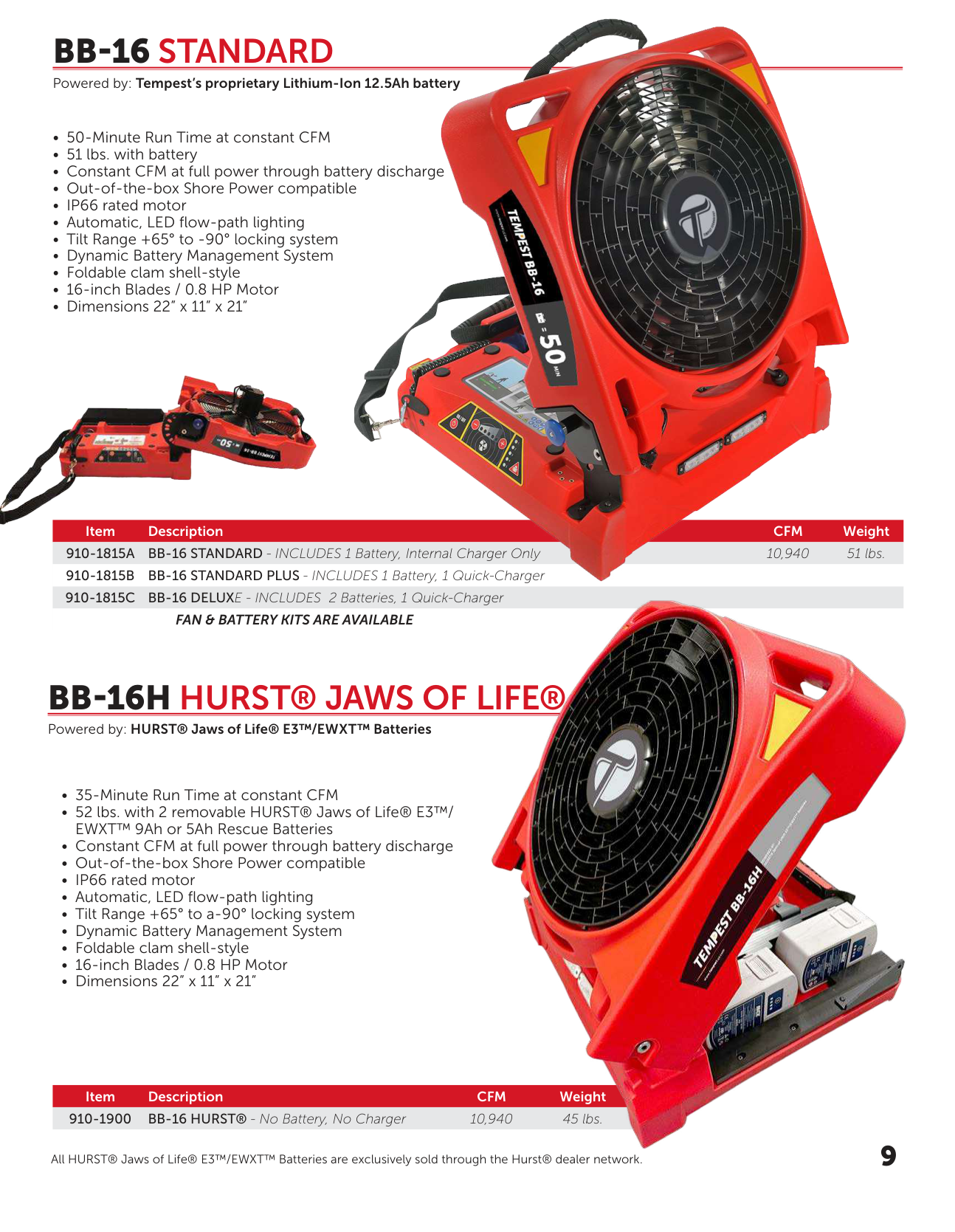
The BB-16 Standard (Item No. 910-1815A) includes one battery and an internal charger. The BB-16 Standard Plus (Item No. 910-1815B) adds a Quick-Charger for faster battery recovery between deployments. The BB-16 Deluxe (Item No. 910-1815C) ships with two batteries and a Quick-Charger, allowing one battery to charge while the other is in service. All three weigh 51 lbs. The BB-16 HURST® (Item No. 910-1900) weighs 45 lbs. and ships without battery or charger, pairing directly with HURST® battery systems departments already carry. For departments evaluating the HURST-compatible variant, the Tempest BB-16H Blower is the specific HURST-platform model available through PE Energy. Departments running the HURST® rescue tool ecosystem gain a real operational advantage: one battery platform, one charger set, fewer spares to manage on the apparatus.
How does the BB-16’s automatic LED flow-path lighting improve positioning accuracy?
The BB-16 includes automatic LED lighting that illuminates the airflow path without requiring crew intervention. The lighting activates automatically, directing visible light along the direction of airflow to assist with fan placement in low-visibility conditions.
Correct PPV fan placement is geometry-dependent. The fan must be positioned so the cone of air covers the full door opening, typically set back from the threshold by a calculated distance based on the fan’s blade diameter. In night operations or when smoke is banking at ground level near the entry point, verifying that placement visually is difficult. The LED flow-path lighting gives the crew a direct visual confirmation that the airstream is aligned with the opening without requiring a flashlight or an additional firefighter to assess positioning. This feature is particularly useful in industrial settings where entry points are irregular or in multi-story residential structures where the doorway geometry varies. The lighting operates automatically, so there is no additional switch to manage during a high-workload entry phase.
What tilt range and physical adjustability does the BB-16 provide on scene?
The BB-16 features an adjustable locking tilt range that allows the fan to be angled upward or downward and locked in position without additional tools. This adjustability enables operators to direct the airstream toward upper or lower sections of an opening depending on smoke layer position.
In a standard residential doorway where smoke is banking at ceiling level, tilting the fan slightly upward directs the pressure cone into the upper portion of the opening more aggressively, accelerating removal of the hot gas layer. In a basement stairwell entry or a low-threshold industrial doorway, a downward tilt angle ensures the pressure cone does not overshoot the opening. The locking mechanism holds the set angle under the vibration load of the motor running at full output, so the angle does not drift during the ventilation evolution. At 10,940 CFM, motor vibration is a real variable, and a tilt mechanism that does not lock reliably will drift out of position mid-incident. The BB-16’s locking tilt design addresses that failure mode directly.
Where is the Tempest BB-16 used and what structural applications is it designed for?
The BB-16 is designed for structural fire ventilation, confined space operations, and large-area industrial environments where high-volume airflow is required without a combustion power source. Its 10,940 CFM output and 50-minute run time make it suitable for single-family residential fires, multi-story structures, and industrial facilities.
In structural fire operations, the BB-16 is positioned at the primary entry point to establish positive pressure inside the structure, pushing smoke and heat toward designated exhaust openings. In confined space rescue operations, the battery-powered design eliminates the exhaust contamination that would compromise a space being ventilated for victim extraction. For industrial facilities with chemical storage or flammable atmospheres, removing a combustion-engine fan from the ventilation equation reduces ignition risk near the hazard zone.
Shore Power compatibility makes the BB-16 a viable option for extended training evolutions and non-emergency industrial ventilation tasks where runtime beyond 50 minutes is required. Departments can plug into apparatus shore power or a generator and run the fan indefinitely for building inspections, post-fire overhaul ventilation, or HAZMAT decon corridor setup. For a complete view of Tempest’s ventilation and blower product line, the full catalog is available through Tempest Products at PE Energy. Departments evaluating the HURST-integrated variant for apparatus standardization should review the Tempest BB-16H Blower specification alongside the standard configurations. The Tempest Products catalog at PE Energy includes additional blower, fan, and ventilation options for departments sourcing multiple units.
For departments comparing the BB-16 against other Tempest battery blower options, the Tempest BB-16H Blower provides the HURST-native specification detail needed to confirm platform compatibility before ordering. Tempest’s manufacturing facility in Fresno, California supports domestic supply chain reliability, a relevant factor for departments subject to procurement policies requiring American-made apparatus equipment. Additional Tempest product specifications are published directly at Tempest’s official product site for departments conducting detailed technical comparison against other PPV fan platforms.
When is the BB-16 the right call, and when should departments consider alternatives?
The BB-16 is the right specification when a department needs full-power, high-volume PPV capability without combustion exhaust, has a run-time requirement of 50 minutes or less per incident (or has Shore Power access for longer operations), and wants the option to integrate with a HURST® battery platform already on the apparatus.
The BB-16 is not the right choice for departments that need multi-hour continuous battery operation without access to Shore Power, or for applications where 10,940 CFM is excessive relative to the structure size and a smaller battery fan would serve adequately. Departments evaluating the HURST® configuration should confirm battery platform compatibility with their existing HURST® equipment before ordering the 910-1900 model, as that unit ships without battery or charger and is designed specifically for integration with HURST® systems already in service. For departments that need a cordless, high-output, weather-resistant PPV fan for structural fire operations, confined space rescue, or industrial ventilation with consistent CFM throughout the discharge cycle, the BB-16 is a technically sound specification that addresses all three of those requirements in a single, Made-in-USA platform.
Tempest Fire
BB-16 Battery PPV Fan
10,940 CFM | 50-Minute Run Time | IP66 Motor | Made in USA
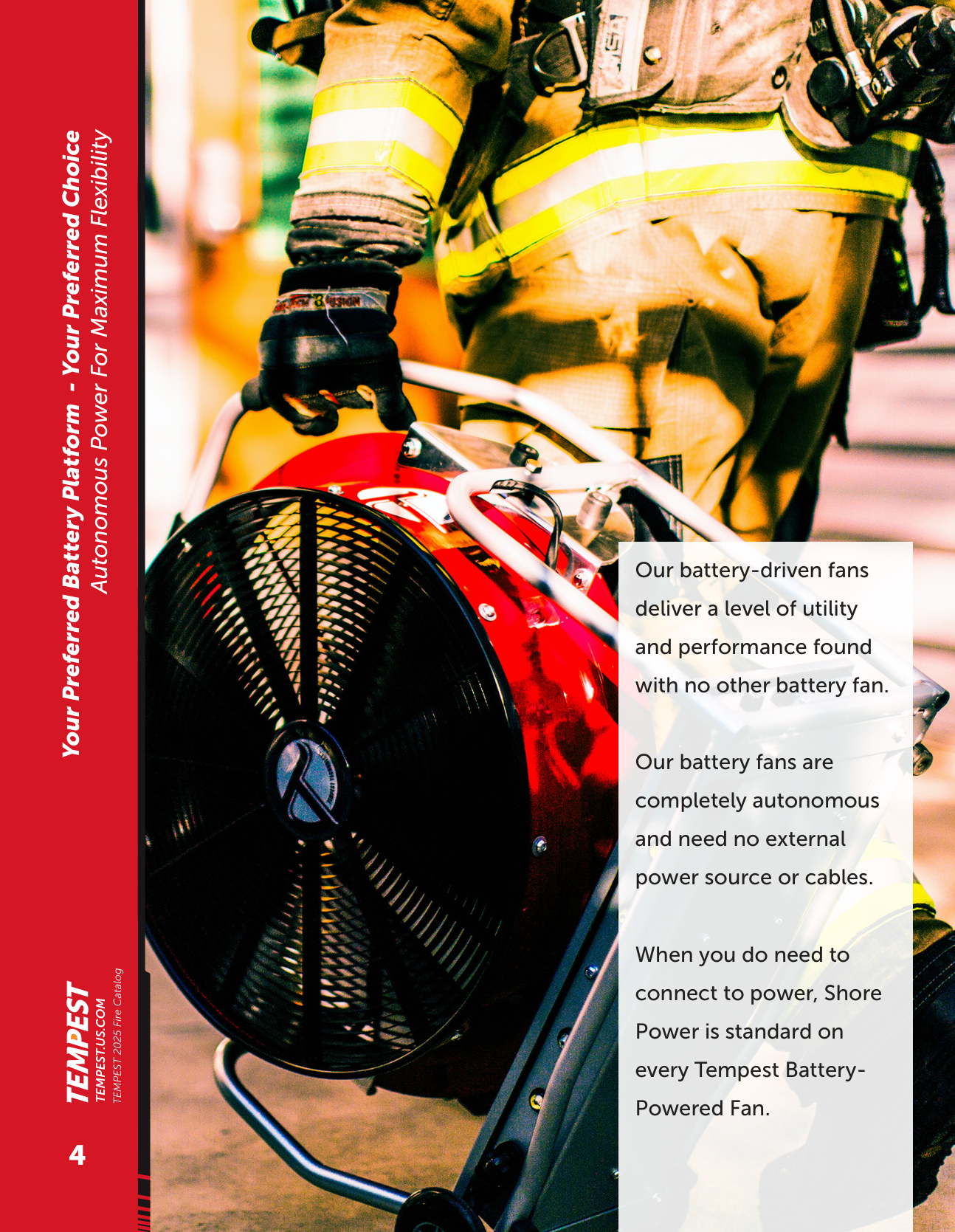
Overview
The Tempest BB-16 is a battery-powered PPV fan delivering 10,940 CFM with a 50-minute constant run time. Available in Standard (proprietary battery) and HURST® configurations, the BB-16 offers departments flexibility to choose the battery platform that matches their existing equipment.
With an IP66-rated motor — offering higher water ingress protection than IP65 — the BB-16 handles the most demanding wet conditions on fire ground. Shore Power compatibility is standard across all configurations for unlimited runtime on extended incidents.
Key Features
10,940 CFM Output
High-volume airflow for fast ventilation of structural fires, confined spaces, and large-area industrial environments. Constant CFM maintained at full power through discharge.
IP66 Rated Motor
IP66 protection — a step above IP65 — provides protection against powerful water jets from any direction. Ideal for operations in heavy rain or active suppression environments.
Multiple Battery Configurations
Standard: 1 Battery + Internal Charger / Standard Plus: 1 Battery + Quick-Charger / Deluxe: 2 Batteries + Quick-Charger / HURST® version also available.
50-Minute Run Time
50 minutes of constant, full-power CFM on a single charge. Dynamic Battery Management System maintains consistent output throughout the entire discharge cycle.
Shore Power Compatible
Shore Power is standard — connect to AC for unlimited runtime on extended incidents, training evolutions, or industrial ventilation applications.
Automatic LED Flow-Path Lighting
LEDs automatically illuminate the airflow path — critical for night operations and smoke-filled environments where precise positioning matters.
Models & Ordering Information
| Item No. | Description | CFM | Weight |
|---|---|---|---|
| 910-1815A | BB-16 STANDARD — 1 Battery, Internal Charger Only | 10,940 | 51 lbs. |
| 910-1815B | BB-16 STANDARD PLUS — 1 Battery, 1 Quick-Charger | 10,940 | 51 lbs. |
| 910-1815C | BB-16 DELUXE — 2 Batteries, 1 Quick-Charger | 10,940 | 51 lbs. |
| 910-1900 | BB-16 HURST® — No Battery, No Charger | 10,940 | 45 lbs. |
Technical Specifications
| Type | Battery-Powered PPV Fan |
| Airflow | 10,940 CFM |
| Run Time | 50 Minutes at Constant CFM |
| IP Rating | IP66 (Motor) |
| Shore Power | Standard (out of box) |
| Tilt Range | Adjustable Locking Tilt Range |
| Lighting | Automatic LED Flow-Path Lighting |
| Weight | 45–51 lbs. (configuration dependent) |
| Origin | Designed, Fabricated & Built in the USA |
Manufacturer: Tempest — 4708 N. Blythe Avenue, Fresno, California 93722 USA — tempest.us.com