
Every second a fire company spends hunting for a working outlet, untangling extension cords, or diagnosing a slipping belt drive is a second smoke stays inside a structure. Positive pressure ventilation works only as fast as the fan you can deploy, and the fan only performs as advertised when the power path between engine and blade is clean. That is the exact problem the Tempest Direct Drive (DD) series was built to eliminate. No belts. No power cords. No intermediate pulleys that wear, glaze, or snap at 2 a.m. on a residential working fire. The DD series ships in four blade diameters, two engine platforms, and outputs that reach 20,523 CFM, with a weight range that keeps a single firefighter mobile across almost any terrain.
What is a direct drive PPV fan and why does it matter for fire ground deployment?
A direct drive PPV fan couples the engine crankshaft directly to the fan blade assembly, eliminating belts, pulleys, and intermediate drive components entirely. All engine horsepower transfers to the blade without friction losses or the mechanical slack that belt-drive systems accumulate over time.
On a fire ground, that matters for two concrete reasons. First, power transfer is maximized from the first pull of the cord: the Tempest DD-21-H-5.5 delivers 20,523 CFM from a 5.5 HP Honda engine precisely because there is no belt absorbing a portion of that output. Second, belt maintenance is removed from the service schedule entirely, which reduces out-of-service time between deployments. The Tempest DD series uses a welded-frame, powder-coat-finished construction fabricated in Fresno, California, designed to absorb the repeated abuse of fire ground drops, road vibration in apparatus compartments, and industrial service cycles.
What CFM outputs do the Tempest DD series fans produce across the four blade sizes?
The Tempest DD series spans 16″, 18″, 21″, and 24″ blade configurations with CFM outputs ranging from 11,541 to 20,523 CFM depending on blade diameter and engine pairing. Larger blade diameter does not automatically guarantee higher CFM because engine horsepower and blade pitch interact.
The 21″ Honda model (DD-21-H-5.5) produces the highest output in the lineup at 20,523 CFM using a 5.5 HP Honda engine. The 24″ Honda model (DD-24-H-5.5) produces 19,606 CFM from the same 5.5 HP engine, reflecting the aerodynamic trade-off between blade diameter and rotational efficiency. On the Briggs & Stratton side, the 16″ entry model (DD-16-B-3.5) uses a 3.5 HP engine and produces 11,541 CFM, while the 21″ and 24″ Briggs models step up to 5.5 HP engines producing 18,025 CFM and 19,232 CFM respectively. Selecting the right model requires matching blade size to door or window opening dimensions as well as the structural volume requiring ventilation.
Honda vs. Briggs & Stratton: which engine option is right for your department?
The Tempest DD series offers Honda (4.8 to 5.5 HP) and Briggs & Stratton (3.5 to 5.5 HP) engine options so departments can align the fan’s power plant with their existing small-engine service capability and spare-parts inventory. Both platforms are proven in gasoline-powered firefighting equipment.
Honda-equipped models carry a slight weight premium: the DD-16-H-4.8 weighs 79 lbs. versus 73 lbs. for the DD-16-B-3.5, and the DD-24-H-5.5 tops out at 99 lbs. versus 97 lbs. for the DD-24-B-5.5. The Honda 16″ model also outperforms its Briggs counterpart on raw CFM output: 12,008 CFM versus 11,541 CFM at the same blade size. Departments that already stock Honda small-engine parts for saws, generators, or water pumps will reduce their logistics burden by standardizing on Honda-equipped fans. Departments running Briggs & Stratton equipment across the fleet gain the same advantage in reverse. Neither engine choice compromises the direct drive architecture or the welded-frame construction.
How does gasoline power change deployment logistics compared to electric PPV fans?
Gasoline-powered PPV fans operate with complete autonomy: no electrical outlet, no extension cord run, no generator staging, and no dependence on building power that may be compromised in a fire event. The fan arrives at the entry point, positioned and running within seconds of pulling the cord.
This autonomy is particularly valuable in remote structure fires, rural responses, post-disaster ventilation operations, and industrial facilities where live electrical circuits cannot be assumed. The trade-off is weight and fuel management: the heaviest DD model reaches 99 lbs. (DD-24-H-5.5), and operational runtime depends on tank capacity. Electric fans such as the Tempest 24-IND Electric Powered Fan are better suited to facilities with reliable power access where exhaust fumes or noise must be minimized. The gasoline DD series excels precisely when those conditions cannot be guaranteed. Solid rubber wheels on all DD models provide terrain mobility across gravel, grass, and uneven surfaces common to fire ground approaches.
What does “Made in USA” mean for the Tempest DD series specifically?
Tempest fabricates the DD series at its facility in Fresno, California. Designed, fabricated, and built in the USA means the welded frame, blade assembly, and powder-coat finish are produced domestically rather than assembled from imported subassemblies at a final-stage facility.
For fire departments and industrial procurement teams operating under domestic-sourcing requirements or Buy American provisions, the Fresno origin satisfies documentation needs without requiring supply-chain verification across multiple countries. The industrial-duty frame construction is consistent with Tempest’s broader product line approach: welded steel rather than bolted or injection-molded structural components, with powder coat applied for corrosion resistance in outdoor and high-humidity deployment environments. The same construction standard applies across all eight DD models from the 73 lb. entry-level Briggs 16″ unit through the 99 lb. Honda 24″ model.
What are the weight and mobility characteristics of the DD series in practice?
The Tempest DD series ranges from 73 lbs. (DD-16-B-3.5) to 99 lbs. (DD-24-H-5.5), with solid rubber wheels on every model for movement across uneven terrain. These weights are competitive for self-contained gasoline fans producing outputs in the 11,500 to 20,500 CFM range.
For a single firefighter deploying off an apparatus, the 73 to 85 lb. range of the 16″ and 18″ models represents a realistic one-person carry over short distances. The 21″ and 24″ models, at 87 to 99 lbs., are more practical as two-person carries or wheel-deployed from a staging position. The absence of belt-drive components also removes one of the most common field failure modes for gasoline fans: a belt that snaps or glazes during a deployment cannot be replaced on the fire ground, while a direct drive fan continues operating until the fuel runs out. That reliability profile matters more at 3 a.m. on a mutual-aid response than it does on a training day.
Where are Tempest DD gasoline PPV fans used in fire and industrial applications?
The DD series is deployed across structural firefighting, hazmat ventilation, confined space pre-entry purging, post-fire overhaul ventilation, and industrial facility ventilation where fixed power is unavailable or unsafe to use. CFM range and blade size selection depend on the specific opening geometry and structure volume.
Fire departments use the 16″ and 18″ models (DD-16-H-4.8 at 12,008 CFM, DD-18-H-4.8 at 14,773 CFM) for residential single-family structures and moderate commercial openings. The 21″ Honda model at 20,523 CFM suits larger commercial structures, big-box retail, and warehouse ventilation where a single high-output fan at the primary entry point can pressurize the entire structure. Industrial teams use the Briggs-powered models for areas where Honda parts are not stocked locally. For facilities with reliable power infrastructure, compare the gasoline DD models against the Tempest 24-IND Electric Powered Fan to determine which power platform fits the application. Browse the full range of available gasoline and electric options in the Blowers and Fans Catalog to compare models side by side. The Blowers and Fans Catalog includes Tempest’s full DD lineup alongside electric and battery-powered alternatives for departments evaluating mixed-fleet ventilation strategies. For departments operating under NFPA 1901 automotive fire apparatus standards, apparatus compartment specifications for ventilation equipment should account for the 73 to 99 lb. weight range and wheel-equipped base of the DD series when planning storage layout.
When is the Tempest DD gasoline PPV fan the right call, and when is it not?
The Tempest DD series is the correct choice when the deployment environment cannot guarantee accessible electrical power, when response locations are remote or rural, when apparatus compartment space accommodates a 73 to 99 lb. gasoline-powered unit, and when the department’s service team can maintain Honda or Briggs & Stratton small-engine equipment.
The DD series is not the right tool when exhaust emissions are a constraint: gasoline engines produce carbon monoxide and require outdoor or well-ventilated staging, which rules them out for enclosed industrial spaces with combustible atmospheres or for confined space entries where contamination of the purge airstream is unacceptable. In those cases, an electric PPV fan is the safer choice. The direct drive design eliminates belt-related failures entirely, but it does not eliminate the need for routine engine maintenance: air filter, spark plug, and fuel system service on Honda and Briggs & Stratton engines should follow manufacturer-specified intervals to maintain the CFM outputs listed at time of manufacture. Departments that service their fans consistently will find the DD series produces the same output on the hundredth deployment as on the first.
Tempest Fire & Industrial
Direct Drive Gasoline PPV Fans
16″–24″ Sizes | Honda & Briggs Engines | Up to 20,523 CFM | Made in USA
Overview
The Tempest Direct Drive (DD) series are gasoline-powered positive pressure ventilation fans built for fire and industrial applications where no external power source is available. Direct drive means no belt slippage, no maintenance headaches — the engine drives the fan blade assembly directly for maximum power transfer and reliability.
Available in 16″, 18″, 21″, and 24″ sizes with Honda or Briggs & Stratton engines, the DD series delivers up to 20,523 CFM with complete autonomy. No cables. No generator. No extension cords. Just drop it in position and pull the cord.
Key Features
True Direct Drive
Engine-to-blade direct coupling — no belts, pulleys, or intermediate drives. Maximum power transfer, zero belt maintenance, maximum reliability in the field.
Four Size Options
16″, 18″, 21″, and 24″ blade configurations provide CFM outputs from 11,541 to 20,523 CFM — matching the fan to the specific structure, opening size, and ventilation requirement.
Honda or Briggs & Stratton
Choose the engine platform that matches your department’s existing service capability and parts supply. Honda (4.8–5.5 HP) and Briggs & Stratton (3.5–5.5 HP) options available.
Complete Autonomy
Self-contained gasoline power — no electrical connections required. Deploy anywhere, including remote locations and structures without accessible power.
Lightweight for Size Class
73–99 lbs. depending on configuration — competitive for gasoline-powered fans delivering this CFM output. Solid rubber wheels for terrain mobility.
Field-Proven Design
Built to Tempest’s industrial-duty welded frame standards with powder-coat finish. Designed to handle the abuse of regular fire ground deployment and industrial service.
Models & Ordering Information
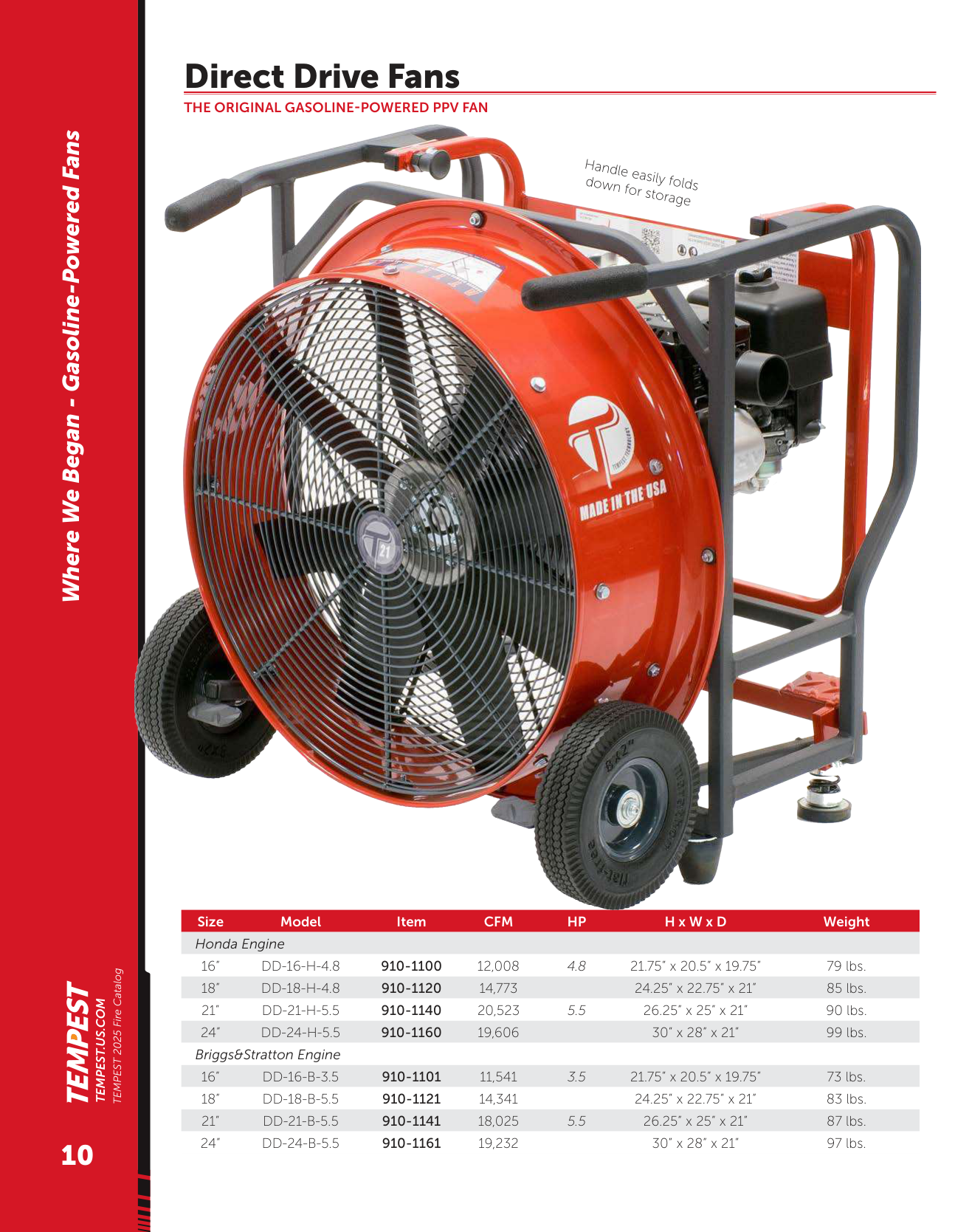
| Item No. | Model | Size | Engine | HP | CFM | Weight |
|---|---|---|---|---|---|---|
| 910-1100 | DD-16-H-4.8 | 16″ | Honda | 4.8 | 12,008 | 79 lbs. |
| 910-1120 | DD-18-H-4.8 | 18″ | Honda | 4.8 | 14,773 | 85 lbs. |
| 910-1140 | DD-21-H-5.5 | 21″ | Honda | 5.5 | 20,523 | 90 lbs. |
| 910-1160 | DD-24-H-5.5 | 24″ | Honda | 5.5 | 19,606 | 99 lbs. |
| 910-1101 | DD-16-B-3.5 | 16″ | Briggs & Stratton | 3.5 | 11,541 | 73 lbs. |
| 910-1121 | DD-18-B-5.5 | 18″ | Briggs & Stratton | 5.5 | 14,341 | 83 lbs. |
| 910-1141 | DD-21-B-5.5 | 21″ | Briggs & Stratton | 5.5 | 18,025 | 87 lbs. |
| 910-1161 | DD-24-B-5.5 | 24″ | Briggs & Stratton | 5.5 | 19,232 | 97 lbs. |
Technical Specifications
| Type | Gasoline-Powered Direct Drive PPV Fan |
| Blade Sizes | 16″, 18″, 21″, 24″ |
| CFM Range | 11,541 – 20,523 CFM |
| Engine Options | Honda (4.8–5.5 HP) or Briggs & Stratton (3.5–5.5 HP) |
| Drive Type | Direct Drive (no belt) |
| Power Source | Gasoline — Fully Autonomous |
| Weight Range | 73 – 99 lbs. |
| Origin | Designed, Fabricated & Built in the USA |
Manufacturer: Tempest — 4708 N. Blythe Avenue, Fresno, California 93722 USA — tempest.us.com