
Here’s what nobody tells you about chemical injection pumps until it’s too late…
At 3:47 AM on a Tuesday, the emergency alarm screamed through the control room. Another pump failure. Another production shutdown. Another five-figure repair bill heading straight for your budget.
Sound familiar?
If you’re responsible for keeping chemical injection systems running in oil and gas operations, you know this nightmare scenario isn’t fiction. It’s your reality. And it’s costing you more than just money—it’s costing you sleep, reputation, and career advancement opportunities.
The Hidden Epidemic Destroying Industrial Operations Across America
Every day, thousands of chemical injection pumps fail across industrial facilities nationwide. Not because of some exotic technical problem. Not because of user error.
They fail because most pumps weren’t designed for the brutal reality of continuous industrial service.
Think about it. Your current pump is probably running 24/7, injecting corrosive chemicals at pressures that would make a hydraulic press jealous. The seals are constantly under attack. The plungers are wearing down with every stroke. The motor is fighting against backpressure that increases every day as your system ages.
And when it finally gives up? You’re not just looking at pump replacement costs. You’re looking at production losses, emergency maintenance callouts, contaminated batches, regulatory compliance issues, and the dreaded phone call to explain why your system went down… again.
Industry studies show the average unplanned downtime event costs between $15,000 to $75,000 per hour in lost production. For a typical 8-hour repair, you’re looking at $120,000 to $600,000 in losses. From one pump failure.
But here’s what really keeps maintenance managers awake at night: the unpredictability. You never know when the next failure will hit. Will it be during the day shift when you have full crew coverage? Or will it be at 2 AM on a weekend when your best technician is 200 miles away?
The stress is eating you alive. And your boss is starting to ask uncomfortable questions about reliability trends and maintenance costs.
There has to be a better way, right?
The Industrial-Grade Solution That’s Been Hiding In Plain Sight
What if I told you there’s a chemical injection pump that’s been quietly solving these exact problems for industrial operations just like yours?
A pump designed from day one for the brutal realities of continuous service. Built with materials that laugh at corrosive chemicals. Engineered with redundancy that keeps you running even when individual components need service.
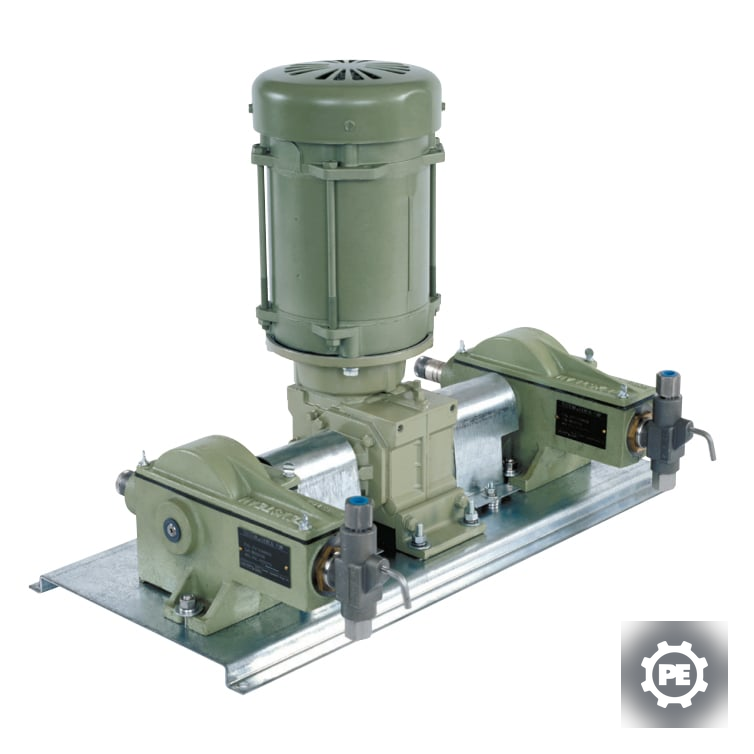
Meet the Texsteam Series 2500 Electric Pump.
This isn’t another “me-too” pump with fancy marketing claims. This is an industrial workhorse that’s been battle-tested in the harshest environments on Earth. And it’s about to transform how you think about chemical injection reliability.
Why This Pump Succeeds Where Others Fail Miserably
First, let’s talk about pressure capability.
The Series 2500 delivers up to 6,000 PSI with its 3/16″ plunger configuration. That’s not a theoretical maximum—that’s real-world, day-in-day-out working pressure. Why does this matter to you? Because high pressure capability means you can inject into systems with significant backpressure without the pump struggling, overheating, or wearing out prematurely.
Most pumps start showing stress fractures and seal failures when you push them near their pressure limits. The Series 2500 operates comfortably at maximum pressure because it was designed with substantial safety margins built in.
But pressure is just the beginning.
The real genius is in the modular configuration options. You can run this pump in simplex (single head), duplex (two heads), triplex (three heads), or quadruplex (four heads) configurations. And here’s the kicker—each head is independently adjustable while the pump is running.
Think about what this means for your operation. You can inject multiple chemicals simultaneously, each at precisely the rate and pressure your process demands. No more complicated manifold systems. No more flow splitting headaches. No more “close enough” injection rates that compromise your product quality.
And the flexibility gets even better.
You can mix and match head sizes on the same pump. Need high-pressure, low-volume injection of corrosion inhibitor combined with high-volume, moderate-pressure biocide injection? No problem. Install a 3/16″ head for the inhibitor and a 1/2″ head for the biocide. One pump, multiple applications, perfect optimization for each chemical.
Now let’s talk about the engineering that makes this possible.
The Series 2500 uses an eccentric cam design that eliminates the need for oil injection. You know what that means? One less maintenance headache. No more oil contamination of your chemicals. No more oil change schedules for the pump mechanism itself. Just reliable, consistent operation day after day.
The pump heads are constructed from 316 stainless steel as standard equipment. Not 304. Not “industrial grade stainless.” 316—the premium grade that stands up to the most corrosive chemicals you’ll ever encounter. This isn’t a cost-cutting decision disguised as an engineering choice. This is serious corrosion resistance that extends pump life and reduces your total cost of ownership.
But what about the wear components?
The plungers are manufactured from 17-4PH stainless steel, heat-treated for maximum durability. And if you’re dealing with particularly abrasive chemicals, you can upgrade to ceramic plungers that virtually eliminate wear-related downtime.
The packing options tell the real story of this pump’s versatility. You can specify Buna-N for general chemical service, hard packing for maximum pressure applications, Viton for aggressive chemical environments, or Teflon for ultimate chemical compatibility. The engineers didn’t just give you one option and hope it works—they gave you the exact right packing material for your specific application.
Here’s where the technical specs translate into real-world benefits.
The pump offers four different stroke speeds (15, 30, 60, and 120 strokes per minute) and four different plunger sizes (3/16″, 1/4″, 3/8″, and 1/2″). This isn’t just engineering showing off—this is precision flow control that lets you dial in exactly the injection rate your process demands.
Need ultra-precise injection of expensive chemicals? Use the 3/16″ plunger at 15 SPM for flows as low as 0.2 gallons per day. Need high-volume injection of less expensive treatment chemicals? The 1/2″ plunger at 120 SPM delivers up to 139.5 gallons per day.
And because each head is independently controllable, you can optimize the injection rate for each chemical without compromise.
The ability to adjust flow rates while running eliminates the downtime associated with manual flow adjustments. This single feature can save you hours of production time every month.
But the real competitive advantage is in the motor and drive system.
The Series 2500 comes standard with a 1/2 HP motor in your choice of single or three-phase configuration. TEFC (Totally Enclosed Fan Cooled) for normal environments or explosion-proof for hazardous locations. 50 Hz or 60 Hz to match your power system anywhere in the world.
The motor connects through a common gear reducer to the eccentric cam drive. This means proven, reliable power transmission with easy serviceability. When maintenance is required, you’re working with standard industrial components, not proprietary systems that require factory technicians and month-long lead times for parts.
Real-World Applications Where This Pump Dominates
The Series 2500 isn’t a specialty pump for exotic applications. It’s designed for the bread-and-butter chemical injection needs that keep your operation running smoothly.
Corrosion inhibitor injection into pipelines and vessels. Scale inhibitor treatment for water systems. Biocide injection for cooling towers and process water. H2S scavenger injection in oil and gas production. Methanol injection for hydrate prevention.
If you’re looking for broader options in chemical injection solutions, PE Energy maintains a comprehensive Electric Pumps Catalog with solutions for every application. And for operations requiring different pressure or flow ranges, consider the Texsteam Series 2400 Electric Pump or Texsteam Series 2200 Electric Pump for specialized requirements.
The versatility of the multiplex configurations means you can handle multiple injection requirements with a single pump installation, reducing your capital equipment costs and simplifying your maintenance procedures.
The Maintenance Story That Will Change Your Budget Forever
Here’s what separates industrial-grade equipment from everything else: the maintenance requirements.
The Series 2500 requires gear reducer oil changes every 2,000 hours for continuous operation or every 2,500 running hours for intermittent service. Not every month. Not every week. Every 2,000+ hours of actual operation.
Monthly maintenance consists of applying grease to the cam bearing and crosshead. That’s it. No complex adjustments. No specialized tools. No factory-trained technicians required.
And because each head is independently coupled, you can perform maintenance on individual heads without shutting down the entire pump. This field-friendly design means you can maintain your injection rates for critical chemicals while servicing less critical injection points.
The 1/4″ NPT fluid connections (suction on bottom, discharge on top) use standard industrial fittings. No proprietary connections. No special adapters. No waiting for custom-made replacement parts.
Why Waiting Another Day Is Costing You More Than The Pump
Every day you continue operating with unreliable chemical injection equipment is another day you’re gambling with production uptime, product quality, and regulatory compliance.
The Series 2500 represents the kind of industrial-grade solution that transforms maintenance headaches into competitive advantages. When your competitors are dealing with emergency repairs and unplanned downtime, you’ll be running smoothly with predictable maintenance schedules and reliable performance.
For complete information about Texsteam Products and technical support, PE Energy Industrial Supply provides the expertise and inventory to keep your operations running at peak efficiency.
The question isn’t whether you can afford to upgrade to the Series 2500. The question is whether you can afford another unplanned downtime event with your current equipment.
Your production schedule doesn’t wait for convenient pump failures. Neither should your equipment selection.
Electric Driven Chemical Injection Pump — Positive Displacement
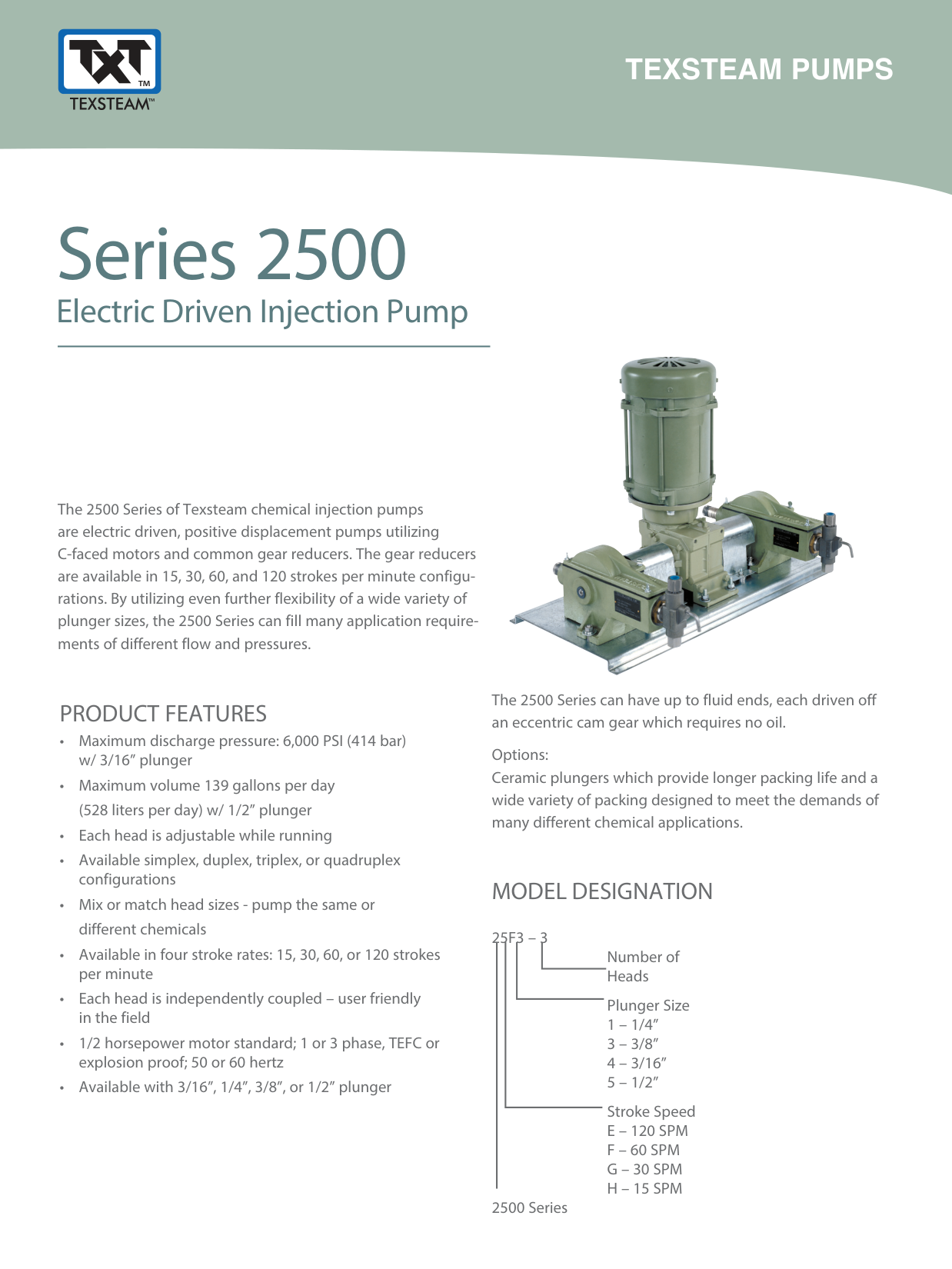
The Texsteam 2500 Series is an electrically driven positive displacement pump using C-faced motors and common gear reducers. Available in simplex, duplex, triplex, and quadruplex configurations with four plunger sizes and four stroke speeds.
- Max discharge pressure: 6,000 PSI (414 bar) with 3/16″ plunger
- Max volume: 139 gallons per day (528 L/day) with 1/2″ plunger at 120 SPM
- Each head independently adjustable while running
- Simplex, duplex, triplex, or quadruplex configurations
- Mix or match head sizes — pump same or different chemicals simultaneously
1. FLOW & PRESSURE SPECIFICATIONS
| Plunger Size | Strokes/Min | Max Discharge Pressure PSI (bar) | Max GPD (L/day) | Min GPD (L/day) |
|---|---|---|---|---|
| 3/16″ | 15 | 6,000 (414) | 2.4 (9) | 0.2 (1) |
| 30 | 6,000 (414) | 4.9 (19) | 0.5 (2) | |
| 60 | 6,000 (414) | 9.8 (37) | 1.0 (4) | |
| 120 | 4,000 (275) | 18.7 (71) | 1.9 (7) | |
| 1/4″ | 15 | 3,200 (221) | 4.3 (16) | 0.4 (2) |
| 30 | 4,000 (275) | 8.6 (33) | 0.9 (3) | |
| 60 | 4,000 (275) | 17.3 (65) | 1.7 (7) | |
| 120 | 2,100 (145) | 34.6 (131) | 3.5 (13) | |
| 3/8″ | 15 | 1,450 (100) | 9.8 (37) | 1.0 (4) |
| 30 | 1,800 (124) | 19.6 (74) | 2.0 (7) | |
| 60 | 1,700 (117) | 39.2 (148) | 3.9 (15) | |
| 120 | 950 (65) | 78.5 (297) | 7.8 (30) | |
| 1/2″ | 15 | 820 (56) | 17.4 (66) | 1.7 (7) |
| 30 | 1,025 (71) | 34.8 (88) | 3.5 (9) | |
| 60 | 1,000 (70) | 69.7 (264) | 7.0 (26) | |
| 120 | 525 (36) | 139.5 (528) | 13.9 (53) |
* For 50 Hz motors multiply volumes by 0.8
2. MAXIMUM PACKING PRESSURE BY MATERIAL
| Plunger Size | Buna-N PSIG (bar) | Hard PSIG (bar) | Viton PSIG (bar) | Teflon PSIG (bar) |
|---|---|---|---|---|
| 3/16″ | 3,000 (207) | 6,000 (414) | 3,500 (345) | 3,000 (207) |
| 1/4″ | 2,400 (165) | 4,000 (275) | 3,500 (240) | 2,400 (165) |
| 3/8″ | 1,500 (103) | 1,800 (124) | 3,500 (240) | 1,500 (103) |
| 1/2″ | 1,000 (69) | 1,025 (71) | 3,500 (240) | 1,000 (69) |
3. MODEL DESIGNATION
Example: 25F3 – 3
| 25 | = 2500 Series |
| E / F / G / H | = Stroke Speed: E=120 SPM, F=60 SPM, G=30 SPM, H=15 SPM |
| 1 / 3 / 4 / 5 | = Plunger Size: 1=1/4″, 3=3/8″, 4=3/16″, 5=1/2″ |
| – 1 to 4 | = Number of Heads |
4. ASSEMBLY CONFIGURATIONS
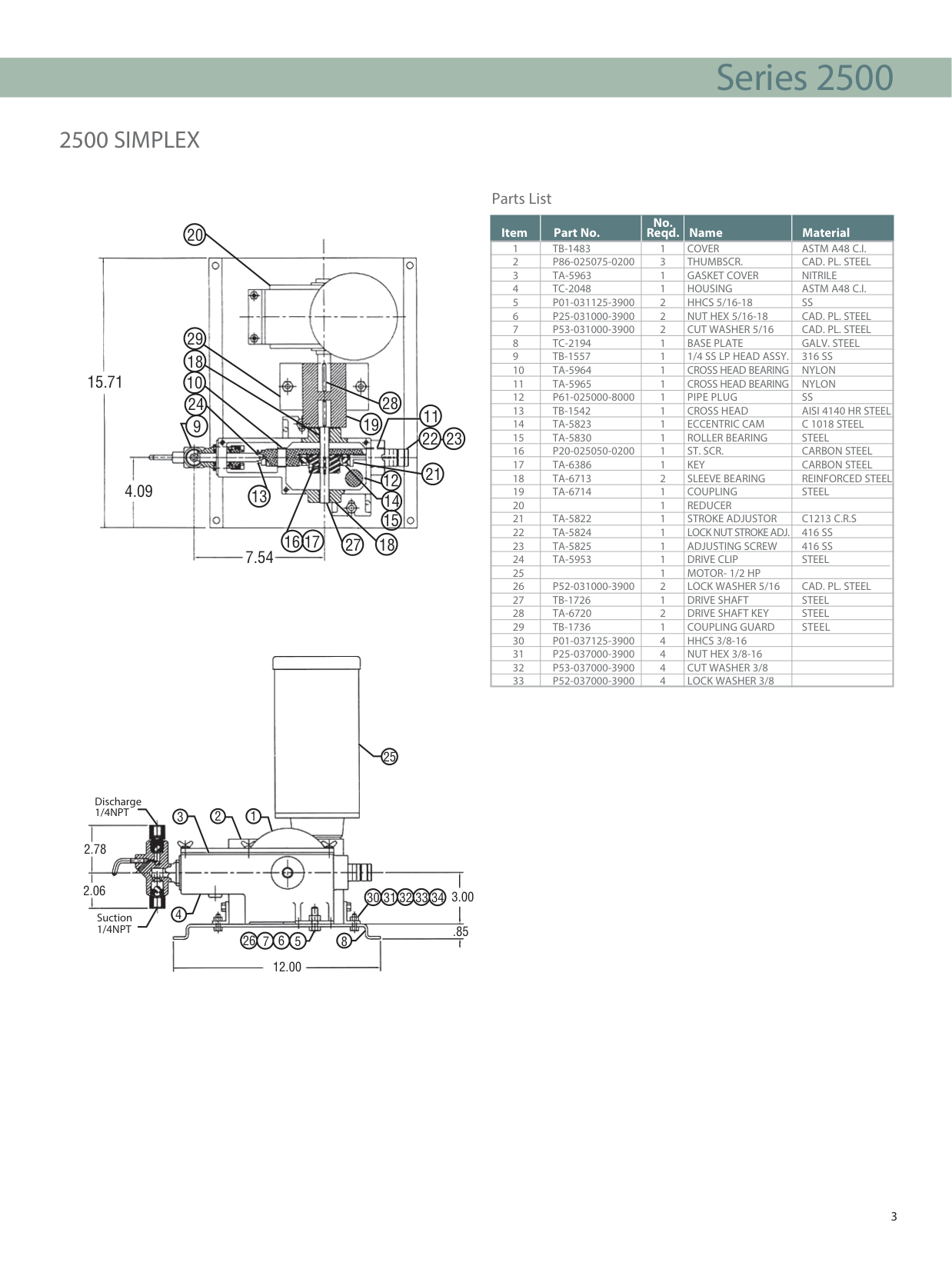
Simplex (Single Head)
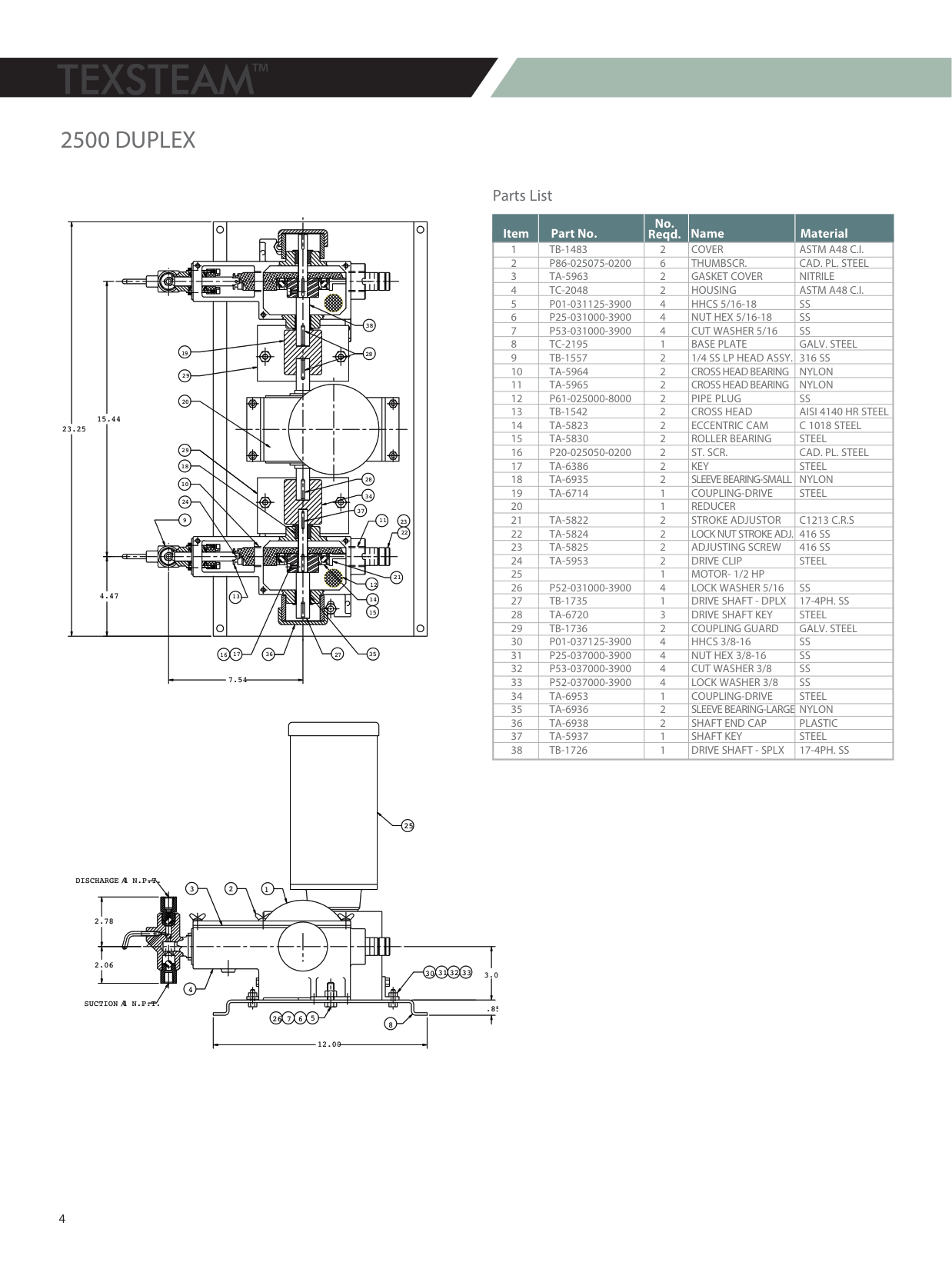
Duplex (Two Heads)
5. FLUID END PARTS BY PLUNGER SIZE
| Item | Description | Material | 3/16″ | 1/4″ | 3/8″ | 1/2″ |
|---|---|---|---|---|---|---|
| 1 | Body | SS | TC 2040 | TC 0291 | TC 0425 | TB 0349 |
| 2 | Gland Nut | 303-SS | TA 6353 (all sizes) | |||
| 3 | Plunger | 17-4PH | TA 6082 | TA 6079 | TA 6080 | TA 6081 |
| 4 | Gland | 303-SS | TA 5642 | TA 1463 | TA 0957 | TA 1219 |
| 5 | Plunger Packing — Buna-N | Buna-N | TA 3969 | TA 1461 | TA 1456 | TA 0959 |
| 5 | Plunger Packing — Hard | Hard | TA 3948 | TA 2295 | TA 1875 | TA 1874 |
| 5 | Plunger Packing — Viton | Viton | TA 3967 | TA 4102 | TA 4101 | TA 4103 |
| 5 | Plunger Packing — Teflon | Teflon | TA 3966 | TA 1642 | TA 1234 | TA 1012 |
| 9 | Head Assembly — 3/16″ | 316SS | TB-1560 | — | ||
| 9 | Head Assembly — 1/4″ | 316SS | — | TB-1557 | — | |
| 9 | Head Assembly — 3/8″ | 316SS | — | TB-1558 | — | |
| 9 | Head Assembly — 1/2″ | 316SS | — | TB-1559 | ||
6. KEY FEATURES
Pump Design
- Eccentric cam design — no oil required
- 316 SS heads standard
- Ceramic plunger option for longer packing life
- Each head independently coupled — field-friendly
- 1/2 HP motor standard; 1 or 3 phase, TEFC or explosion proof; 50 or 60 Hz
- Fluid connections: 1/4″ NPT suction (bottom) and discharge (top)
Maintenance
- Check gear reducer oil level before start-up
- Continuous run: oil change every 2,000 hours
- Intermittent: oil change every 2,500 running hours or 6 months
- Use Mobil SHC 634 (0°F to 135°F) or Texaco Meropia 460 (32°F to 100°F)
- Apply grease to cam bearing and crosshead monthly
- Do not over-tighten packing — can damage plunger