
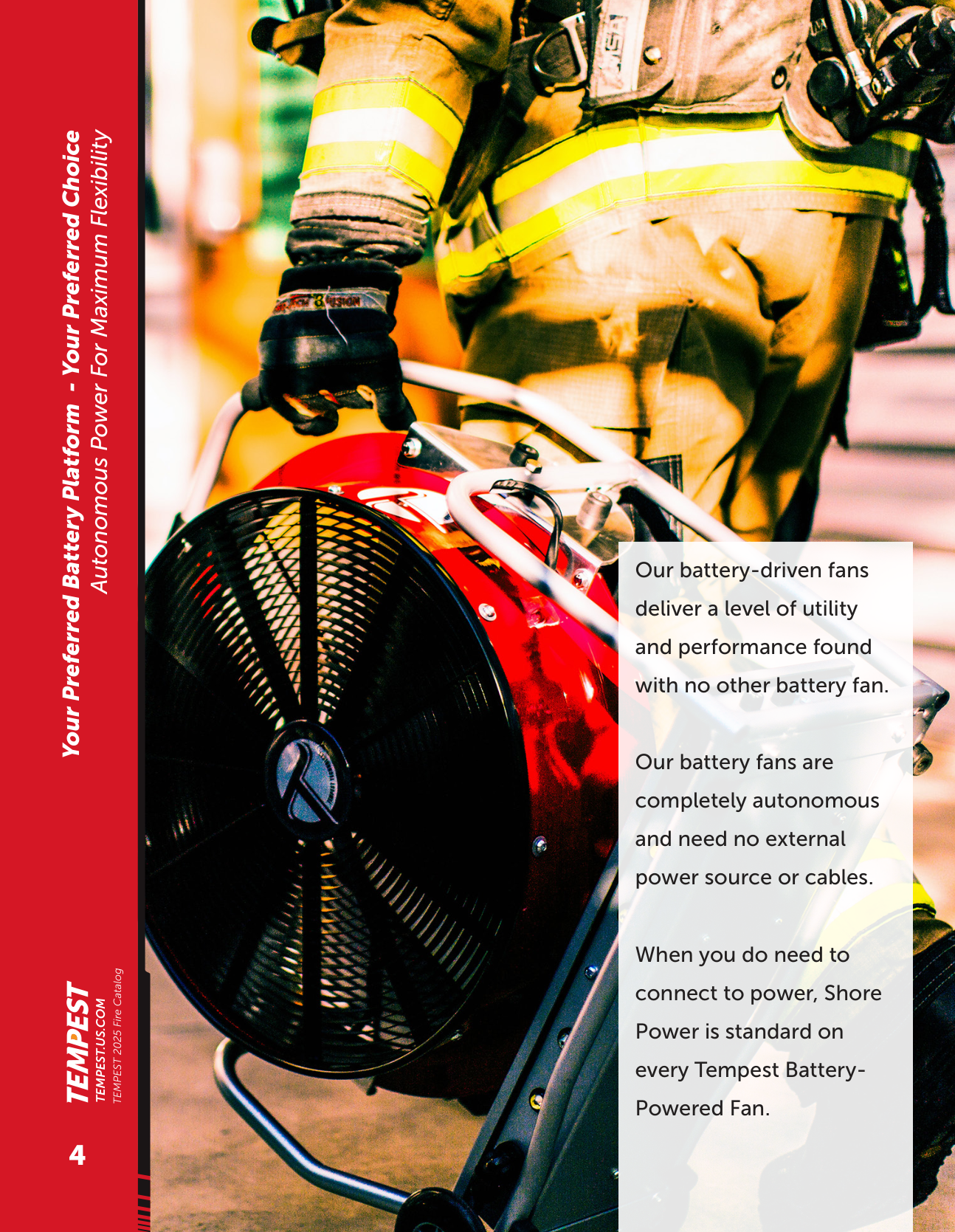
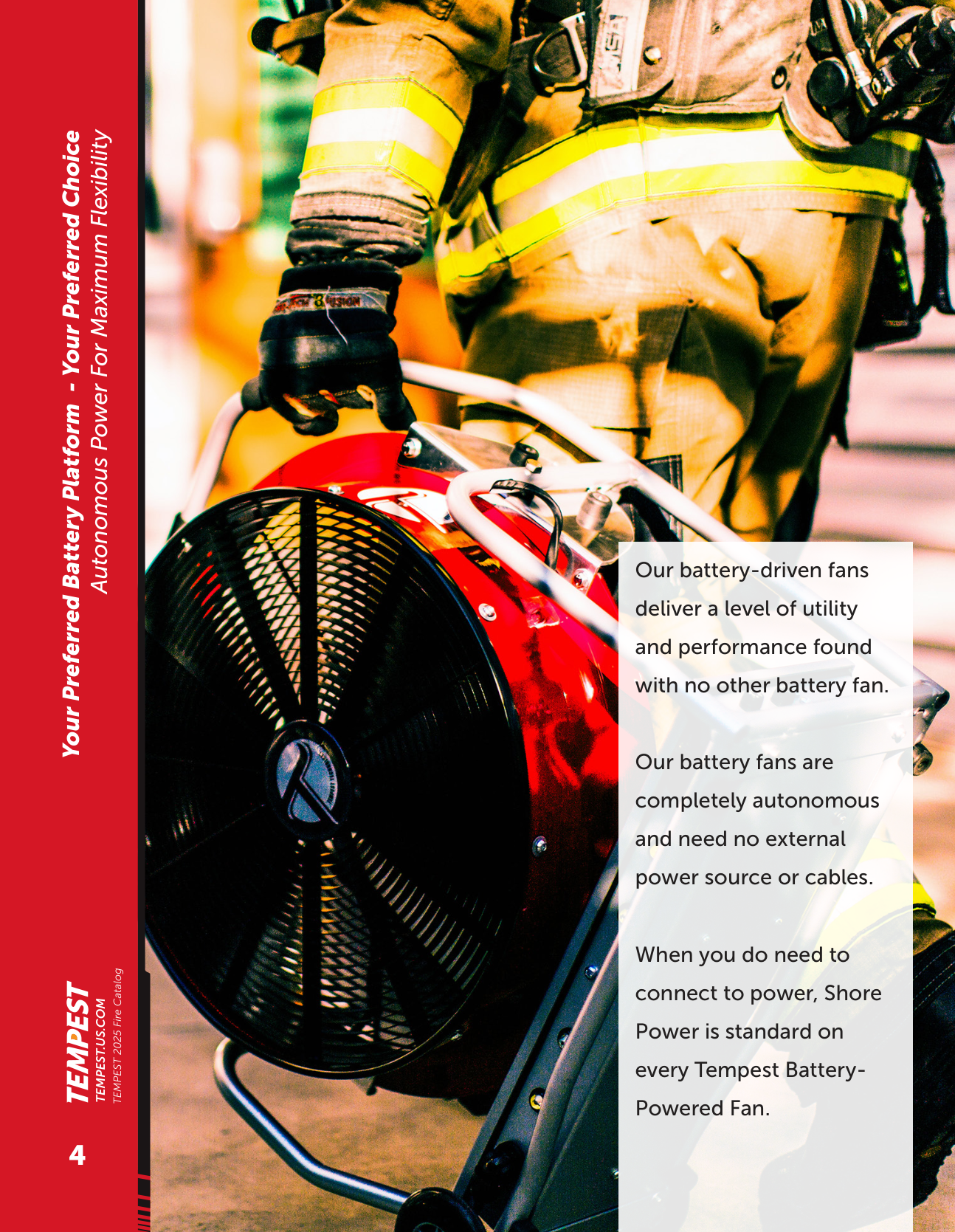
The fan dies at minute four of a working structure fire. The battery is proprietary, the spare is on a different apparatus, and the charger is back at the station. That failure mode is not hypothetical — it is the cost of running a PPV fleet fragmented across incompatible battery platforms. The Tempest VS-1.3M was built to close that gap. It delivers the same 9,614 CFM output as the rest of the VS-1.3 series, but it runs on the Milwaukee M18 REDLITHIUM HIGH OUTPUT HD12.0 battery that most departments are already carrying on their tools. One platform, one charger, no orphaned batteries sitting dead on a shelf.
What is the Tempest VS-1.3M and how does it differ from the standard VS-1.3?
The VS-1.3M is the Milwaukee M18-compatible variant of Tempest’s VS-1.3 battery-powered positive pressure ventilation fan. The core difference is the battery interface: the VS-1.3M accepts one to three Milwaukee M18 REDLITHIUM HIGH OUTPUT HD12.0 batteries rather than a Tempest-proprietary pack, allowing departments invested in the Milwaukee M18 platform to draw from their existing tool inventory.
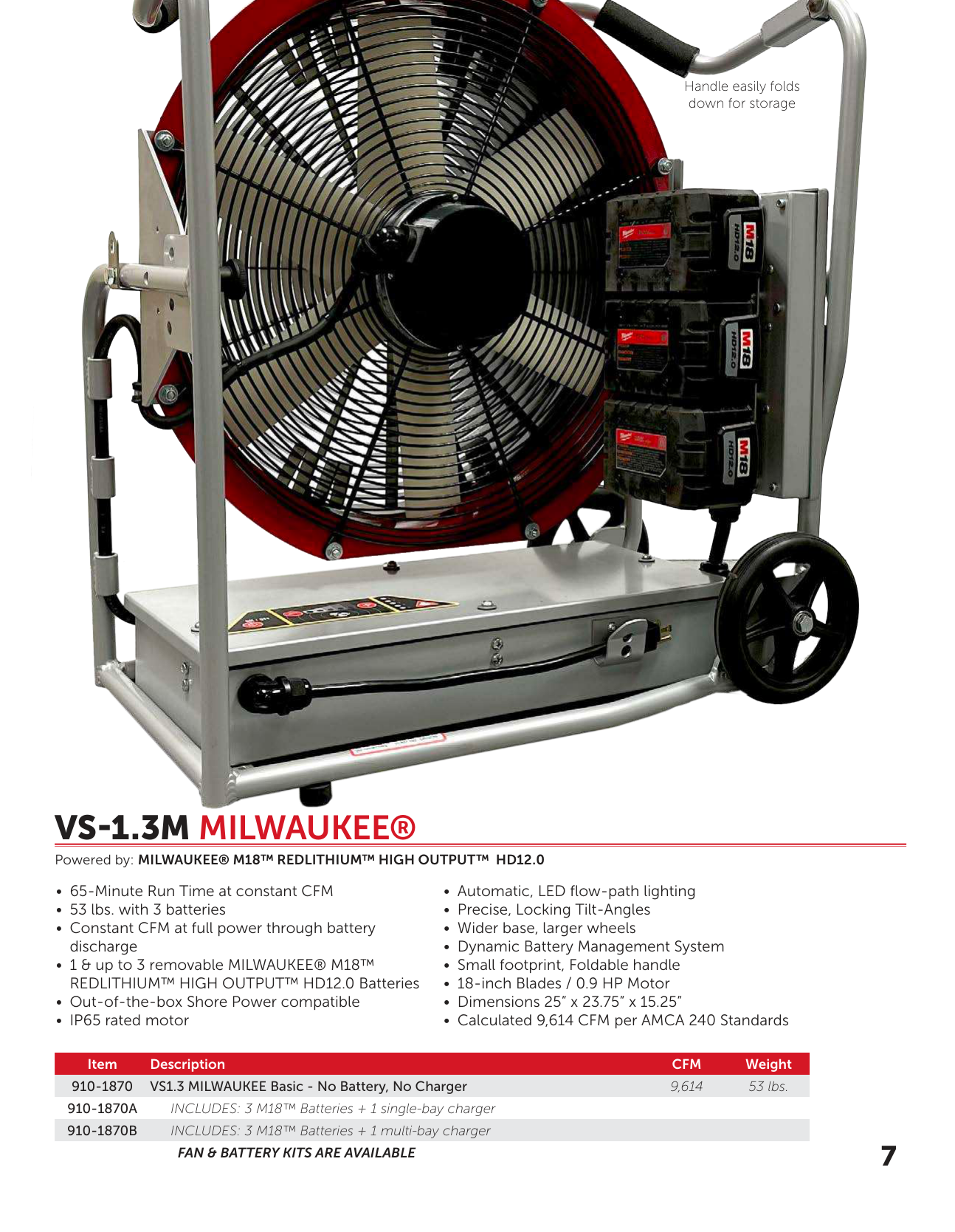
Airflow output is identical across variants at 9,614 CFM, driven by an 18-inch blade and a 0.9 HP motor. Weight is 53 lbs. with three batteries installed. The VS-1.3M is designed, fabricated, and built in the USA at Tempest’s Fresno, California facility, which is consistent across the VS-1.3 product family. Shore Power compatibility is included out of the box on the VS-1.3M, a feature that distinguishes it from base-configuration gas and corded fans entirely.
How long does the Tempest VS-1.3M run on a single Milwaukee M18 battery?
On a single Milwaukee M18 REDLITHIUM HIGH OUTPUT HD12.0 battery, the VS-1.3M delivers 65 minutes of constant CFM at full power. That is the longest single-battery runtime in the VS-1.3 Milwaukee-compatible series.
The fan accepts one to three batteries simultaneously, so runtime extends in proportion to battery count. For extended overhaul operations, training evolutions, or industrial ventilation deployments that run beyond 65 minutes, the Shore Power connection provides unlimited runtime on AC power without any battery management. The multi-battery capacity also functions as a practical hedge against arriving on scene with a partially depleted pack — the fan draws from available capacity across all installed batteries rather than relying on a single fully charged cell.
What does IP65 mean for the VS-1.3M motor, and why does it matter on the fire ground?
IP65 is an ingress protection rating defined under IEC 60529. The first digit, 6, means the enclosure is completely dust-tight. The second digit, 5, means the motor withstands water projected from a nozzle in any direction without harmful ingress. On the fire ground, that combination matters because PPV fans operate directly in the path of hose stream runoff, foam application residue, and airborne particulate from structural collapse.
Many battery-powered fans in this class use motors rated only to IP44 or IP54, which permit limited dust ingress and splash protection but are not rated for directed water jets. The VS-1.3M’s IP65-rated motor removes water-jet exposure from the failure-mode list, which is meaningful for departments that routinely place fans in doorways where charged lines are operating nearby. Motor replacement on a PPV fan is a significant maintenance cost and an out-of-service event — IP65 reduces the frequency of both.
Why does base stability and wheel design affect PPV fan performance?
A PPV fan that tips over mid-operation or has to be manually repositioned repeatedly introduces two problems: it breaks the pressure cone at the entry point, reducing ventilation effectiveness, and it takes a firefighter off primary tasks to manage equipment. The VS-1.3M addresses this with a wider base geometry and larger wheels compared to standard VS-series configurations.
Larger wheels roll over debris fields, hose lines, and rough terrain that would stop a smaller-diameter wheel flat. On residential fire grounds, the surface at the front door is rarely clean concrete — it is commonly a mix of wet grass, hose lays, debris thrown during forcible entry, and uneven paving. A fan that stays positioned where it was set delivers consistent airflow through the structure. A fan that has to be moved or propped wastes time and dilutes the pressure differential that positive pressure ventilation depends on to move smoke out of a defined exit opening.
How does automatic LED flow-path lighting improve fan placement accuracy?
The VS-1.3M includes automatic LED lighting that illuminates the airflow path at the fan face. The LEDs activate without a separate switch, giving the placing firefighter a visible reference for centering the pressure cone on the entry opening in low-visibility conditions.
Accurate fan placement is not cosmetic. PPV effectiveness is directly tied to covering between 85 and 100 percent of the entry opening with the airflow cone. An off-center or improperly distanced fan allows ambient air to short-circuit around the cone, reducing the pressure differential inside the structure and slowing smoke clearance. In smoke-filled exterior conditions at night or in heavy weather, placing a fan by feel rather than visible reference introduces positioning error. The LED flow-path lighting reduces that error without requiring additional lighting equipment or a second firefighter to guide placement.
When should a department choose the VS-1.3M over a gas-powered PPV fan?
A battery-powered PPV fan eliminates exhaust emissions inside or at the threshold of a structure, removes the gasoline storage and fuel maintenance requirement from the apparatus, and reduces mechanical complexity. Gas PPV fans require carburetor maintenance, fuel stabilizer management for reserve units, and startup procedures under pressure. The VS-1.3M starts on a button press.
The relevant trade-off is runtime under heavy sustained use. A gas fan runs as long as there is fuel. The VS-1.3M’s 65-minute ceiling on a single battery is sufficient for most residential structural operations, and Shore Power removes the ceiling for training and industrial use. Departments conducting multi-hour ventilation operations on large commercial structures without accessible AC power should evaluate whether their expected operational duration fits within the battery capacity available on the apparatus. The When Every Second Counts, Your PPV Fan Just Died resource covers the cost of battery-related PPV failure in operational context and is worth reviewing before making a platform decision.
What ordering configurations are available for the Tempest VS-1.3M?
Tempest offers three SKUs for the VS-1.3M, allowing departments to match the order to their existing Milwaukee M18 inventory. Item 910-1870 is the base fan with no batteries or charger included — the right choice for departments that already stock Milwaukee M18 REDLITHIUM HIGH OUTPUT HD12.0 batteries across their tool inventory. Item 910-1870A includes three M18 batteries and one single-bay charger. Item 910-1870B includes three M18 batteries and one multi-bay charger.
All three configurations deliver identical performance: 9,614 CFM, 53 lbs. with three batteries, IP65 motor, Shore Power included, and the same wider base and larger-wheel chassis. The choice between SKUs is purely a battery and charger procurement decision, not a performance trade-off. Departments evaluating total cost of ownership should account for the Milwaukee M18 batteries they already carry — the VS-1.3M turns that existing capital into PPV runtime at no incremental cost. For full technical detail, the Tempest VS-1.3M Tech Series Powered by MILWAUKEE product page carries complete specifications and ordering information.
Where is the Tempest VS-1.3M used in the field?
The VS-1.3M is deployed in positive pressure attack ventilation at residential and light commercial structure fires, post-fire overhaul ventilation to clear residual smoke from occupied spaces, fire academy and department training evolutions, and industrial facility ventilation tasks where portable high-flow equipment is needed without a generator or hardwired power connection.
Shore Power compatibility extends the VS-1.3M’s utility to fixed-station training bays and industrial applications where an AC outlet is available and indefinite runtime is required. For apparatus already running the Milwaukee M18 platform across tools, the VS-1.3M slots into the battery logistics structure without adding a new charging system to the apparatus bay. Departments evaluating the full Tempest battery PPV lineup can review the Tempest VS-1.3M Tech Series Powered by MILWAUKEE product page for side-by-side configuration options. Departments weighing battery platform risk in operational contexts should also review When Every Second Counts, Your PPV Fan Just Died for a direct analysis of what happens when PPV equipment fails mid-operation.
For departments specifically concerned with NFPA 1901 automotive fire apparatus standards and apparatus compartment space allocation, the VS-1.3M’s 53-lb. weight and Milwaukee M18 platform compatibility reduce the compartment footprint for fan support equipment compared to multi-charger proprietary systems.
When is the Tempest VS-1.3M the right call, and when is it not?
The VS-1.3M is the right choice when a department already operates on the Milwaukee M18 tool platform, needs 9,614 CFM from a battery-powered fan without adding a new charging ecosystem, and wants Shore Power available for training and overhaul without a separate corded fan. The IP65 motor rating makes it appropriate for dirty, wet fire ground conditions where less-sealed motors would accumulate damage over time.
It is not the right choice for departments on a different battery platform who would be buying Milwaukee M18 inventory solely to run this fan. In that scenario, Tempest’s proprietary-battery VS-1.3 variants or a Shore Power-only corded fan may offer lower total cost. It is also not the right choice for sustained multi-hour operations in locations without AC access where battery capacity exceeds what can be carried on the apparatus. For those edge cases, a gas-powered large-diameter PPV fan remains the practical solution. Within its designed operational envelope, the VS-1.3M eliminates the proprietary battery problem that has stranded departments mid-ventilation and delivers the runtime, output, and platform compatibility to make battery PPV a reliable primary tool rather than a backup option.
Tempest Fire
VS-1.3M Milwaukee® Battery PPV Fan
Milwaukee® M18™ Compatible | 9,614 CFM | 65-Minute Run Time | Made in USA
Overview
The Tempest VS-1.3M is the Milwaukee® M18™ platform version of the VS-1.3 battery PPV fan. It accepts 1 to 3 Milwaukee® M18™ REDLITHIUM™ HIGH OUTPUT™ HD12.0 batteries — delivering 9,614 CFM for up to 65 minutes on a single charge, or extended runtime with multiple batteries.
Departments already running Milwaukee M18 tools can leverage their existing battery inventory. Shore Power compatible out of the box, with a wider base and larger wheels for stability on uneven terrain.
Key Features
65-Minute Run Time
Longest run time in the Milwaukee-compatible VS-1.3 series — 65 minutes of constant CFM at full power. Extend further with 2nd and 3rd batteries.
Milwaukee® M18™ Platform
Accepts 1 to 3 Milwaukee® M18™ REDLITHIUM™ HIGH OUTPUT™ HD12.0 batteries. Eliminate proprietary charging — use the same platform already on your apparatus.
IP65 Rated Motor
Dust-tight, water-jet resistant motor for reliable operation in fire ground conditions.
Wider Base & Larger Wheels
Enhanced stability on uneven fire ground surfaces. Larger wheels improve maneuverability over debris, hose lines, and rough terrain.
Shore Power Compatible
Out-of-the-box Shore Power for unlimited runtime on AC power — ideal for extended training, overhaul, and industrial ventilation applications.
Automatic LED Flow-Path Lighting
LEDs automatically illuminate the airflow path for precise fan placement in low-visibility environments.
Models & Ordering Information
| Item No. | Description | CFM | Weight |
|---|---|---|---|
| 910-1870 | VS1.3 MILWAUKEE Basic — No Battery, No Charger | 9,614 | 53 lbs. |
| 910-1870A | Includes: 3 M18™ Batteries + 1 Single-Bay Charger | 9,614 | 53 lbs. |
| 910-1870B | Includes: 3 M18™ Batteries + 1 Multi-Bay Charger | 9,614 | 53 lbs. |
Technical Specifications
| Type | Battery-Powered PPV Fan — Milwaukee® M18™ Platform |
| Airflow | 9,614 CFM |
| Blade Size | 18-inch Blades |
| Motor | 0.9 HP |
| Compatible Battery | Milwaukee® M18™ REDLITHIUM™ HIGH OUTPUT™ HD12.0 (1 to 3 batteries) |
| Run Time | 65 Minutes at Constant CFM (single battery) |
| IP Rating | IP65 (Motor) |
| Shore Power | Standard (out of box) |
| Tilt | Precise Locking Tilt-Angles |
| Lighting | Automatic LED Flow-Path Lighting |
| Weight | 53 lbs. (with 3 batteries) |
| Origin | Designed, Fabricated & Built in the USA |
Manufacturer: Tempest — 4708 N. Blythe Avenue, Fresno, California 93722 USA — tempest.us.com