
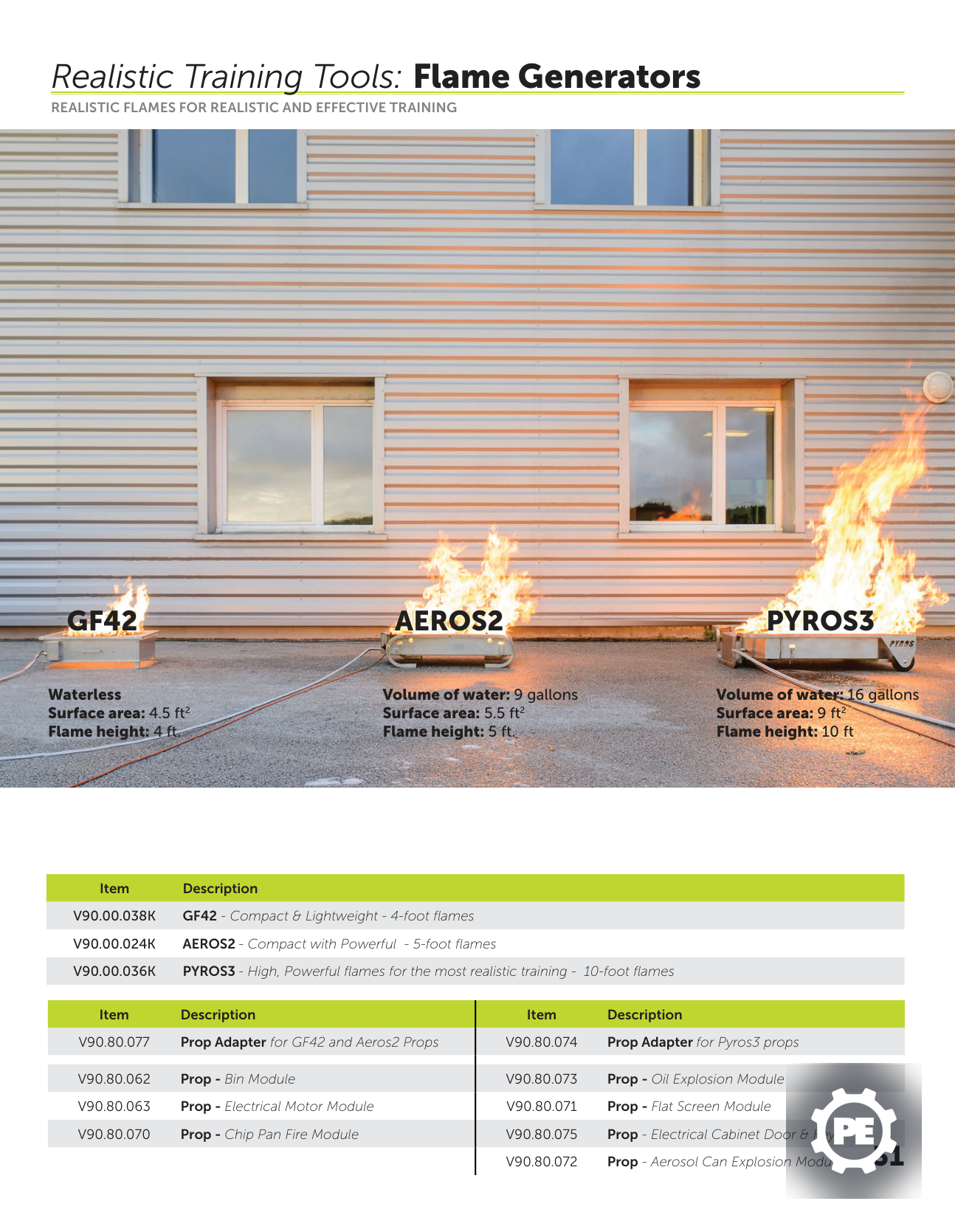
Most fire training programs are held back by the same problem: the fire is not realistic enough to trigger the instincts you need to build, or it cannot be repeated identically from one trainee to the next. Burn barrels and sacrificial structures create uncontrolled combustion, variable heat output, and safety hazards that complicate the training objective. The Tempest flame generator line solves this directly. Three purpose-built units, from the compact GF42 at 4-foot flames to the PYROS3 at 10-foot flames, deliver actual fire with actual heat in a controlled, repeatable format that pairs with seven scenario-specific training props covering the exact fire types departments encounter on structure responses.
What is a Tempest flame generator and how does it differ from traditional fire training methods?
A Tempest flame generator is a propane-fed, controlled-output device that produces real flames and real thermal output in a managed, repeatable format. Unlike burn buildings or fuel-soaked props, the flame generator gives an instructor precise control over fire size, making it possible to stop or restart a scenario instantly without resetting a burned structure.
Traditional live-fire methods under NFPA 1403, the standard on live-fire training evolutions, require extensive documentation, structural integrity assessments, and post-burn debris management. Controlled flame generators reduce that administrative and logistical burden while still delivering the thermal and visual cues that build muscle memory in firefighters. The Tempest lineup, manufactured at 4708 N. Blythe Avenue, Fresno, California, is designed specifically to meet the operational demands of modern training programs that run multiple evolutions per day.
What are the differences between the GF42, AEROS2, and PYROS3 flame generators?
The three models in the Tempest line are separated by flame output and physical size, which directly determines whether they fit indoor classroom use, covered training bays, or full open-air tower evolutions. Choosing the wrong output level means either under-challenging trainees or introducing a fire size that outpaces the hoselines or extinguishers being used in the exercise.
The Leader GF42 Flame Generator (item V90.00.038K) produces 4-foot flames and is described as compact and lightweight, making it the correct selection for portable extinguisher training, classroom props, and introductory fire attack exercises where trainees are learning approach distance and attack angle before advancing to larger fires. The Leader AEROS 2 Flame Generator (item V90.00.024K) steps up to 5-foot flames while remaining compact, filling the gap between introductory and intermediate training without requiring an outdoor pad. The Leader PYROS 3 Flame Generator (item V90.00.036K) reaches 10-foot flames, the output level Tempest identifies as producing the most realistic training evolution, appropriate for hoseline attack training, advanced crew coordination exercises, and scenarios where thermal stress on trainees must approximate real structure fire conditions.
Which scenario-specific training props are compatible with Tempest flame generators?
One of the most significant limitations of generic propane training fires is that they do not replicate the specific fuel geometries and ignition signatures that firefighters encounter on actual calls. Tempest addresses this with seven prop modules that attach to the flame generators via size-matched adapters, each simulating a distinct fire type.
The full prop lineup includes the Bin Module (V90.80.062), Oil Explosion Module (V90.80.073), Electrical Motor Module (V90.80.063), Flat Screen Module (V90.80.071), Chip Pan Fire Module (V90.80.070), and Electrical Cabinet Door and Key (V90.80.075). The GF42 and AEROS2 use the Prop Adapter V90.80.077; the PYROS3 uses a separate adapter, V90.80.074, sized for its larger output. This matters operationally: the Chip Pan Fire Module replicates a cooking oil fire, which has a distinct flame spread pattern and requires a different attack approach than the Electrical Cabinet scenario, where trainees must identify energized equipment hazards before applying suppression. The Electrical Motor Module adds the visual cue of an energized motor housing, reinforcing the decision-making process for Class C fires. The Oil Explosion Module introduces an elevated-intensity event, allowing instructors to simulate rapid fire development within a controlled envelope.
How do Tempest flame generators support repeatable, assessable fire training?
Repeatability is the core mechanical advantage of controlled flame generators over natural fuel fires. When every trainee faces an identical fire size, fuel configuration, and flame behavior, the variable being measured is trainee performance rather than fire variability.
The Tempest system delivers identical fire scenarios across consecutive evolutions, which is essential for skills assessment programs where instructors need to compare how different crews or individuals respond to the same fire condition. In a burn building, no two evolutions produce the same thermal profile because the structure degrades with each use. With the GF42, AEROS2, or PYROS3, the same chip pan fire or electrical cabinet fire can be run back-to-back for an entire training class without structural repair, fuel bed replacement, or environmental variable shifts. This also reduces instructor overhead: setup between evolutions requires resetting the prop, not rebuilding a burn room. For departments running annual certification recertifications or multi-station training days, that efficiency directly affects how many evolutions can be completed in a training day.
What fire suppression skills can be trained with the GF42, AEROS2, and PYROS3?
The three output levels map directly to two distinct training tracks: portable extinguisher training at smaller flame sizes and hoseline attack training at larger flame outputs. Mixing up the pairing, for example using a PYROS3 10-foot flame with a portable extinguisher evolution, creates a training scenario that does not reflect safe or realistic extinguisher use.
The GF42 at 4-foot flames is the correct tool for portable extinguisher training, where trainees practice PASS technique, proper approach distance, and discharge angle on a fire that a portable extinguisher can realistically suppress. The AEROS2 at 5-foot flames sits at the boundary between extinguisher and hoseline training, making it versatile for intermediate scenarios. The PYROS3 at 10-foot flames is explicitly suited to hoseline attack training, where crews practice coordinated nozzle advancement, flow rates, and team movement under realistic thermal conditions. The thermal output at 10 feet generates actual heat stress, which builds the physiological conditioning and decision-making under stress that no simulation software or low-heat prop can replicate. Scenario-specific props further refine the skill set: the Flat Screen Module trains the recognition that flat-screen televisions present a unique fire and electrical hazard, while the Oil Explosion Module tests crew response to rapid fire development.
How do Tempest flame generators fit into a complete training facility setup?
A flame generator alone produces fire. A complete training environment pairs fire with smoke, realistic props, and scenario complexity that forces trainees to make decisions rather than just execute suppression technique. Tempest manufactures across both areas, and the flame generator line is designed to integrate with smoke-generation equipment that fills the training space with reduced-visibility conditions.
Adding a Tempest Dusk Smoke Generator to a PYROS3 evolution replicates the combination of thermal output and zero-visibility conditions that characterize interior structure fires, elevating the cognitive and physiological demand of the training exercise significantly beyond what a flame alone provides. The GF42 and AEROS2 pair effectively with smoke in confined indoor training bays for enclosed-space fire scenarios. The compact footprint of both smaller units means they can be repositioned between stations without heavy rigging, supporting multi-scenario training days where different prop configurations are set up simultaneously. Departments building or upgrading a training facility should review the full Training Equipment Catalog at PE-Energy Industrial to identify compatible props, adapters, and smoke equipment that complete the training environment rather than purchasing flame generators in isolation.
Where are Tempest flame generators used, and what applications are outside their range?
Tempest flame generators are used by municipal fire departments, industrial fire brigades, military fire rescue units, and fire training academies running recurring certification and skills-maintenance programs. The scenario-specific props make them especially well suited to departments whose response district includes commercial kitchens (Chip Pan Fire Module), light industrial facilities with electrical equipment (Electrical Motor Module, Electrical Cabinet Door and Key), and residential or commercial structures with consumer electronics (Flat Screen Module).
The GF42 is commonly deployed at community safety events, junior firefighter programs, and basic extinguisher certification courses where participants need hands-on fire contact with a flame size that portable extinguishers can control. The PYROS3 belongs in dedicated outdoor training towers and large training bays where its 10-foot output can develop freely without ceiling or overhead obstruction creating unintended hazards. Industrial fire brigades running scenario-based training for petrochemical or manufacturing facility fires use the Oil Explosion Module and Electrical Motor Module to replicate the specific hazards present in their facilities, which generic training fires do not address.
These units are not substitutes for confined-space rescue training, vehicle fire suppression training, or wildland fire behavior training. Those applications require different tools, fuel configurations, and prop geometries. Tempest flame generators are optimized for structural, appliance, and equipment fire scenarios in controlled training environments.
When is a Tempest flame generator the right call, and when is it not?
The Tempest GF42, AEROS2, and PYROS3 are the right call when a department needs controlled, repeatable, scenario-specific fire training that produces real flames and real heat without the structural degradation, administrative overhead, and variability of traditional burn buildings. When training objectives include extinguisher technique, hoseline attack, crew coordination under thermal stress, or scenario-specific recognition and decision-making for kitchen fires, electrical fires, or industrial equipment fires, the Tempest flame generator system provides the controlled environment to build and assess those skills consistently.
They are not the right call for departments that need to train interior search and rescue in a degraded structural environment, or for programs that require large-scale exterior suppression training on burning vehicles or wildland fuel models. For those applications, different equipment categories apply. But for the full range of structural and appliance fire scenarios that make up the majority of a typical department’s response profile, the three-unit Tempest line, paired with its seven scenario-specific props and compatible smoke generation equipment, covers the training requirements that matter most.
Tempest Fire Training
Flame Generators for Fire Training
GF42 | AEROS2 | PYROS3 | 4–10 Foot Flames | Realistic Training Props
Overview
The Tempest flame generator line provides realistic, controlled fire for firefighter training scenarios. Three units cover the full range of training intensity: the GF42 (compact, 4-foot flames), AEROS2 (powerful, 5-foot flames), and PYROS3 (high-power, 10-foot flames for the most realistic training). All three are compatible with a comprehensive range of training props for scenario-specific fire simulation.
Available training prop scenarios include chip pan fires, electrical fires, oil explosion modules, bin module fires, flat screen fires, and electrical cabinet scenarios — enabling departments to train for the specific fire types their crews will face in the field.
Key Features
Three Output Levels
GF42: compact and lightweight, 4-foot flames for basic fire attack training. AEROS2: compact with powerful 5-foot flames. PYROS3: high, powerful flames for the most realistic training evolution — 10-foot flames.
Scenario-Specific Props
Compatible with 7 training props: Bin Module, Oil Explosion Module, Electrical Motor Module, Flat Screen Module, Chip Pan Fire Module, Electrical Cabinet Door & Key, and Prop Adapters for each generator size.
Controlled Realistic Fire
Produce realistic fire behavior in a controlled training environment — actual flames, realistic heat, and visual cues that simulate live fire without the uncontrolled hazards of natural fuel fires.
Repeatable Training Scenarios
Identical fire scenarios can be repeated consistently — essential for skills assessment, ensuring every trainee faces the same challenge and instructors can compare performance objectively.
Extinguisher & Hoseline Training
Compatible with extinguisher training at small fire sizes and hoseline attack training at larger sizes. Train proper attack angles, flow rates, and approach distances on realistic fires.
Compact & Versatile
The GF42 and AEROS2 are compact enough for indoor training facilities and classroom demonstrations. The PYROS3 delivers outdoor training-tower level realism for advanced evolutions.
Models & Ordering Information
| Item No. | Description |
|---|---|
| Flame Generators | |
| V90.00.038K | GF42 — Compact & Lightweight — 4-Foot Flames |
| V90.00.024K | AEROS2 — Compact with Powerful — 5-Foot Flames |
| V90.00.036K | PYROS3 — High, Powerful Flames for Most Realistic Training — 10-Foot Flames |
| Training Props | |
| V90.80.077 | Prop Adapter for GF42 and AEROS2 Props |
| V90.80.074 | Prop Adapter for PYROS3 Props |
| V90.80.062 | Prop — Bin Module |
| V90.80.073 | Prop — Oil Explosion Module |
| V90.80.063 | Prop — Electrical Motor Module |
| V90.80.071 | Prop — Flat Screen Module |
| V90.80.070 | Prop — Chip Pan Fire Module |
| V90.80.075 | Prop — Electrical Cabinet Door & Key |
Manufacturer: Tempest — 4708 N. Blythe Avenue, Fresno, California 93722 USA — tempest.us.com