
Standard positive pressure ventilation fans handle residential structure fires well enough. But put a company in front of a 100,000-square-foot warehouse, a multi-story industrial complex, or a high-rise corridor choked with smoke, and the gap between “adequate” and “effective” becomes a life-safety issue. The Tempest Special Operations (SP) series was built specifically for those scenarios where the standard product line runs out of runway — delivering up to 19,936 CFM from a 21-inch fan powered by an 8.5 HP Honda gasoline engine, with a variable speed electric alternative for environments where combustion exhaust cannot enter the structure. These are not general-purpose fans given a new label. They are purpose-engineered for the edge cases that end careers when the wrong equipment shows up.
What is the Tempest Special Operations PPV fan series and how does it differ from standard PPV fans?
The Tempest SP series is a line of positive pressure ventilation fans designed for fire ground scenarios that exceed the performance envelope of standard residential or light commercial fans. The series includes three models spanning 18-inch and 21-inch blade diameters, available in Honda gasoline or variable speed electric power configurations, with a CFM range of 15,792 to 19,936.
Where a typical residential PPV fan might push 8,000 to 12,000 CFM from a 4 to 5 HP engine, the SP-21-H-8.5 doubles the output with an 8.5 HP Honda engine producing 19,936 CFM from a 21-inch blade. The SP series fills the operational space between standard apparatus fans and full industrial ventilation equipment, which typically requires permanent installation or three-phase power. All three SP models include a foldable handle for apparatus storage, keeping the larger footprint manageable in tight compartments. Manufacturing is performed at Tempest’s Fresno, California facility, meaning quality control and component sourcing remain under domestic oversight.
How much airflow do the Tempest SP series models deliver, and which scenarios require each output level?
The SP series spans two CFM output levels: 15,792 CFM for the 18-inch models (both gas and electric) and 19,936 CFM for the 21-inch Honda model. Selecting between them depends on structure volume, opening geometry, and the acceptable time-to-clearance for a given incident type.
The SP-18-H-5.5 (item 910-1620) runs a Honda 5.5 HP gasoline engine, produces 15,792 CFM, and weighs 88 lbs., making it the lightest of the three at a practical one- to two-firefighter carry weight. The SP-18-V-2.0 (item 910-1720) matches that 15,792 CFM output through a 2.0 HP variable speed electric motor at 110V/60Hz, with the added capability to modulate airflow — useful in confined industrial spaces where over-pressurizing a zone creates safety hazards. The SP-21-H-8.5 (item 910-1640) tops the lineup at 19,936 CFM from its 8.5 HP Honda engine, carrying a 122 lb. weight that reflects the larger blade assembly and engine mass. Large open-plan warehouses, underground parking structures, and multi-story commercial buildings are the primary scenarios where that near-20,000 CFM output justifies the additional handling requirement.
When should a fire department choose the variable speed electric SP-18-V-2.0 over the gasoline-powered models?
The variable speed electric SP-18-V-2.0 is the correct choice when combustion exhaust from a gasoline engine cannot be introduced into the ventilation stream or the surrounding environment. Hospitals, pharmaceutical manufacturing floors, food processing facilities, and occupied high-rise buildings are the clearest examples.
Beyond the no-exhaust requirement, the variable speed control on the SP-18-V-2.0 provides a capability the Honda models cannot match: adjustable CFM output without shutting down and repositioning the fan. In industrial environments with strict airflow requirements — cleanrooms, chemical storage areas, or HVAC-integrated structures where pressure differentials matter — the ability to dial in a specific airflow rate without guesswork is operationally significant. The electric model operates on standard 110V/60Hz power, which is available from apparatus-mounted inverters or on-site electrical panels in most commercial and industrial occupancies. At 103 lbs., the SP-18-V-2.0 is slightly heavier than the 5.5 HP Honda version due to the motor and control electronics, but it remains a manageable two-person carry. For departments responding regularly to industrial or institutional occupancies, the electric model is not an optional upgrade — it is the functionally correct tool for those environments.
What makes the Honda engine a reliable power source for the SP-21-H-8.5 and SP-18-H-5.5 gasoline models?
Honda small engines are widely specified in fire service portable equipment because of their cold-start reliability, parts availability, and established service network across North America. The SP series leverages this platform in two displacements: 5.5 HP for the 18-inch model and 8.5 HP for the 21-inch model.
The 8.5 HP configuration is notable because it achieves near-20,000 CFM output — 19,936 CFM — while remaining a self-contained, apparatus-deployable unit. No external power source is required, which matters during large-scale incidents where electrical infrastructure may be compromised or unavailable. The gasoline models also offer full-power operation from the first pull regardless of ambient temperature, a characteristic that matters during cold-weather deployments where electric motors drawing from inverters may experience reduced available current. Honda’s overhead valve (OHV) engine architecture contributes to fuel efficiency at high load, allowing sustained high-CFM operation without rapid fuel consumption at extended incidents. Departments already maintaining Honda-powered hydraulic tools, generators, or other apparatus-mounted equipment benefit from shared technician familiarity and parts commonality in the supply chain.
How does the foldable handle design affect apparatus storage and deployment logistics?
The foldable handle on all three SP series models reduces the stored profile of the fan, allowing it to fit in apparatus compartments that would otherwise be too shallow for a fixed-handle fan of this output class. This is a direct response to the reality that apparatus compartment space is one of the most constrained resources in fire department equipment specification.
At 122 lbs. and a 21-inch blade diameter, the SP-21-H-8.5 is a physically large piece of equipment. Without a foldable handle, storing it on a standard engine or rescue company would require dedicating a full-depth exterior compartment or a hosebed space — both unacceptable tradeoffs on most apparatus configurations. The foldable handle collapses the vertical profile so the fan can be positioned horizontally in a standard lower compartment. The SP-18-H-5.5, at 88 lbs., benefits similarly: its lighter weight makes it a candidate for upper compartments that a 122 lb. unit could not occupy safely. Deployment speed is also preserved because unfolding the handle at the scene is a seconds-long operation that does not require tools. For departments evaluating whether the SP series fits their current apparatus configuration, the foldable handle is often the specification detail that makes the difference between a yes and a no in the procurement decision.
What types of fire ground scenarios is the Tempest SP series specifically engineered to address?
The SP series addresses four primary scenario categories where standard PPV fans are insufficient: large open-plan structures, high-rise ventilation, high-volume confined space clearance, and complex industrial layouts with unusual geometry or airflow restrictions.
Large warehouses and distribution centers present the most direct application for the SP-21-H-8.5’s 19,936 CFM output. These structures have high cubic footage, wide door openings that benefit from a larger blade sweep, and limited natural ventilation pathways that require forced-air volume to achieve clearance. High-rise ventilation is where the variable speed electric SP-18-V-2.0 becomes particularly relevant — stairwell pressurization and floor-by-floor smoke management require both the absence of combustion byproducts and the ability to modulate airflow as conditions change across floors. Confined space clearance, particularly in underground parking structures, utility tunnels, or large mechanical rooms, benefits from the sustained high-CFM output of either gasoline model to achieve air changes fast enough to support entry team operations. Complex industrial layouts — facilities with internal partitions, elevated mezzanines, and multiple exhaust points — require the kind of volume the SP series provides to overcome the distributed resistance of the structure’s own geometry. For more information on the full range of firefighting ventilation equipment available, visit the Blowers and Fans Catalog at PE Energy.
Where are Tempest SP series fans manufactured and what does domestic production mean for quality and support?
Tempest designs, fabricates, and builds the SP series at its facility located at 4708 N. Blythe Avenue in Fresno, California. Domestic manufacturing gives the company direct control over fabrication tolerances, materials sourcing, and final assembly inspection — factors that directly affect the consistency of CFM output across production runs.
For procurement officers and apparatus specification committees, Made in USA manufacturing also simplifies compliance with Buy America provisions in federally funded grant programs, including FEMA Assistance to Firefighters Grant (AFG) procurement. Parts availability and warranty service logistics are simplified when the manufacturer is operating domestically rather than coordinating through an overseas supply chain. Tempest’s full product information, including additional SP series documentation, is available at the official Tempest Fire website. For departments evaluating the SP series as part of a broader apparatus equipment specification, the domestic manufacturing origin is a substantive specification advantage, not merely a marketing position.
Where are Tempest Special Operations PPV fans used in practice?
The SP series sees regular specification in municipal fire departments serving mixed residential and industrial response districts, industrial fire brigades, airport rescue and firefighting (ARFF) units, and hazmat teams requiring smoke and vapor clearance in large enclosed spaces.
Industrial fire brigades operating within petrochemical plants, manufacturing campuses, and power generation facilities are a natural fit for the SP-18-V-2.0 electric model, where fuel exhaust exclusion is a standard operating requirement. Municipal departments covering commercial corridors with big-box retail, cold storage, or auto dealership structures benefit from the SP-21-H-8.5’s 19,936 CFM for post-knock down ventilation that would otherwise require multiple standard fans staged in relay. ARFF units at cargo-handling airports use high-CFM PPV fans to clear large hangar spaces following fuel spill events or suppression foam deployment. Departments building out their ventilation complement can explore the full selection available through PE Energy’s Blowers and Fans Catalog to compare the SP series against adjacent product families and identify the right coverage for each response scenario.
When is the Tempest SP series the right choice, and when is it not?
The Tempest SP series is the right specification when a department’s primary response scenarios include large or complex structures where standard 4 to 5 HP fans cannot deliver adequate air changes, when apparatus storage permits a 88 to 122 lb. fan with a foldable handle, or when industrial or institutional occupancies require a no-exhaust electric option with variable speed control.
The SP series is not the right choice for departments whose call volume is predominantly single-family residential, where a lighter, lower-CFM fan is more practical to carry and position. Departments with severely limited apparatus compartment space — even accounting for the foldable handle — may find the 21-inch blade diameter physically incompatible with their current apparatus layout. And for scenarios requiring truly industrial-scale forced ventilation permanently integrated into a building’s HVAC infrastructure, the SP series remains a portable, apparatus-deployed tool rather than a fixed installation solution. Within its intended operational envelope, though, the SP series from Tempest delivers the CFM, power configuration flexibility, and domestic build quality that complex fire ground scenarios require.
Tempest Fire
Special Operations PPV Fans
18″–21″ | Honda Gas or Variable Speed Electric | Up to 19,936 CFM | Made in USA
Overview
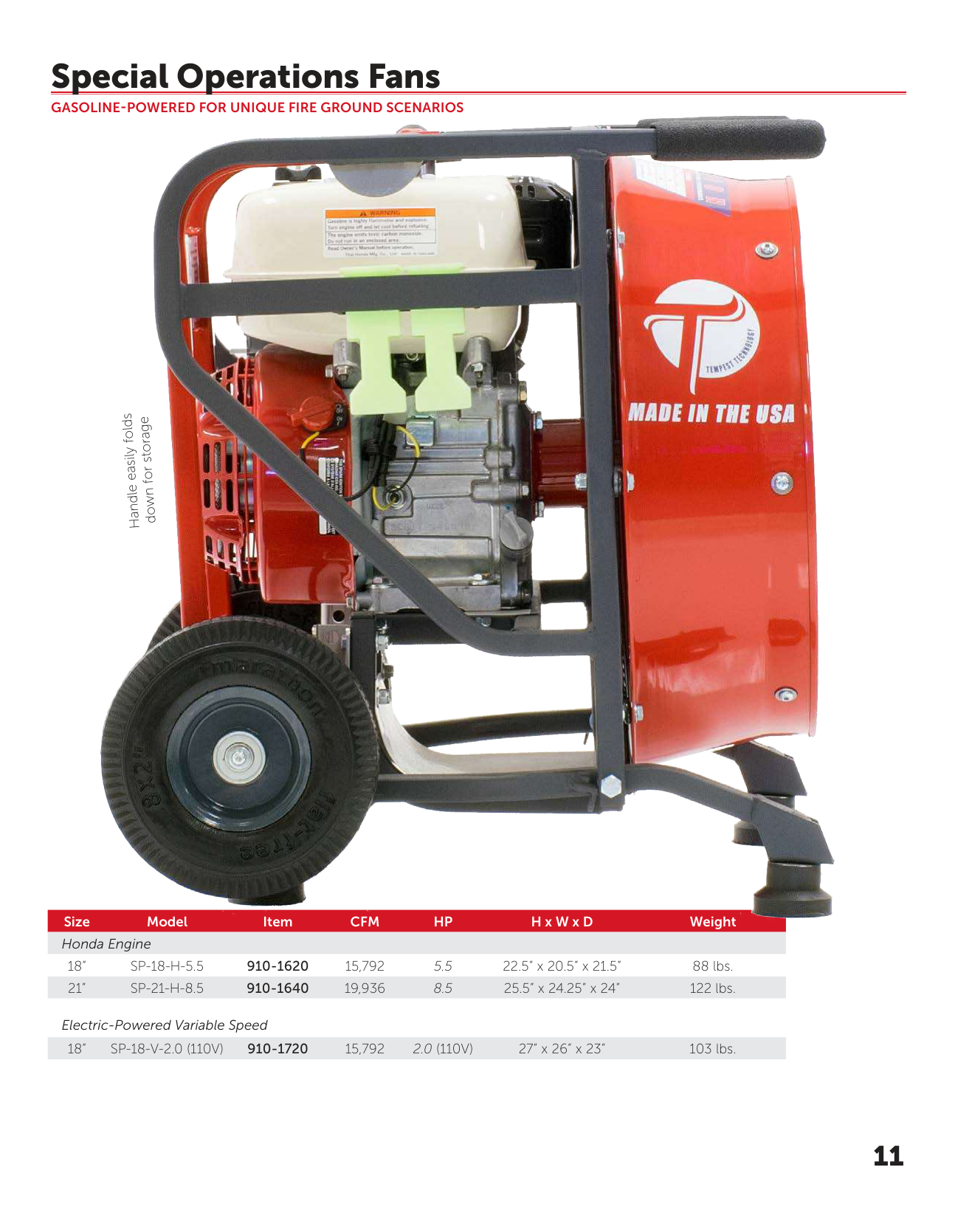
The Tempest Special Operations (SP) series fans are built for unique fire ground scenarios that require higher CFM output or specific power configurations beyond the standard product line. Available in Honda-powered gasoline and variable-speed electric versions, the SP series bridges the gap between standard and industrial-scale ventilation needs.
The SP-21-H-8.5 Honda configuration delivers the highest CFM in this class at 19,936 CFM — powered by an 8.5 HP engine for maximum output in large or complex structures. The variable speed electric SP-18-V-2.0 (110V) brings 15,792 CFM with adjustable airflow control. Both models feature a foldable handle for compact apparatus storage.
Key Features
Up to 19,936 CFM
The 21″ Honda 8.5 HP configuration delivers near 20,000 CFM — high-volume performance for large structures, warehouse fires, and complex industrial ventilation challenges.
Gas or Variable Speed Electric
Choose gasoline for complete autonomy, or variable speed electric (110V, 2.0 HP) for precise airflow control in environments where fuel exhaust is not acceptable.
Foldable Handle
Handle easily folds down for compact storage on apparatus — critical when apparatus storage space is at a premium and the fan needs to fit in tight compartments.
Unique Scenario Design
The SP series was engineered for scenarios where standard fans don’t suffice — unusual structure configurations, high-rise ventilation, high-volume confined space clearance, and complex industrial layouts.
Variable Speed Control (Electric)
The SP-18-V-2.0 variable speed electric provides adjustable CFM output — ideal for precise ventilation management in industrial environments with strict airflow requirements.
Made in USA
Designed, fabricated, and built at Tempest’s facility in Fresno, California. Quality-controlled manufacturing ensures consistent performance and long service life.
Models & Ordering Information
| Item No. | Model | Size | Power | HP | CFM | Weight |
|---|---|---|---|---|---|---|
| 910-1620 | SP-18-H-5.5 | 18″ | Honda Gasoline | 5.5 | 15,792 | 88 lbs. |
| 910-1640 | SP-21-H-8.5 | 21″ | Honda Gasoline | 8.5 | 19,936 | 122 lbs. |
| 910-1720 | SP-18-V-2.0 | 18″ | Variable Speed Electric (110V) | 2.0 | 15,792 | 103 lbs. |
Technical Specifications
| Type | Special Operations PPV Fan (Gasoline & Electric) |
| Blade Sizes | 18″, 21″ |
| CFM Range | 15,792 – 19,936 CFM |
| Gas Engine Options | Honda 5.5 HP (18″) / Honda 8.5 HP (21″) |
| Electric Option | 2.0 HP Variable Speed, 110V/60Hz |
| Storage | Foldable Handle |
| Weight Range | 88 – 122 lbs. |
| Origin | Designed, Fabricated & Built in the USA |
Manufacturer: Tempest — 4708 N. Blythe Avenue, Fresno, California 93722 USA — tempest.us.com