
A poorly ventilated confined space doesn’t give you a warning. Flammable vapor accumulates at ankle level, workers overhead have no idea the concentration is rising, and the next arc from a non-rated motor becomes a fatality. Industrial facilities, oil and gas processing sites, and chemical plants all share the same core problem: getting enough clean air volume into a hazardous location fast enough to matter, without introducing an ignition source in the process. The Tempest 24-HD is the specific tool engineered to solve that problem. It delivers up to 15,663 CFM through a motor certified for Class I and Class II explosive atmospheres, built on a welded steel frame that handles terrain no wheeled fan should logically survive.
What is the Tempest 24-HD and what makes it different from a standard industrial fan?
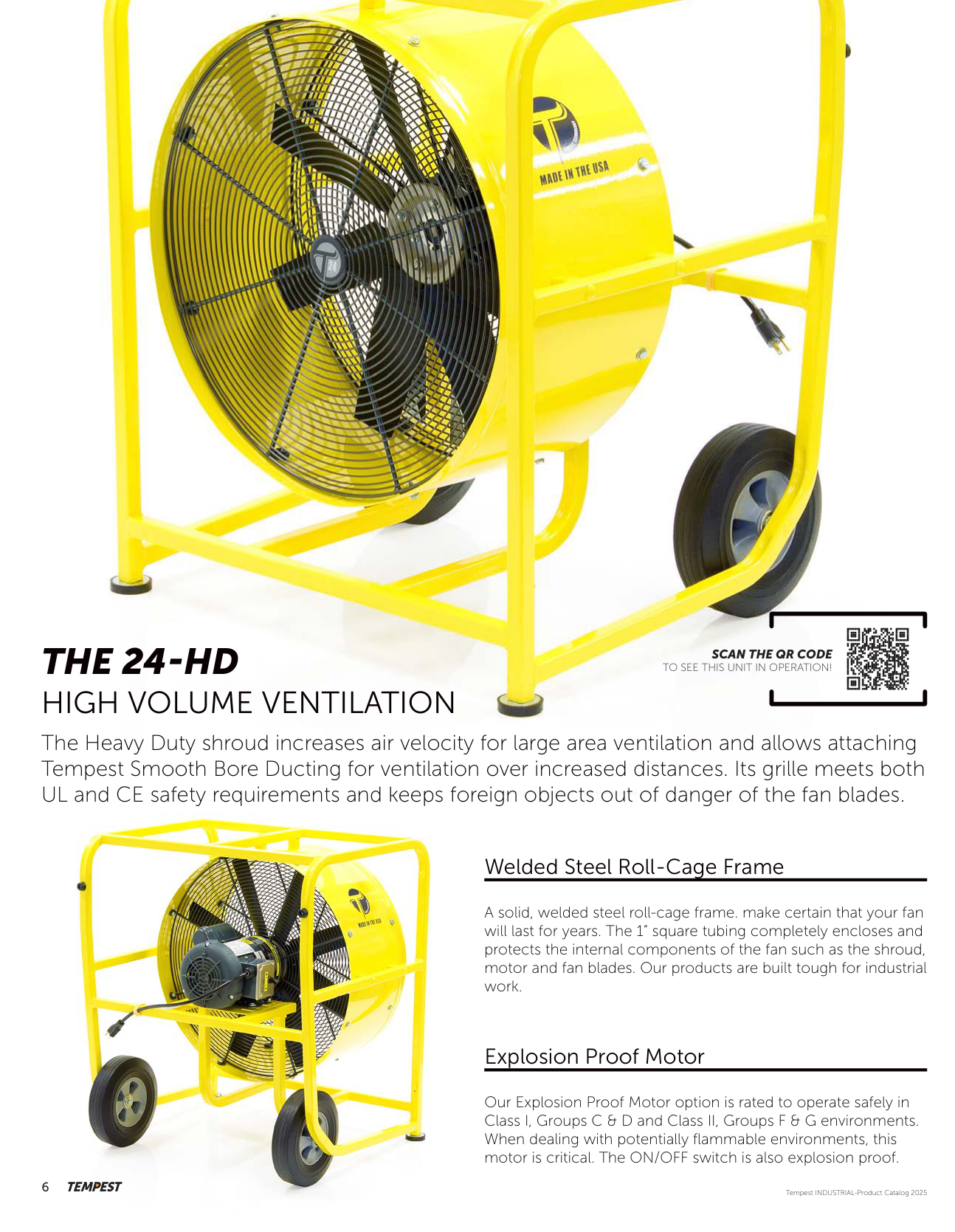
The Tempest 24-HD is a 24-inch heavy-duty industrial ventilation fan designed specifically for high-volume general ventilation in hazardous locations. Unlike standard industrial fans that use open-frame motors unsuitable near flammable gases or combustible dusts, the 24-HD is built around an explosion-proof motor configuration, a welded steel roll-cage frame, and a UL- and CE-compliant grille assembly.
The frame is constructed from 1-inch square steel tubing that fully encloses the shroud, motor, and blade assembly, finished with a powder-coat treatment for corrosion resistance during long-term industrial service. The rolled steel shroud is not decorative: it increases air velocity at the discharge point and accepts Tempest smooth bore ducting for extended-reach delivery into winding passages or deep confined spaces. The grille is circular wound, externally welded steel wire with 8 tie points, zinc-plated with a clear chromate finish, satisfying both UL and CE safety standards for foreign object exclusion from the blade path. The entire unit measures 30.00 inches wide by 25.25 inches deep by 34.25 inches tall and weighs between 112 and 120 pounds depending on configuration.
What does “explosion-proof” mean for the 24-HD-EP, and which hazard classes does it cover?
The 24-HD-EP model carries an explosion-proof motor rating covering Class I (Groups C and D) and Class II (Groups F and G) environments. Class I covers locations where flammable gases or vapors may be present in the air in sufficient quantities to produce explosive or ignitable mixtures. Class II covers locations made hazardous by the presence of combustible dust.
Group C includes atmospheres containing ethyl ether, ethylene, or cyclopropane vapors. Group D covers gasoline, hexane, naphtha, benzine, butane, propane, acetone, toluene, and similar materials common on petrochemical and refinery sites. Group F covers carbon black, coal dust, and coke dust. Group G covers flour, starch, and grain dust. For anyone working near grain storage, petroleum processing, or chemical blending areas, this dual-class rating is not a marketing claim: it is the legal and operational line between an approved tool and a prohibited ignition source. The 24-HD-EP also includes an explosion-proof ON/OFF switch as standard equipment, eliminating the need to source and mount a separately rated disconnect. Read more about the stakes involved in When One Spark Could Kill Your Entire Crew… And Destroy Your Career.
How much airflow does the Tempest 24-HD deliver, and which configuration is right for the job?
The 24-HD is available in three distinct configurations with meaningfully different output levels. The single-speed model (part number 913-1160) and the explosion-proof model (913-1161) both produce 12,867 CFM from a 1.0 HP Totally Enclosed Fan-Cooled (TEFC) motor drawing approximately 14 amps on a 15-amp circuit. The variable-speed model (913-1163) steps up to a 2.0 HP motor and delivers 15,663 CFM at full output.
The difference between 12,867 and 15,663 CFM is not marginal in a confined space ventilation scenario. The variable-speed model allows operators to dial back output for noise-sensitive or pressure-sensitive passages while retaining the ceiling capacity for large open industrial bays or multiple-duct configurations. All three models use an 8-blade composite blade assembly bolted to a center hub on a 24-inch diameter sweep. Maximum cord length ratings are published by gauge: 14 AWG supports up to 60 feet, 12 AWG up to 95 feet, 10 AWG up to 150 feet, 8 AWG up to 240 feet, and 6 AWG up to 380 feet. Matching wire gauge to distance is critical for maintaining rated motor performance and avoiding heat buildup in the supply circuit.
How does the 24-HD handle rough terrain and positioning in industrial environments?
The 24-HD rolls on 10-inch solid rubber wheels with high-strength polymer hubs. Because the wheels are solid rubber rather than pneumatic, there is no risk of a flat tire when navigating across rocks, pipe racks, broken glass, or debris-covered industrial floors. The wheels are sized and spaced to allow the fan to be moved quickly to the point of use without tilting or wheel jamming on typical industrial debris.
Positioning is controlled through manual set leg extensions that provide four discrete tilt angles: 0 degrees (level), plus 8 degrees, plus 12 degrees, and plus 20 degrees. In a confined space entry scenario, the plus 20-degree tilt allows the discharge airflow to be aimed upward into a vertical shaft or elevated manway without repositioning the base of the unit. In a wide low-ceiling processing bay, the 0-degree setting keeps airflow horizontal and parallel to the floor surface where vapor accumulation typically concentrates. This four-position system is a fixed mechanical adjustment, not a continuous friction lock, which means field personnel do not need to guess at angles or re-adjust after vibration shifts the setting.
When should smooth bore ducting be attached to the 24-HD, and how far can it reach?
Smooth bore ducting attaches directly to the rolled steel HD shroud and extends the effective ventilation distance beyond what a free-blowing fan can achieve. This is the practical answer to deep tank entries, long horizontal runs through processing tunnels, or multi-bend passages where open-face fan placement is not possible at the entry point.
The shroud’s function as both a velocity-increasing nozzle and a duct attachment collar is why the HD designation matters in the product name. A standard open-frame fan without a purpose-built shroud cannot accept ducting without improvised adapters that reduce both velocity and safety. Tempest smooth bore ducting is the manufacturer-specified accessory for this application, maintaining the system’s velocity profile across the duct run. For facilities requiring multiple fan positions or variable output across different zones, the Tempest Variable-Speed Special Operations Electric blower series provides a complementary option where portability requirements differ.
What are the TEFC motor specifications and circuit requirements for the 24-HD?
The single-speed and explosion-proof models both use a 1.0 HP Totally Enclosed Fan-Cooled electric motor. TEFC construction means the motor windings are sealed from the surrounding atmosphere, preventing flammable dust or vapor from entering the motor housing while allowing the external fan to cool the frame. This is the required motor construction type for the hazardous locations the 24-HD is designed to operate in.
The motor draws approximately 14 amps and requires a 15-amp circuit. That single-amp margin between draw and circuit rating is worth noting during site electrical planning: any voltage drop caused by undersized extension cord runs will push actual draw closer to the circuit limit. This is why Tempest publishes explicit maximum cord lengths by wire gauge. At 14 AWG, the 60-foot maximum reflects both voltage drop tolerance and heat-at-load considerations. Running a 14 AWG cord at 100 feet in a 24-HD application would violate the published specification and could result in motor damage or circuit failure. The Tempest official product specifications at tempest.us.com confirm these wire gauge and distance pairings as part of the installation requirements.
How does the Tempest 24-HD compare to the Tempest 24-IND for industrial ventilation applications?
Both the 24-HD and the 24-IND are 24-inch electric industrial fans from Tempest, but they are not interchangeable. The 24-HD’s defining features are its rolled steel shroud for duct attachment, its explosion-proof motor option (24-HD-EP), and its variable-speed 2.0 HP option delivering 15,663 CFM. The Tempest 24-IND Electric Powered Fan is the appropriate choice when the application does not require ducted reach or explosion-proof certification, and when a lighter or lower-cost platform is acceptable.
The 24-HD’s 1-inch square steel roll-cage frame, powder-coat finish, and 10-inch solid rubber wheels represent a durability specification for sites where fan equipment is regularly transported over rough terrain and exposed to industrial grime, chemical splash, and physical impact. Facilities that need open-air warehouse cooling rather than hazardous atmosphere ventilation may find the Tempest Warehouse Cooling Kit a better-matched solution. The 24-HD is purpose-built for the hazardous location and confined space ventilation segment, and that specificity carries both a weight and cost premium relative to general-purpose fans in the Tempest line.
Where is the Tempest 24-HD used in industrial and energy sector applications?
The 24-HD series is deployed across a range of high-stakes industrial environments where airflow volume, explosion-proof certification, and physical durability all need to be present simultaneously. Core applications include petroleum refinery confined space entry, tank cleaning and inspection ventilation, chemical processing plant maintenance areas, grain handling and storage facilities (Class II environments), underground utility vault ventilation, mining and tunneling exhaust, and oil and gas processing plant maintenance shutdowns.
In refinery turnaround work, the 24-HD-EP is often positioned at vessel or tank manways where hydrocarbon vapor displacement is required before entry. The smooth bore duct connection allows a single fan position outside the hazardous zone to ventilate deep into a horizontal vessel. In grain handling facilities, the Class II Group F and G rating satisfies the combustible dust exposure requirement that would disqualify a standard TEFC fan without explosion-proof certification. Emergency response teams also use the 24-HD where a gasoline-powered option like the Tempest Gasoline-Powered Smoke Ejector cannot be used safely due to exhaust gas introduction into the ventilated space. The fan’s 30-by-34-inch footprint and solid rubber wheels allow rapid repositioning between entry points during multi-point ventilation operations.
When is the Tempest 24-HD the right call, and when is it not?
The 24-HD is the right call when the application combines three requirements: high CFM volume (above 12,000), an explosive or combustible atmosphere requiring Class I or Class II certification, and the need for ducted reach into spaces that cannot be directly accessed. The explosion-proof motor, UL- and CE-compliant grille, and smooth bore duct compatibility make it uniquely qualified for that intersection of requirements.
It is not the right call for every ventilation need. At 112 to 120 pounds and with a 15-amp circuit draw, the 24-HD is a stationary or semi-mobile tool rather than a rapid-deploy lightweight unit. Applications requiring frequent single-operator transport, rooftop deployment, or non-ducted open-bay cooling at lower CFM requirements should be evaluated against other models in the Tempest line. The 24-HD is designed, fabricated, and built in the USA at Tempest’s Fresno, California facility, which means lead times and support availability reflect domestic manufacturing, but it also means this is not a commodity fan. It is a purpose-engineered ventilation tool for hazardous industrial work, and using it in a context where that engineering is unnecessary adds cost and handling burden without operational benefit.
Tempest Industrial
24-HD High Volume Industrial Ventilation Fan
Heavy-Duty Ventilation for Hazardous Locations | Made in the USA
Overview
The Tempest 24-HD is a heavy-duty 24-inch industrial ventilation fan designed for high-volume general ventilation in hazardous locations. Its heavy-duty rolled steel shroud increases air velocity and allows attachment of Tempest smooth bore ducting for extended-reach ventilation.
Available in single-speed, explosion-proof, and variable-speed configurations, the 24-HD delivers up to 15,663 CFM with its solid welded steel roll-cage frame and grille that meets both UL and CE safety requirements — keeping foreign objects away from the fan blades.
Key Features
Welded Steel Roll-Cage Frame
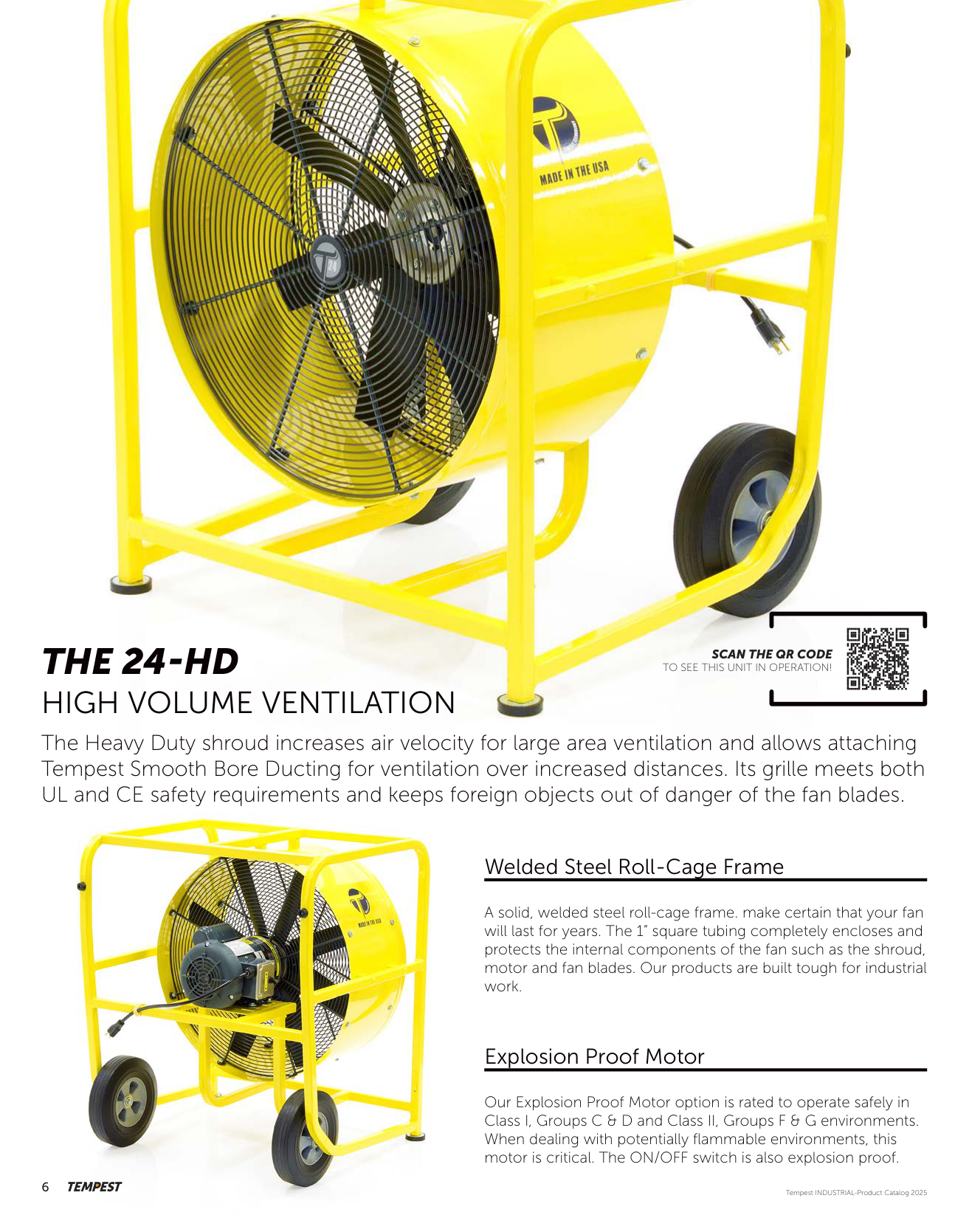
1″ square steel tubing completely encloses the shroud, motor, and blades. Built for years of tough industrial service with powder-coat finish.
Explosion-Proof Motor
Rated for Class I (Groups C & D) and Class II (Groups F & G) environments. Explosion-proof ON/OFF switch included for maximum safety in flammable atmospheres.
UL & CE Compliant Grille
Circular wound, external-weld steel wire grille with 8 tie points meets both UL and CE safety standards, keeping foreign objects clear of blades.
Adjustable 4-Position Tilt
Manual set leg extensions provide 4-position tilt: 0°, +8°, +12°, and +20° for precise airflow direction in confined or elevated spaces.
10″ Solid Rubber Wheels
Never-flat high-strength polymer hub wheels navigate any terrain — rocks, mud, pipe, glass. Designed to get the fan where it’s needed quickly.
Smooth Bore Ducting Compatible
The HD shroud accepts Tempest smooth bore ducting for ventilation over increased distances — ideal for complex industrial layouts and winding passages.
Models & Ordering Information
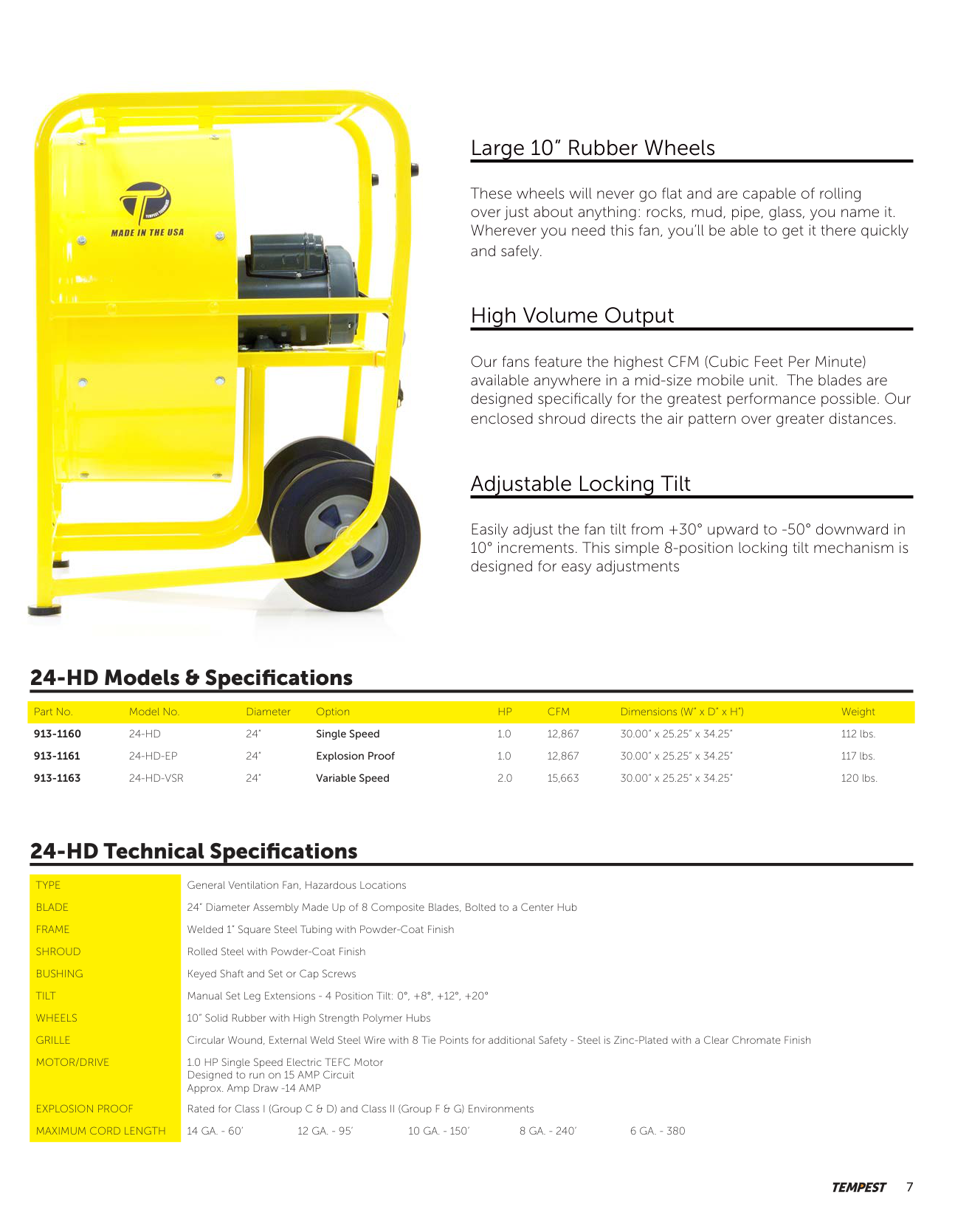
| Part No. | Model | Configuration | HP | CFM | Weight |
|---|---|---|---|---|---|
| 913-1160 | 24-HD | Single Speed | 1.0 | 12,867 | 112 lbs. |
| 913-1161 | 24-HD-EP | Explosion Proof — Class I & II | 1.0 | 12,867 | 117 lbs. |
| 913-1163 | 24-HD-VSR | Variable Speed | 2.0 | 15,663 | 120 lbs. |
Technical Specifications
| Type | General Ventilation Fan, Hazardous Locations |
| Blade Assembly | 24″ Diameter — 8 Composite Blades, Bolted to a Center Hub |
| Frame | Welded 1″ Square Steel Tubing with Powder-Coat Finish |
| Shroud | Rolled Steel with Powder-Coat Finish |
| Bushing | Keyed Shaft and Set or Cap Screws |
| Tilt | Manual Set Leg Extensions — 4 Position: 0°, +8°, +12°, +20° |
| Wheels | 10″ Solid Rubber with High Strength Polymer Hubs |
| Grille | Circular Wound External-Weld Steel Wire — 8 Tie Points — Zinc-Plated with Clear Chromate Finish (UL & CE) |
| Motor / Drive | 1.0 HP Single Speed Electric TEFC — 15 AMP Circuit — Approx. 14 AMP Draw |
| Explosion Proof Rating | Class I (Group C & D) and Class II (Group F & G) |
| Dimensions (W × D × H) | 30.00″ × 25.25″ × 34.25″ |
| Maximum Cord Length | 14 GA — 60′ | 12 GA — 95′ | 10 GA — 150′ | 8 GA — 240′ | 6 GA — 380′ |
| Origin | Designed, Fabricated & Built in the USA |
Manufacturer: Tempest — 4708 N. Blythe Avenue, Fresno, California 93722 USA — tempest.us.com