
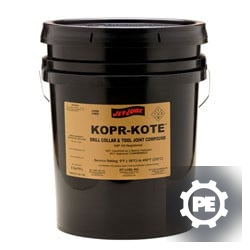
Standard thread compounds stiffen, lose penetration, and fail to adhere when temperatures drop below freezing. On a long horizontal directional drilling run in a hard formation at -40°F, that failure is not a maintenance note — it is a seized connection, a pulled string, and a day of lost progress. Kopr-Kote Arctic was formulated specifically for that scenario: a pumpable, sprayable NLGI Grade 1 compound that stays workable at -65°F, sticks to wet joints, and delivers extreme-pressure protection across the full range of arctic and high-speed drilling applications where the standard Kopr-Kote grade reaches its limits.
What is Jet-Lube Kopr-Kote Arctic, and how does it differ from standard Kopr-Kote?
Kopr-Kote Arctic is the low-temperature, pumpable variant of the Kopr-Kote family, engineered for drill collar and tool joint protection in waterwell, HDD, and other rotary drilling applications where ambient or formation temperatures fall well below the service floor of conventional thread compounds. While standard Kopr-Kote is formulated as a general-purpose drill string compound, the Arctic grade uses a low pour petroleum base oil and an anhydrous calcium thickener to maintain workable consistency at temperatures as low as -65°F (-54°C).
The product carries an NLGI Grade 1 rating, which is softer and more pumpable than NLGI Grade 2, enabling reliable delivery through spray and pump application equipment without pre-heating in cold environments. Jet-Lube manufactures this compound at an ISO 9001:2015 and ISO 14001:2015 certified facility, and the formulation conforms to California Assembly Bill 1953, confirming the absence of lead and other restricted heavy metals. The specific gravity of 1.15 and density of 9.6 lb/gal place it in the same physical handling class as the rest of the Kopr-Kote line.
Why does Kopr-Kote Arctic use copper flake and graphite rather than lead-based solids?
Lead-based thread compounds were historically used because lead’s soft, ductile nature filled microscopic surface irregularities on tool joint threads, reducing galling under high contact stress. Kopr-Kote Arctic achieves the same protective mechanism through copper flake combined with graphite and extreme-pressure additive chemistry, without the toxicity and regulatory burden of lead or zinc.
Copper flake functions by cold-welding a thin, sacrificial metallic layer onto thread flanks under compressive load. This layer shears preferentially before the base metal does, preventing galling during repeated high-torque makeup cycles. Graphite contributes solid lubrication that remains stable across the full service range of -65°F to 300°F (149°C). The combined extreme-pressure package produces a 4-Ball Weld Point of 800 kgf (ASTM D-2596, typical), which reflects the compound’s ability to prevent welding of metal surfaces under concentrated tribological load. Copper flake also provides a secondary benefit in rotary shouldered connections: it counteracts circumferential thread slip during makeup, contributing to the product’s unequaled resistance to makeup downhole claim and supporting consistent, repeatable torque values.
What does the friction factor of 1.15 mean for tool joint makeup torque?
Friction factor, as defined relative to API RP 5A3 Annex I, is a multiplier applied to the reference torque value to calculate the actual makeup torque needed when using a specific thread compound. A friction factor of 1.15 means that more torque is required at the tong than the API baseline predicts, which is a direct consequence of the compound’s protective, high-solids formulation.
For severe drilling applications — high speeds, high penetration rates, long horizontal holes, hard formations — Jet-Lube specifies an additional 10% makeup torque beyond standard API values when using Kopr-Kote Arctic on drill rods and rotary shouldered connections. This is not a generic safety margin; it is derived from full-scale API tool joint connection testing. Variables including pipe size, thread geometry, and drilling mud contamination all affect the realized friction factor, so drillers should calculate site-specific torque values rather than relying on a single published number. The dropping point of greater than 300°F (ASTM D-2265) confirms the compound will not liquefy or migrate from the joint under typical downhole heat conditions.
How does Kopr-Kote Arctic perform in spray and pump application systems?
The NLGI Grade 1 consistency is the key enabler for mechanical application. At NLGI Grade 2, many thread compounds become too stiff to flow reliably through pump lines and spray nozzles in cold weather without heat tracing. The Arctic grade’s lower viscosity profile, produced by its low pour petroleum base oil and Grade 1 thickener level, allows continuous delivery through automated spray systems even at sub-zero ambient temperatures.
The penetration value at 77°F (ASTM D-217) falls in the range of 310 to 330, confirming a semi-fluid consistency that flows readily while retaining enough body to cling to vertical and inclined thread surfaces. Oil separation at 212°F (ASTM D-6184) is less than 3.0 wt.%, meaning the compound does not bleed excessively under elevated temperature storage or during the downhole temperature transition from arctic surface conditions to warmer formation zones. Flash point above 320°F (ASTM D-92) ensures safe handling and storage in enclosed equipment bays where spray systems are typically housed.
When is Kopr-Kote Arctic the correct choice versus Jet-Lube 21 or EXTREME?
Kopr-Kote Arctic is the correct choice for waterwell and HDD applications in standard or freshwater mud systems, particularly where low ambient temperatures, high drilling speeds, or hard formation abrasion are the dominant stressors. It is not the correct choice for every drilling environment, and Jet-Lube’s own product selection guidance is explicit on this point.
For invert (oil-based) muds or high-pH mud systems, Jet-Lube 21 or EXTREME should be used instead of Kopr-Kote Arctic. Invert mud chemistry can degrade the anhydrous calcium thickener matrix and reduce the compound’s ability to adhere to thread surfaces, undermining the corrosion and galling protection the product is designed to deliver. This compatibility boundary is a formulation reality, not a conservative upsell. Drillers running synthetic or oil-based mud systems should consult the Jet-Lube product selection matrix before specifying any Kopr-Kote variant. The Arctic grade is also available alongside Standard, Thermal, and Specialty grades within the broader Kopr-Kote family, allowing application-specific selection across a wide range of temperature and chemical environments.
What regulatory and environmental standards does Kopr-Kote Arctic meet?
Kopr-Kote Arctic contains no lead and no zinc, satisfying the requirements of California Assembly Bill 1953, which restricts lead content in plumbing and fluid-contact materials. While AB 1953 targets potable water system components, the conformance designation is particularly relevant for waterwell drilling contractors who must demonstrate that compounds entering the wellbore zone do not introduce regulated heavy metals into the formation or aquifer proximity.
The manufacturing facility operates under dual ISO certification: ISO 9001:2015 for quality management systems and ISO 14001:2015 for environmental management systems. ISO 14001 certification requires documented controls over chemical inputs, waste streams, and environmental impact assessment, which directly supports the lead-free and zinc-free formulation commitment. Copper strip corrosion testing per ASTM D-4048 returns a 1A typical result, indicating minimal corrosive activity on copper alloy surfaces, relevant when the compound contacts brass or bronze components in pump and wellhead assemblies.
Where is Kopr-Kote Arctic used in waterwell and HDD drilling operations?
Kopr-Kote Arctic is applied to drill collars, drill rod connections, and rotary shouldered tool joints in the following operational contexts: arctic and cold-region waterwell drilling, long-reach horizontal directional drilling bores in hard or abrasive formations, and high-speed rotary drilling programs where frictional heat generation at connections exceeds the capacity of standard-grade compounds to protect threads.
Contractors running HDD programs for utility installation, pipeline crossing, and conduit placement in northern climates rely on the compound’s pumpability and wet-surface adhesion to maintain consistent connection integrity across repeated makeup and breakout cycles. You can order the 10512 Kopr-Kote Arctic in a 19 lb pail for field crew use, or review the complete range of Jet-Lube Products available through PE Energy for broader compound and lubricant needs. For a side-by-side understanding of the Kopr-Kote oilfield line, the Protect the Connections of Your Drilling Tools overview covers rotary shouldered connection requirements across product grades. The KOPR-KOTE technical data sheet provides compound-specific property tables, and the Korp Kote_SS_JL_12-17 sell sheet gives a quick-reference format for field procurement decisions.
When is Kopr-Kote Arctic the right call, and when is it not?
Kopr-Kote Arctic is the right compound when the drilling program combines low ambient temperatures with demanding mechanical conditions: hard formations, high rotational speeds, long horizontal bores, or operations requiring spray and pump application at sub-zero temperatures. Its NLGI Grade 1 consistency, -65°F lower service limit, 800 kgf 4-Ball Weld Point, and lead-free copper flake formulation address exactly those stressors in a single product that also meets AB 1953 environmental requirements.
It is not the right compound for invert mud or high-pH mud systems, where Jet-Lube 21 or EXTREME should be specified instead. It is also not the correct product when NLGI Grade 2 body is required for specific manual application techniques or when the service temperature consistently exceeds 300°F, where the Thermal or Specialty grades in the Kopr-Kote family should be evaluated. Specifying the correct grade from the outset eliminates seized connections, inconsistent makeup torque, and premature thread wear that accrue across a drilling season on a high-cycle rig.
Kopr-Kote® Arctic Drill Collar & Tool Joint Compound
NLGI Grade 1 • Anhydrous Calcium • Lead-Free • Service: -65°F to 300°F
The pumpable and sprayable arctic-grade version of Kopr-Kote — premier waterwell and HDD drilling compound with over 3 decades of field-proven reliability. Engineered for the most severe conditions: higher speeds, higher penetration rates, long horizontal holes, and harder formations where standard grades fall short.
Lead-Free • Copper Flake • Graphite • Extreme-Pressure Additives • ISO 9001:2015 & ISO 14001:2015 Facility • Conforms to Assembly Bill 1953
DESIGNED FOR:
- Extreme low-temperature drilling operations
- Higher speeds and higher penetration rate applications
- Long horizontal holes
- Harder formations
- Spray and pump equipment application
- Drill rods and rotary shouldered connections requiring additional 10% makeup
- Waterwell and HDD (horizontal directional drilling)
Note: For invert or high-pH muds, use Jet-Lube® 21 or EXTREME™.
KEY BENEFITS:
- Designed to handle extremes in low temperature
- Contains no lead or zinc
- Designed for spray and pump equipment application
- Extreme-pressure additives protect against seizing and galling
- Allows consistent make-up
- Sticks to wet joints
- Unequaled resistance to makeup downhole
- Available in Standard, Thermal, and Specialty grades
- Conforms to Assembly Bill 1953
PRODUCT CHARACTERISTICS:
| Property / Test Method | Value |
|---|---|
| NLGI Grade | 1 |
| Thickener | Anhydrous Calcium |
| Fluid Type | Low Pour Petroleum |
| Color | Gray |
| Dropping Point (ASTM D-2265) | >300°F (149°C) |
| Flash Point (ASTM D-92) | >320°F (160°C) |
| Specific Gravity | 1.15 |
| Density | 9.6 lb/gal |
| Oil Separation @ 212°F (ASTM D-6184), wt.% loss | <3.0 |
| Penetration @77°F (ASTM D-217) | 310–330 |
| Copper Strip Corrosion (ASTM D-4048) | 1A, typical |
| 4-Ball Weld Point, kgf (ASTM D-2596) | 800, typical |
| Friction Factor* (Relative to API RP 5A3 Annex I) | 1.15 |
| Service Rating | -65°F (-54°C) to 300°F (149°C) |
*Many factors such as pipe size, thread geometry, and drilling mud contamination affect friction factor. Base oil pour points can vary, affecting the service temperature range.
ARCTIC MAKE-UP GUIDANCE:
For severe drilling applications (high speeds, high penetration rates, long horizontal holes, hard formations), drill rods and other rotary shouldered connections should be made up an additional 10% beyond standard API torque values. Friction factors were developed using full-scale API tool joint connections.
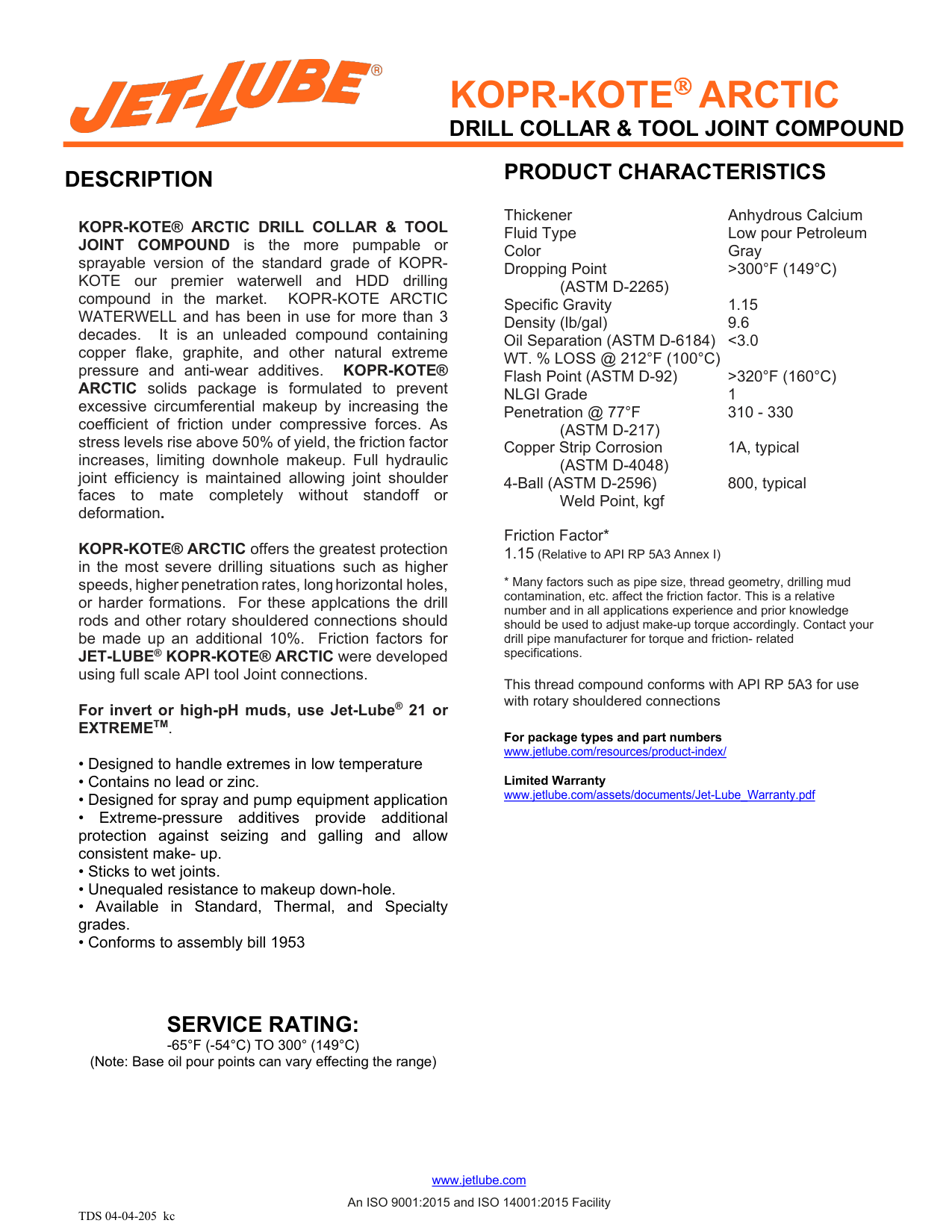
Jet-Lube, Inc. • jetlube.com • www.jetlube.com • ISO 9001:2015 & ISO 14001:2015 Facility • TDS 04-04-205 • Product: Kopr-Kote® Arctic Drill Collar & Tool Joint Compound
Standard oilfield conditions? For ambient temperatures within 0–450°F, the original Kopr-Kote drill collar & tool joint compound is the API RP 5A3 reference product.