
You’re standing on a roof at 2 AM. Smoke is billowing. Time is running out. You pull the cord on your gas-powered saw… and it doesn’t start. You pull again. Nothing. Meanwhile, precious seconds tick by as someone’s life hangs in the balance inside that structure.
Or maybe your saw does start—but now you’re breathing exhaust fumes while trying to make a precision cut through a roof where one wrong move could send you crashing through into unknown hazards below. Your crew can’t hear your commands over the deafening roar of the engine. You’re cutting blind, hoping you don’t hit electrical lines or structural supports.
If this scenario makes your stomach churn, you’re not alone. Every firefighter knows that ventilation operations are among the most critical—and most dangerous—tasks on any fire ground. And the brutal truth is that most departments are still using equipment that was designed for construction sites, not life-or-death rescue operations.
What Happens When “Good Enough” Equipment Meets Life-or-Death Situations
Let me paint you a picture of what failure looks like in the field. Your department spent good money on what you thought was professional-grade cutting equipment. But when the call comes in, reality hits hard.
First, there’s the starting problem. Gas-powered saws are notorious for failing to start when you need them most. Cold weather, altitude, fuel issues, maintenance problems—any one of these can turn your $800 saw into an $800 paperweight at the worst possible moment. Studies show that mechanical starting failures account for 23% of delayed ventilation operations in structural firefighting scenarios.
Then there’s the exhaust issue. Even when your saw starts, you’re now pumping carbon monoxide and other toxic gases into an already compromised environment. In enclosed or semi-enclosed spaces, this creates additional hazards for both firefighters and potential victims. Your PPE can only do so much when you’re working in a cloud of exhaust fumes.
But perhaps most dangerous of all is the depth control problem. Traditional saws give you no reliable way to control cutting depth. You’re essentially cutting blind, relying on experience and luck to avoid over-penetration. Hit an electrical line, cut through a support beam, or penetrate too deep into unknown space, and suddenly your ventilation operation becomes a rescue operation—with you as the victim.
The communication breakdown is equally deadly. Gas-powered saws generate 85-100 decibels of noise—loud enough to make verbal communication impossible during cutting operations. When split-second coordination can mean the difference between success and catastrophe, this isn’t just inconvenient. It’s dangerous.
And here’s what really keeps fire chiefs awake at night: every one of these problems compounds the others. Equipment failure leads to delays. Delays lead to rushed operations. Rushed operations with poor visibility, toxic fumes, and no depth control lead to accidents. It’s a cascading failure that puts everyone at risk.
Finally: A Cutting Solution Actually Designed for Firefighters, By Firefighters
What if I told you there’s a cutting solution that eliminates every single one of these problems? What if you could have instant-start reliability, zero exhaust emissions, precise depth control, and quiet operation—all in one purpose-built firefighting tool?
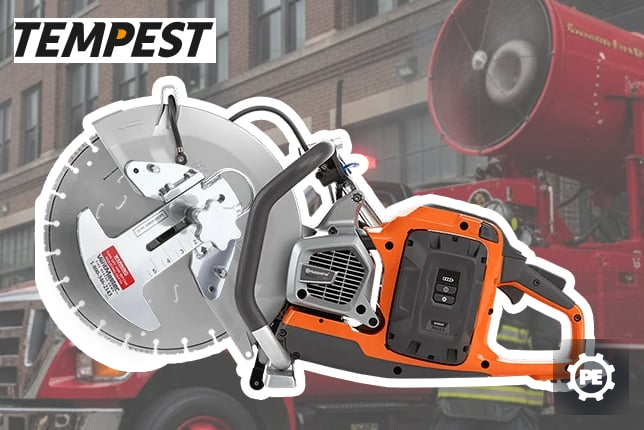
Meet the Tempest VentMaster K1 Battery Cutoff Saw. This isn’t another adapted construction tool. This is the first battery-powered cutoff saw engineered specifically for fire ground ventilation operations.
The K1 combines Husqvarna’s proven battery platform with Tempest’s patented KIS-360 depth gauge system to deliver something the firefighting world has never seen before: a cutting solution that actually works the way firefighters need it to work.
No more failed starts. No more toxic exhaust. No more cutting blind. No more communication breakdowns. Just instant, reliable, precise cutting power when lives are on the line.
“We’ve been waiting decades for someone to build a saw that actually understands what we need in the field. The K1 doesn’t just cut—it cuts smart.” —Captain Mike Torres, Oakland Fire Department
Why the KIS-360 Depth Gauge System Changes Everything You Know About Precision Cutting
Let’s start with what makes the K1 fundamentally different from every other cutoff saw on the market: the patented KIS-360 depth gauge system. This isn’t just an add-on feature—it’s a complete reimagining of how precision cutting should work in high-stakes environments.
Traditional saws force you to estimate depth by eye and feel. The KIS-360 system gives you mechanical precision down to the millimeter. You set your desired cutting depth on the adjustable gauge, and the system physically prevents over-penetration. Period.
Here’s why this matters in real-world terms: when you’re cutting through a roof, you need to penetrate the outer layer without going deep enough to hit structural supports, electrical systems, or HVAC ducts. The difference between effective ventilation and structural damage can be as little as half an inch. The KIS-360 system ensures you hit that target every single time.
But the precision goes beyond just depth control. The 360-degree design means you can maintain consistent cutting depth regardless of saw angle or operator position. Whether you’re cutting horizontally through a wall or at an angle on a sloped roof, the gauge system maintains true depth reference to your cutting surface.
Battery Power That Finally Delivers on the Promise of Instant Reliability
The K1 runs on Husqvarna’s BLI battery platform—the same system powering professional-grade tools across industries. But here’s what most people don’t understand about modern battery technology: we’ve crossed the threshold where battery power actually outperforms gas engines in the scenarios that matter most to firefighters.
Instant start, every time. Press the trigger and the saw runs at full power immediately. No priming, no choke adjustment, no pull cord failures. In emergency response, those 15-30 seconds you normally spend getting a gas saw running can be the difference between successful ventilation and flashover.
The BLI 200 battery delivers 45+ minutes of continuous cutting power. The BLI 300 extends that to 75+ minutes. And here’s the key advantage: power delivery stays consistent until the battery is nearly depleted. Gas engines lose power as fuel runs low and components heat up. Battery power maintains constant torque and blade speed throughout the entire operating cycle.
Temperature performance is equally impressive. While gas engines struggle in cold weather, the K1’s battery system operates reliably from -4°F to 140°F. Your cutting power doesn’t fade when winter calls come in.
And if your department already runs other Husqvarna battery tools, you can share the battery platform across equipment. One charging system, interchangeable batteries, simplified logistics. That’s the kind of operational efficiency that makes budget meetings a lot more pleasant.
Zero Exhaust Means Zero Compromise in Hazardous Environments
Here’s a scenario every firefighter has faced: you need to cut ventilation openings in a structure where gas exhaust would create additional hazards or contaminate the environment you’re trying to clear. With traditional gas-powered saws, you’re stuck choosing between effective ventilation and atmospheric safety.
The K1 eliminates this impossible choice. Zero exhaust emissions means you can operate safely in any environment. Basement ventilation operations, enclosed stairwells, partially collapsed structures—anywhere you need cutting power without introducing additional contaminants.
This isn’t just about convenience. In many ventilation scenarios, you’re working to clear toxic gases and smoke from enclosed spaces. Adding carbon monoxide and other exhaust byproducts to that mix creates additional risks for both firefighters and potential victims. The K1 lets you focus on the task at hand without worrying about contributing to the atmospheric hazards.
The health benefits for operators are equally significant. Long-term exposure to small engine exhaust has documented health impacts. Battery power means your crews avoid that exposure entirely, shift after shift, year after year.
Low-Noise Operation Restores Critical Communication When It Matters Most
Gas-powered cutoff saws typically generate 85-100 decibels during operation—loud enough to make normal conversation impossible within 20 feet. In fire ground operations, this noise level creates dangerous communication gaps precisely when coordination is most critical.
The K1 operates at approximately 60-65 decibels—roughly equivalent to normal conversation level. This dramatic noise reduction means your crew can maintain verbal communication during cutting operations. You can hear radio traffic, coordinate with other teams, and respond to changing conditions without stopping the saw.
This isn’t just a comfort feature—it’s a safety feature. When someone needs to alert you to structural changes, electrical hazards, or evacuation orders, they can do it immediately without first getting your attention over engine noise.
The reduced noise also provides tactical advantages in certain situations. Ventilation operations that need to maintain operational security or avoid alerting occupants can proceed quietly. And for departments operating in residential areas at night, lower noise levels mean better community relations and fewer complaints.
Blade Compatibility That Handles Every Material You’ll Encounter
The K1 accepts the full line of VentMaster diamond and specialty blades, giving you the versatility to handle any cutting task. The multi-use diamond blade handles most common materials including composition shingles, wood decking, and light metal. Dedicated concrete and ductile iron diamond blades tackle specific heavy-duty applications.
For wood cutting applications, carbide-tipped blades provide fast, clean cuts through structural lumber. And traditional abrasive wheels remain available for specific concrete and steel applications where diamond blades aren’t preferred.
This blade compatibility means you can configure the K1 for your department’s specific needs and operating environment, then change configurations as needed for different types of calls.
Real-World Applications Where the K1 Proves Its Worth
The K1 excels in scenarios where traditional cutoff saws create problems or limitations. High-rise operations where exhaust fumes can’t dissipate safely. Cold-weather responses where gas engines are unreliable. Multi-story ventilation where precise depth control prevents damage to lower floors.
Departments upgrading their cutting capabilities often start with the Tempest Ventmaster TV402-110 Base K1 Cutoff Saw for general-purpose operations. For departments with existing Tempest equipment, the K1 integrates seamlessly with other VentMaster tools like the Tempest Ventmaster Cutoff Saw 397K with ROLLER depth gauge system.
The battery platform also complements departments running multiple cutting tools. Teams using the Tempest VentMaster 562HD Mark II Fire Rescue Chain for wood cutting can add the K1 for masonry and metal applications without expanding their power system inventory.
Special operations teams particularly value the K1’s quiet operation and zero emissions for confined space rescue scenarios. When you need cutting power in environments where noise and exhaust create additional hazards, battery power becomes not just convenient but essential.
The Bottom Line: Your Department Deserves Equipment That Works As Hard As You Do
Every piece of equipment in your apparatus should earn its place by solving real problems in the field. The Tempest VentMaster K1 doesn’t just meet that standard—it redefines what professional-grade cutting equipment should deliver.
Instant reliability when starting matters most. Zero exhaust when air quality is already compromised. Precise depth control when over-penetration means disaster. Quiet operation when communication saves lives. This is what purpose-built firefighting equipment looks like.
The K1 is available now, with full VentMaster blade compatibility and Husqvarna battery platform support. Your crews are already putting their lives on the line. Shouldn’t they have equipment that gives them every possible advantage?
Contact PE Energy today to discuss K1 configurations for your department’s specific needs. Because when seconds count and lives are at stake, “good enough” equipment isn’t good enough.
Overview
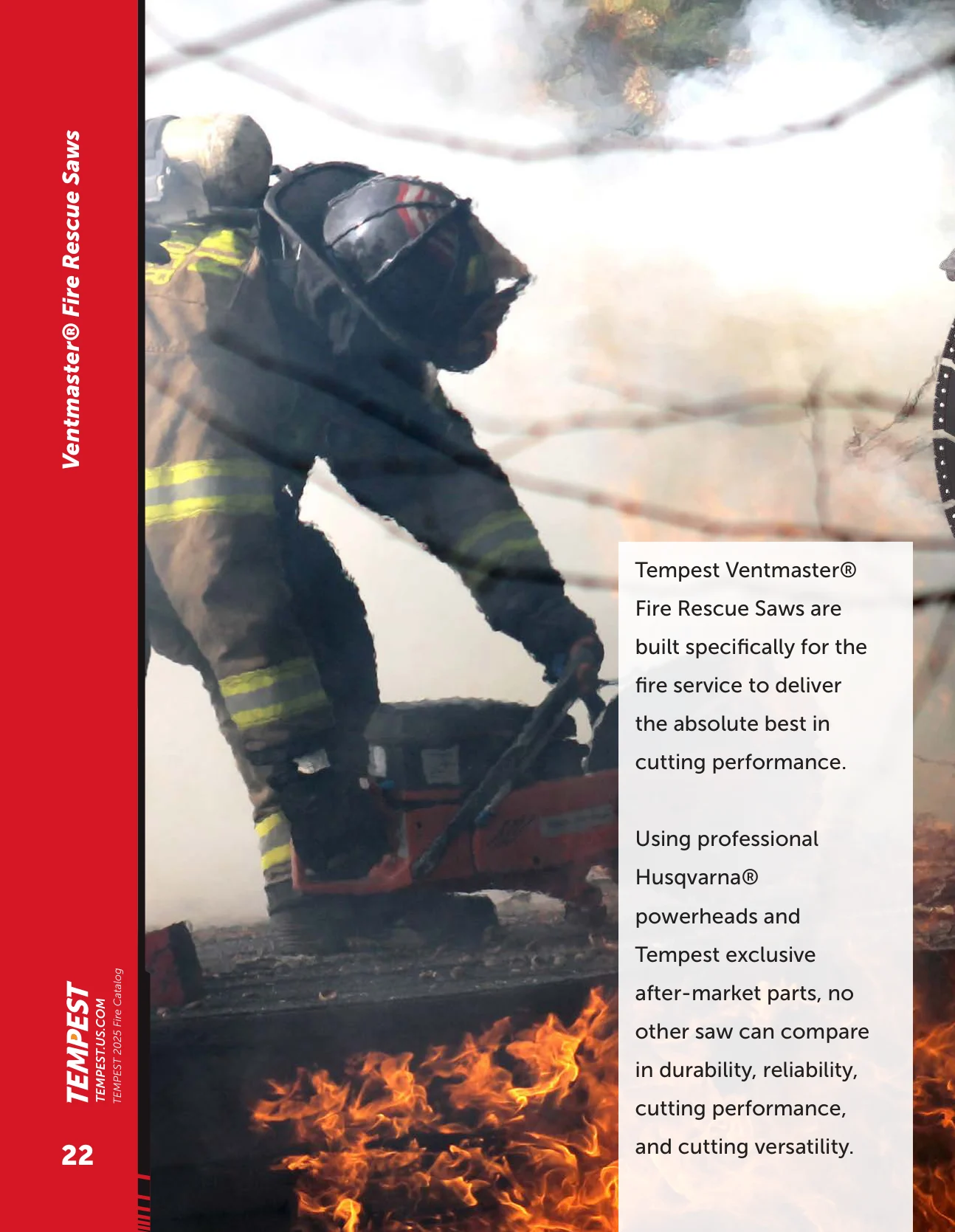
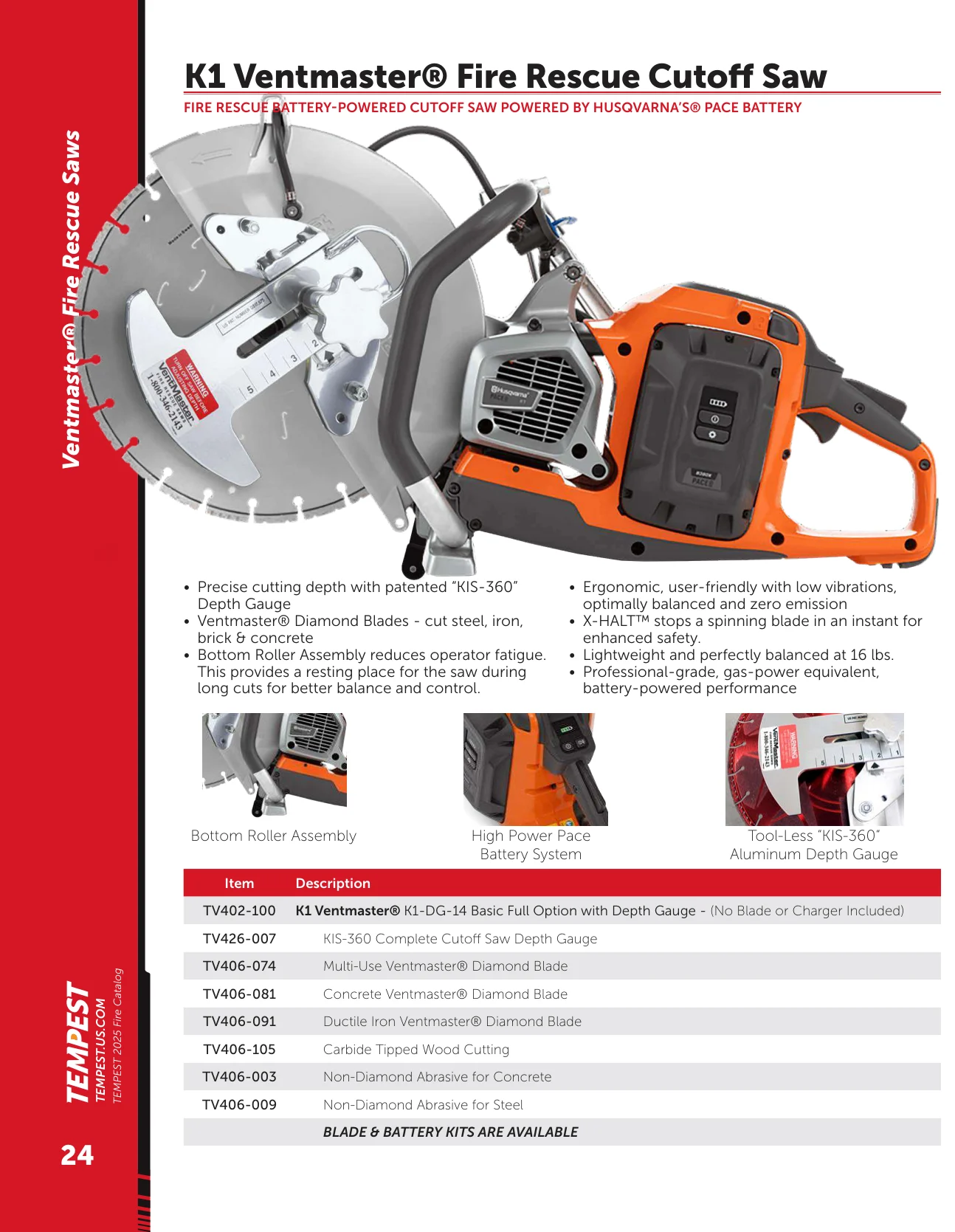
The Tempest VentMaster® K1 is a battery-powered cutoff saw purpose-built for fire ground ventilation operations. Combining the precision of the patented KIS-360 depth gauge system with battery power, the K1 gives crews a zero-exhaust, low-noise cutting solution for structural ventilation in any environment.
The K1 uses Husqvarna batteries and chargers — available in BLI 200 or BLI 300 configurations for extended runtime. The KIS-360 depth gauge provides precise, adjustable cutting depth control, preventing over-penetration during roof and wall ventilation.
Key Features
Patented KIS-360 Depth Gauge
Precise cutting depth control with the patented KIS-360 system — adjustable to prevent over-penetration on roofs and walls, protecting firefighters from hidden structural elements and utilities.
Battery Powered — No Exhaust
Zero exhaust emissions — ideal for enclosed or partially enclosed ventilation operations where gasoline exhaust would contaminate the work environment or create additional hazards.
Husqvarna Battery Platform
BLI 200 and BLI 300 Husqvarna® batteries available — departments running other Husqvarna battery tools can share the platform.
VentMaster® Diamond Blades
Compatible with the full VentMaster® blade line — multi-use, concrete, ductile iron diamond blades, plus carbide wood and abrasive options for any cutting material.
Low Noise Operation
Significantly quieter than gasoline-powered saws — improved crew communication on the fire ground during cutting operations.
Quick Deployment
No priming, no choke, no pull cord — battery power means the saw is ready to cut the instant it’s needed. Critical time savings at the start of a ventilation operation.
Models & Ordering Information
| Item No. | Description |
|---|---|
| TV402-100 | K1 VentMaster® K1-DG-14 Basic Full Option with Depth Gauge (No Blade or Charger Included) |
| TV426-007 | KIS-360 Complete Cutoff Saw Depth Gauge |
| TV406-074 | Multi-Use VentMaster® Diamond Blade |
| TV406-081 | Concrete VentMaster® Diamond Blade |
| TV406-091 | Ductile Iron VentMaster® Diamond Blade |
| TV406-105 | Carbide Tipped Wood Cutting Blade |
| TV406-003 | Non-Diamond Abrasive for Concrete |
| TV406-009 | Non-Diamond Abrasive for Steel |
Blade & battery kits available. Contact for kit configurations.