
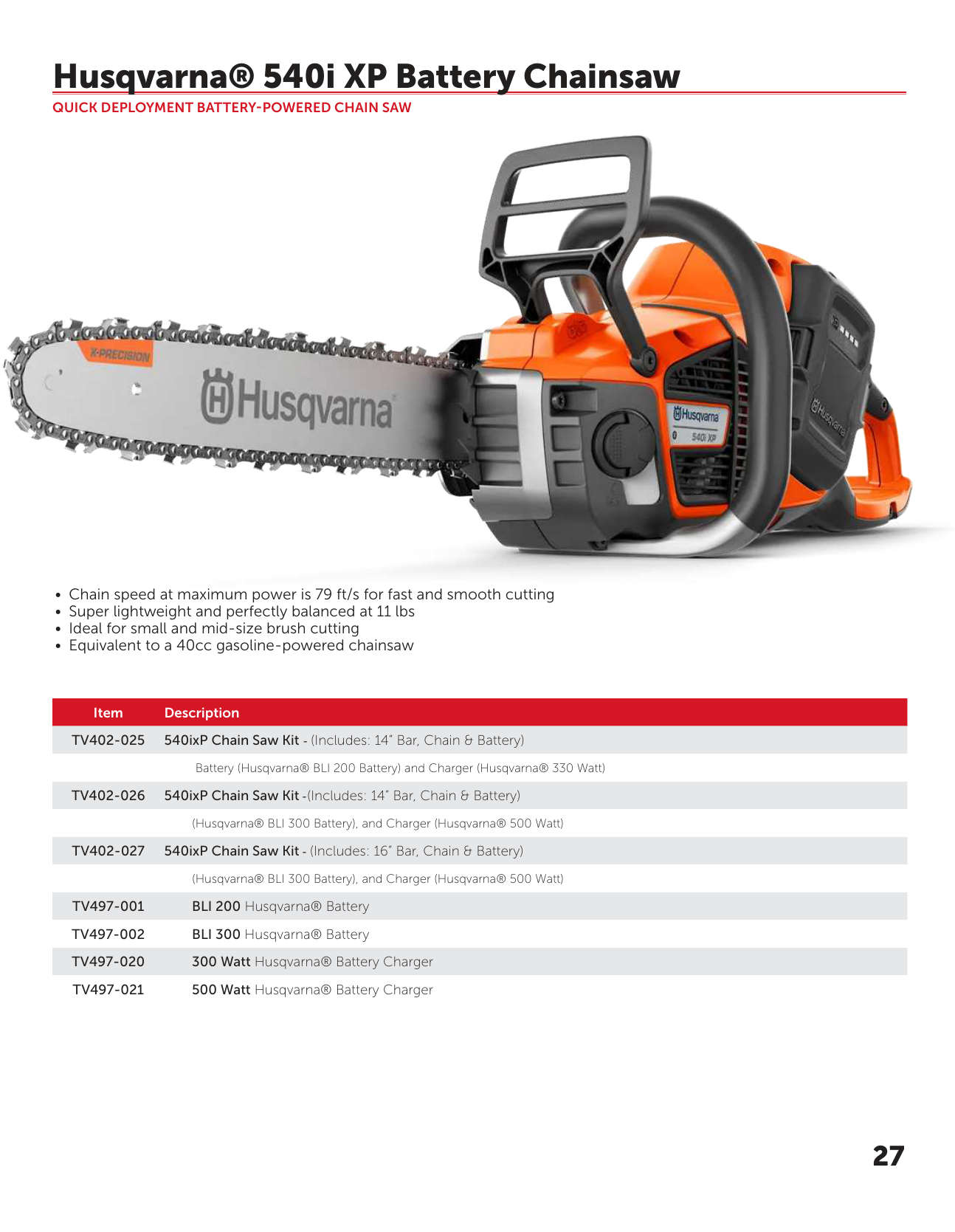
Gasoline chainsaws have served fire rescue crews for decades, but they carry a specific set of operational liabilities that become serious problems at the wrong moments. A flooded carburetor at scene, exhaust fumes accumulating in a partially collapsed structure, or a crew member unable to hear a victim calling out over engine noise are not hypothetical scenarios. They are documented operational failures that electric power eliminates outright. The Husqvarna 540i XP, distributed through Tempest Fire, is a purpose-selected battery chainsaw built to remove those failure modes from structural ventilation and rescue cutting operations without sacrificing the cutting capability fire crews actually need.
What is the Husqvarna 540i XP and why do fire rescue departments select it?
The Husqvarna 540i XP is a battery-powered chainsaw available through Tempest in 14-inch and 16-inch bar configurations, offered as complete ready-to-deploy kits specifically for fire and rescue operations. Its primary selection drivers are instant electric start, zero exhaust emissions, and significantly reduced operating noise compared to gasoline saws.
Tempest sources the 540i XP as part of a dedicated fire rescue tool line from their Fresno, California facility. Three complete kit configurations cover the operational range: TV402-025 (14-inch bar, BLI 200 battery, 330W charger), TV402-026 (14-inch bar, BLI 300 battery, 500W charger), and TV402-027 (16-inch bar, BLI 300 battery, 500W charger). Each kit ships with bar, chain, battery, and charger configured for immediate apparatus deployment, removing the field-assembly step that delays first cut time.
How does instant electric start change the operational timeline during rescue ventilation?
The 540i XP starts cutting within seconds of being taken off the apparatus, with no pull cord procedure, no choke sequence, and no warm-up requirement. In time-critical ventilation and collapse rescue operations, the difference between a saw that starts immediately and one that requires multiple pull attempts is directly measurable in operational delay.
Gasoline chainsaw starting failure at scene is one of the most common tool reliability complaints documented in fire service after-action reports. Cold weather carburetor issues, stale fuel, and flooded engines account for a significant portion of those failures. The 540i XP’s battery electric system removes every one of those variables. The saw does not care about ambient temperature in the way a carbureted engine does, and there is no fuel management requirement between deployments. For rapid roof access operations where the ventilation cut needs to happen in the first minutes of scene arrival, this reliability margin is operationally significant.
Why does zero exhaust emission matter in collapse rescue and confined structural environments?
In a collapsed structure, partially enclosed void space, or any rescue environment with limited air exchange, gasoline engine exhaust adds carbon monoxide and hydrocarbon contamination to an atmosphere that may already be compromised. Battery electric operation produces zero exhaust gases, removing that hazard entirely from the working environment.
This is not a minor comfort consideration. OSHA’s permissible exposure limit for carbon monoxide is 50 parts per million as an 8-hour time-weighted average, with a ceiling of 200 ppm. A gasoline chainsaw running at full throttle in a confined space can exceed hazardous thresholds quickly, forcing crews to pause cutting for ventilation or work in SCBA when the respiratory load is already high. The 540i XP’s electric drive generates no combustion byproduct, allowing continuous cutting operations in tighter environments without adding an atmospheric hazard on top of the structural one. For technical rescue teams operating under OSHA confined space and CO exposure standards, this is a material operational advantage.
BLI 200 vs BLI 300 battery: which configuration matches your operational requirements?
The BLI 200 battery pairs with the 330W charger in the TV402-025 kit and is sized for standard fire rescue cutting operations. The BLI 300 battery, available separately as TV497-002 and included in both the TV402-026 and TV402-027 kits, provides extended runtime for longer operations and pairs with the 500W charger for faster between-incident recharge.
The decision between BLI 200 and BLI 300 comes down to two factors: anticipated cutting duration per incident and apparatus storage capacity. Departments running primary structural fire response where ventilation cuts are typically completed in a few minutes will find the BLI 200 adequate for most operations. Departments running extended collapse rescue, wildland interface, or multi-structure operations where the saw may be in continuous use for longer periods should specify the BLI 300. The 500W charger included with BLI 300 kits recharges faster than the 330W unit, which matters when apparatus turnaround time between incidents is short. The Tempest TV497-002 Battery BLI 300 Husqvarna is also available as a standalone spare, allowing departments to carry a second charged battery on apparatus without purchasing a second complete kit.
14-inch bar vs 16-inch bar: what determines the right cutting geometry for fire rescue?
The 14-inch bar is optimized for compact, maneuverable cutting in tight roof access situations and structural environments where swing clearance is limited. The 16-inch bar provides deeper cut capacity through thicker structural elements, including heavier dimensional lumber, engineered wood members, and stacked materials encountered in collapse scenarios.
Most residential structural ventilation operations fall within 14-inch bar capacity. Peaked roof ventilation cuts through standard dimensional framing, door or window breaching through typical construction, and tree cutting for road clearance or entrapment operations are all well within 14-inch capability. The 16-inch bar becomes the correct selection when departments regularly operate on commercial structures with heavier framing, respond to trench or collapse incidents involving thick engineered lumber, or want a single bar length that handles both residential and heavier structural work without changing setups. Replacement bar options for both lengths are available, including the Bar – .325 Mini, .043 Gauge, for 51 Drive Links and the Tempest TV497-061 16″ Bar for departments maintaining spare cutting components on apparatus.
How does reduced operating noise affect rescue effectiveness during cutting operations?
The 540i XP operates at significantly lower noise levels than comparable gasoline chainsaws. That noise reduction has two direct operational benefits: improved ability to hear victim communication during active cutting near a collapse site, and improved crew coordination without requiring radio communication for short-distance coordination instructions.
Gasoline chainsaws in full operation generate sound levels that overwhelm normal verbal communication and can mask victim calls from within a structure. Crews working collapse rescue are trained to use sound and voice contact to locate victims, and a gasoline saw running during that process introduces a continuous masking noise that forces work-stop cycles to listen. The 540i XP’s lower acoustic output allows the cutting operation and the listening operation to coexist more effectively. This is particularly relevant for technical rescue teams running concurrent victim search and ventilation operations, where crew members within close proximity need to exchange information rapidly without relying entirely on radio traffic.
What applications is the Husqvarna 540i XP best suited for in the fire service?
The 540i XP covers the primary cutting scenarios encountered in structural firefighting, technical rescue, and hazmat-adjacent operations where exhaust contamination is a concern. Core applications include rapid roof ventilation on residential and light commercial structures, forcible entry cutting through wood frame construction, vehicle extrication support cuts through composite and structural materials, tree entrapment operations in wildland interface, and collapse rescue cutting in void space environments.
For departments building or upgrading a fire rescue chainsaw kit, the complete Tempest Husqvarna 540i xP Battery-Powered Chain Saw kit configurations eliminate the need to source components separately. The Tempest Fire Rescue Chainsaw Upgrade Kit is an additional option for departments transitioning existing saw inventories to rescue-configured cutting components. Both paths are supported through PE Energy’s fire and rescue equipment line, with individual battery and charger components available separately for departments expanding runtime capacity on existing 540i XP units. Tempest’s product line is backed by their Fresno, California facility, with part numbers structured to support fleet standardization across apparatus.
When is the 540i XP the right selection, and when should departments consider other options?
The 540i XP is the correct selection when the operational priorities are instant reliability, zero exhaust, reduced acoustic output, and complete kit readiness for fire rescue and structural ventilation. It is particularly well matched to departments that run frequent structure fires with active ventilation requirements, technical rescue teams where confined space operations are a regular scenario, and any apparatus configuration where fuel management between incidents creates a reliability risk.
The 540i XP is not the correct selection when the primary use case is sustained high-volume cutting over very extended operations where battery recharge time exceeds what BLI 300 runtime and 500W charging can support. Departments running multi-day wildfire support with no apparatus return cycle, or operations requiring continuous cutting beyond what a single BLI 300 charge provides and without a spare battery in rotation, should evaluate whether supplemental gasoline saws remain in their tool complement. For all other standard fire rescue operations, the 540i XP removes the three most common gasoline chainsaw failure modes at scene, start reliability, exhaust contamination, and acoustic interference, and delivers them in a complete deployable kit with no field assembly required. Consult the Tempest official product resources for current specification documentation when specifying for apparatus procurement.
Tempest Fire
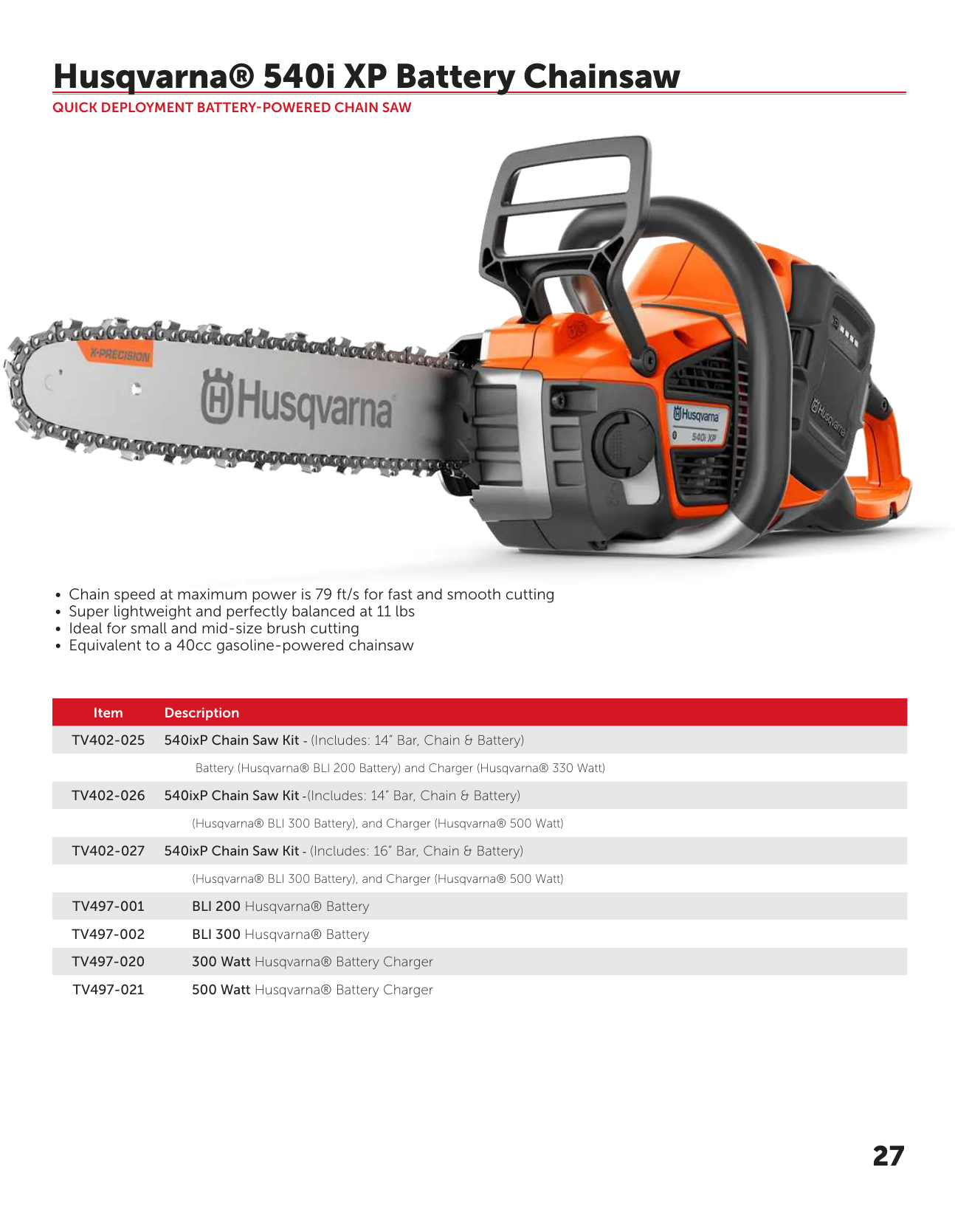
Husqvarna® 540i XP Battery Chainsaw
14″ & 16″ Bar Options | BLI 200 & 300 Batteries | Fire & Rescue
Overview
The Husqvarna® 540i XP is a battery-powered chainsaw offered through Tempest for fire rescue and structural ventilation operations. Available in 14-inch and 16-inch bar configurations with BLI 200 or BLI 300 batteries, the 540i XP provides quick-deployment cutting power with zero exhaust emissions.
Complete kits are available including bar, chain, battery, and charger — ready for immediate deployment. The 540i XP is particularly useful for rapid roof access, collapse rescue, and tree cutting operations where gasoline exhaust and noise create operational complications.
Key Features
14″ & 16″ Bar Options
Two bar length options for different cutting requirements. The 14-inch bar for compact, maneuverable cutting; the 16-inch bar for deeper cuts through thicker structural elements.
Instant Start — No Pull Cord
Battery electric start eliminates the delay of gasoline starting procedures. The saw is cutting within seconds of taking it off the apparatus — critical for time-sensitive rescue and ventilation operations.
BLI 200 & BLI 300 Battery Options
BLI 200 battery for standard operations; BLI 300 for extended cutting runtime. Both available with 300W or 500W chargers depending on charge speed requirements.
Zero Exhaust Emissions
Electric operation — no exhaust gases in enclosed rescue environments, collapsed structures, or partially confined spaces where gasoline exhaust is an additional hazard.
Reduced Noise
Significantly quieter than gasoline chainsaws — improved victim communication during collapse rescue, improved crew coordination during cutting operations.
Complete Kits Available
Ready-to-deploy kits include bar, chain, battery, and charger. Three kit configurations available for 14″ BLI 200, 14″ BLI 300, and 16″ BLI 300 setups.
Models & Ordering Information
| Item No. | Description |
|---|---|
| TV402-025 | 540i XP Chain Saw Kit — 14″ Bar, Chain & BLI 200 Battery + 330W Charger |
| TV402-026 | 540i XP Chain Saw Kit — 14″ Bar, Chain & BLI 300 Battery + 500W Charger |
| TV402-027 | 540i XP Chain Saw Kit — 16″ Bar, Chain & BLI 300 Battery + 500W Charger |
| TV497-001 | BLI 200 Husqvarna® Battery |
| TV497-002 | BLI 300 Husqvarna® Battery |
| TV497-020 | 300 Watt Husqvarna® Battery Charger |
| TV497-021 | 500 Watt Husqvarna® Battery Charger |
Manufacturer: Tempest — 4708 N. Blythe Avenue, Fresno, California 93722 USA — tempest.us.com