
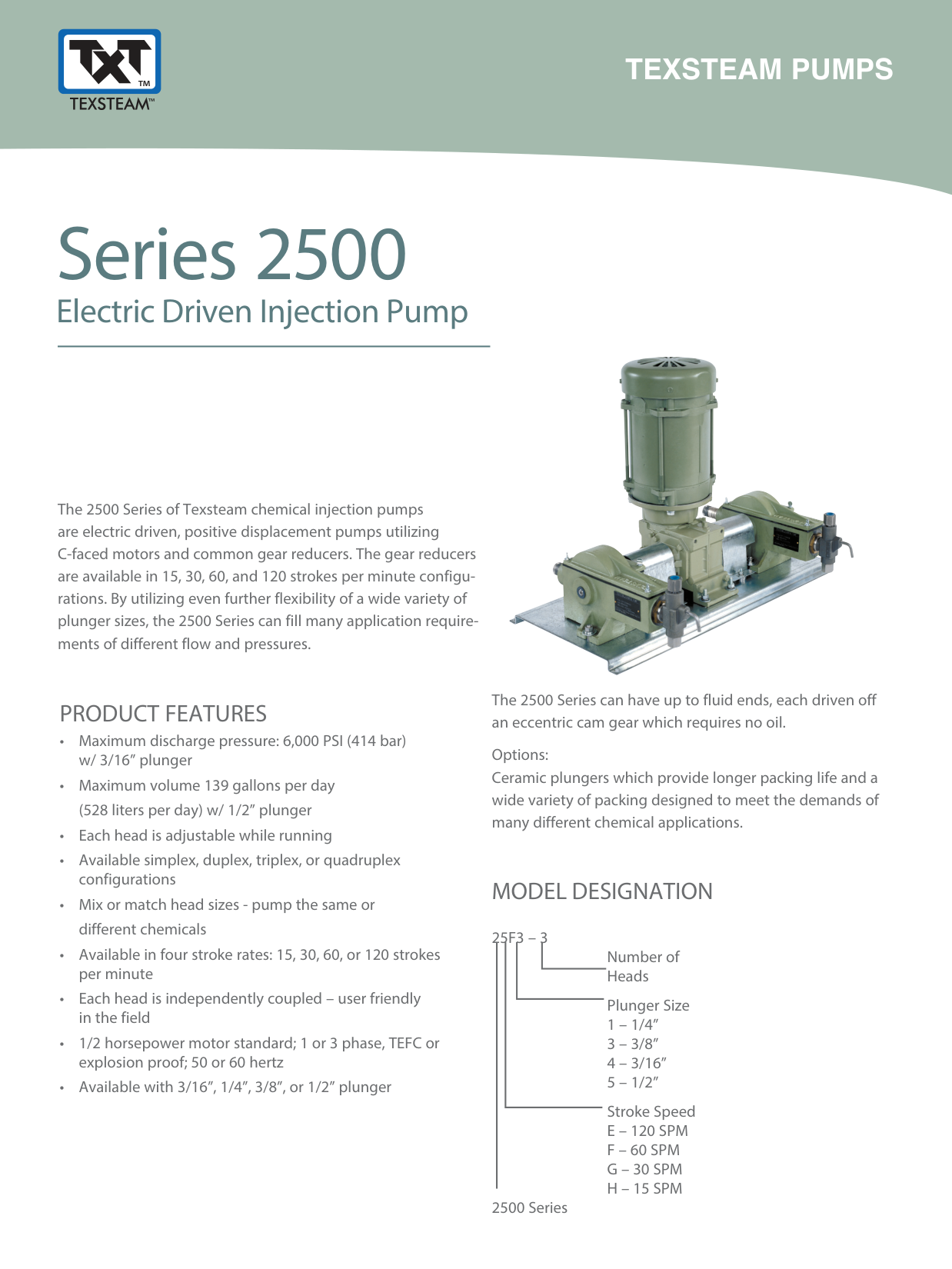
Chemical injection failure in the field rarely announces itself with a loud bang. It shows up quietly, as scale buildup choking a wellhead, as corrosion pitting a flowline from the inside, or as hydrate plugs shutting in a pipeline nobody expected to go offline. The pump injecting your corrosion inhibitor, scale inhibitor, or methanol has one job: deliver a precise, repeatable dose at whatever pressure the process demands, every hour of every day. When the pump drifts, leaks, or stops, the downstream chemistry fails with it. The Texsteam Series 2500 Electric Pump was engineered specifically to solve that problem in electrically powered installations where gas-driven alternatives are impractical or prohibited.
What is the Texsteam 2500 Series and how does it work?
The Texsteam 2500 Series is an electrically driven, positive displacement chemical injection pump that uses a C-faced motor coupled to a common gear reducer and an eccentric cam mechanism to drive plunger-style fluid ends. Positive displacement means each stroke moves a fixed, predictable volume of fluid regardless of discharge pressure variations, which is the defining requirement for accurate chemical dosing in oil and gas service.
The eccentric cam design is a notable detail: it requires no oil bath around the cam itself, reducing one maintenance variable that plagues conventional crankshaft designs. The fluid end bodies are standard 316 stainless steel, and plungers are manufactured from 17-4PH stainless steel, a precipitation-hardened grade that provides significantly higher yield strength than standard 316 SS while retaining corrosion resistance. A ceramic plunger option is also available for applications where aggressive chemicals accelerate packing wear on metallic plungers.
What discharge pressures and flow rates does the 2500 Series support?
The 2500 Series covers a wide operating envelope: maximum discharge pressure reaches 6,000 PSI (414 bar) using the 3/16-inch plunger at 15 or 30 strokes per minute, and maximum volumetric output reaches 139.5 gallons per day (528 L/day) using the 1/2-inch plunger at 120 SPM. The combination of four plunger sizes and four stroke speeds gives operators 16 distinct flow-pressure operating points from a single pump platform.
To illustrate the tradeoff: the 3/16-inch plunger at 60 SPM delivers 9.8 GPD at up to 6,000 PSI, while the 1/2-inch plunger at 120 SPM delivers 139.5 GPD but drops maximum pressure to 525 PSIG (36 bar). The minimum injectable flow at the 3/16-inch / 15 SPM configuration is 0.2 GPD (1 L/day), making this series viable for very low-dose inhibitor injection that would overwhelm a larger-bore pump. For 50 Hz electrical installations, all volumes are derated by a factor of 0.8, a straightforward correction stated in the published specification sheet.
How do packing material choices affect maximum operating pressure?
Packing material selection is not cosmetic. It directly sets the upper pressure limit for a given plunger size, and choosing the wrong material for a chemical or pressure service is one of the most common sources of premature seal failure in chemical injection applications.
The 2500 Series fluid end supports four packing materials: Buna-N, Hard, Viton, and Teflon. For the 3/16-inch plunger, Hard packing reaches the full 6,000 PSIG (414 bar) rating, while Buna-N and Teflon are limited to 3,000 PSIG (207 bar) and Viton to 3,500 PSIG (345 bar). The pressure hierarchy holds across all plunger sizes: Hard packing consistently allows the highest working pressure, and Viton consistently outperforms Buna-N and Teflon at the larger bore sizes. For the 3/8-inch and 1/2-inch plungers, Viton packing carries a rated maximum of 3,500 PSIG (240 bar), compared to only 1,500 PSIG (103 bar) for Buna-N or Teflon at the 3/8-inch size. Operators handling aromatic hydrocarbon-based chemicals should confirm Buna-N compatibility before specifying, as aromatic hydrocarbons are a known swelling agent for nitrile elastomers.
What configurations are available, and when should you use duplex or triplex?
The 2500 Series is available in simplex (one head), duplex (two heads), triplex (three heads), and quadruplex (four heads) configurations. Each head is independently coupled, meaning heads can be added or removed in the field without replacing the drive assembly.
More practically, the multi-head architecture allows operators to mix plunger sizes within a single pump, injecting different chemicals at different rates simultaneously from one motor and gear reducer. A duplex unit could run a 3/16-inch head at 60 SPM for a high-pressure corrosion inhibitor injection point while running a 1/2-inch head at 15 SPM for a higher-volume scale inhibitor at lower pressure, sharing one electrical connection and one mechanical drive. Each head is independently adjustable while the pump is running, so dose rates can be tuned without shutting down injection. The model designation encodes this configuration: a model number ending in -2 is a duplex unit, -3 is triplex, and -4 is quadruplex, with the plunger size and stroke speed embedded in the preceding characters.
What motor options are available for hazardous area installations?
The standard motor is 1/2 HP, available in single-phase or three-phase configurations, in both 50 Hz and 60 Hz ratings. Motor enclosure options include TEFC (Totally Enclosed Fan-Cooled) for general industrial environments and explosion-proof enclosures for classified hazardous locations common in oil and gas processing facilities.
Explosion-proof motor selection is a non-negotiable requirement under OSHA 29 CFR 1910 Subpart S hazardous location electrical requirements in areas classified as Class I Division 1 or Division 2 for flammable gas or vapor. The C-faced motor mounting system used on the 2500 Series is a NEMA-standardized interface, which simplifies motor substitution or upgrade in the field without modifying the pump base plate or drive coupling geometry.
What does the 2500 Series maintenance schedule actually require?
Maintenance requirements for the 2500 Series are straightforward but specific about lubricant type and interval. The gear reducer oil must be checked before first start-up, and oil change intervals are 2,000 hours for continuous duty or 2,500 running hours (or 6 months, whichever comes first) for intermittent service.
Two gear reducer lubricants are specified by name: Mobil SHC 634, rated for ambient temperature service from 0°F to 135°F, and Texaco Meropia 460, suitable for the narrower range of 32°F to 100°F. Using a non-specified lubricant or extending oil change intervals is a documented path to gear reducer bearing failure. Separately, the cam bearing and crosshead require monthly grease application. The published maintenance notes include a specific caution against over-tightening packing: excessive packing torque damages the 17-4PH plunger surface, which then accelerates packing wear in a self-reinforcing failure cycle. Packing should be snugged to stop leakage and no further. Understanding common maintenance failure modes is covered in detail in the article The $50000 Mistake That’s Killing Your Chemical Injection System Right Now.
How does the 2500 Series compare to other Texsteam electric pump series?
The 2500 Series occupies a specific position within the Texsteam electric pump lineup. Its 6,000 PSI maximum discharge pressure at the 3/16-inch plunger makes it one of the higher-pressure options in electrically driven chemical injection, suited for wellhead injection points or high back-pressure pipeline applications where gas-driven pumps are not available.
The Texsteam Series 2400 Electric Pump serves applications with different flow-pressure requirements, and the Texsteam Series 4300 Electric Pump addresses higher-volume injection needs. Selecting between these series requires matching the plunger bore and stroke speed to the target injection rate and back-pressure, not simply choosing the largest pump available. Oversizing a positive displacement chemical injection pump creates dose inaccuracy at the low end of the adjustment range, which can result in under-inhibition at normal operating rates while the pump runs at minimum stroke setting.
Applications: Where is the Texsteam 2500 Series typically deployed?
The 2500 Series is designed for continuous chemical injection service across upstream and midstream oil and gas operations. Typical deployment points include wellhead corrosion inhibitor injection at high shut-in pressures, pipeline hydrate inhibitor (methanol or MEG) dosing, scale inhibitor injection into production flowlines, and biocide injection into water handling systems.
The multi-head configuration makes the pump particularly practical at production facilities where several chemical programs must be managed from a single installation point. A quadruplex 2500 unit can simultaneously handle corrosion inhibitor, scale inhibitor, oxygen scavenger, and a demulsifier from one electrically powered skid, reducing the footprint and wiring complexity compared to four separate simplex units.
For operators evaluating the broader impact of chemical injection system performance on facility economics, the article How One “Invisible” Problem Is Bleeding Oil & Gas Operations Dry provides relevant context on how injection failures propagate into operational losses. The full product specification and ordering details are available on the Texsteam Series 2500 Electric Pump product page.
When is the 2500 Series the right choice, and when is it not?
The 2500 Series is the correct specification when an application requires reliable electrical drive, precise metered dosing at pressures up to 6,000 PSI, and the operational flexibility of independently adjustable multi-head injection from a single motor and gear reducer. It performs well in permanent surface installations with a stable electrical supply and a maintenance program that can support the specified gear reducer oil change intervals and monthly cam bearing greasing.
It is not the right choice where no electrical power is available, where the required injection volume exceeds 139.5 GPD, or where the application involves extremely high-viscosity chemicals that require a different pump geometry. At high-volume injection points, the 2500 Series operating at maximum stroke on a 1/2-inch head will be running at the edge of its pressure rating (525 PSIG at 120 SPM), which leaves no margin for pressure excursions. For those applications, reviewing the Texsteam 4300 Series or a higher-displacement platform is the appropriate next step. Specifying the 2500 Series within its published flow-pressure envelope, with the correct packing material for the injected chemical, is what makes it a long-service, low-maintenance workhorse rather than a repeat maintenance problem.
Series 2500
Electric Driven Chemical Injection Pump — Positive Displacement
The Texsteam 2500 Series is an electrically driven positive displacement pump using C-faced motors and common gear reducers. Available in simplex, duplex, triplex, and quadruplex configurations with four plunger sizes and four stroke speeds.
- Max discharge pressure: 6,000 PSI (414 bar) with 3/16″ plunger
- Max volume: 139 gallons per day (528 L/day) with 1/2″ plunger at 120 SPM
- Each head independently adjustable while running
- Simplex, duplex, triplex, or quadruplex configurations
- Mix or match head sizes — pump same or different chemicals simultaneously
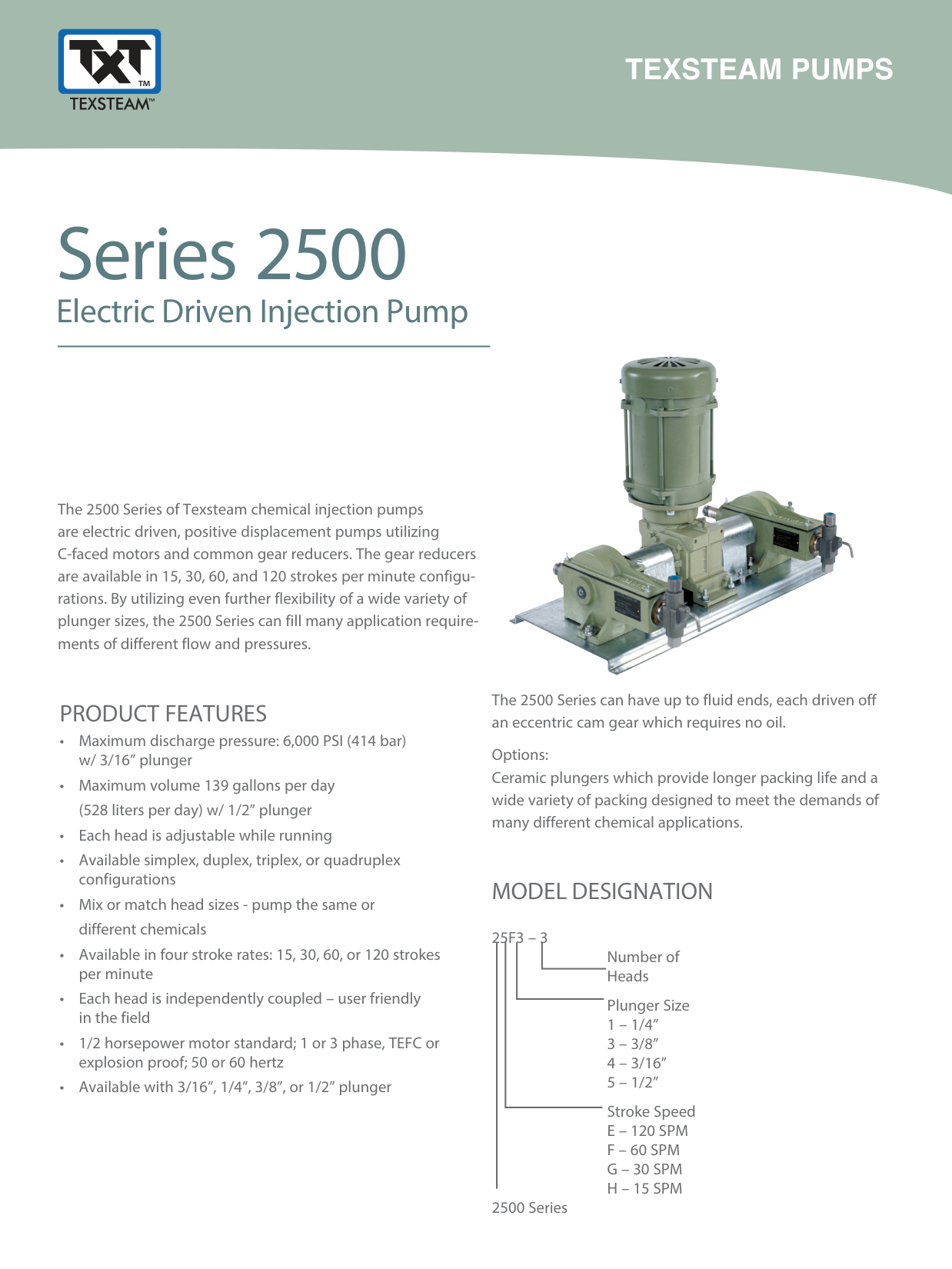
1. FLOW & PRESSURE SPECIFICATIONS
| Plunger Size | Strokes/Min | Max Discharge Pressure PSI (bar) | Max GPD (L/day) | Min GPD (L/day) |
|---|---|---|---|---|
| 3/16″ | 15 | 6,000 (414) | 2.4 (9) | 0.2 (1) |
| 30 | 6,000 (414) | 4.9 (19) | 0.5 (2) | |
| 60 | 6,000 (414) | 9.8 (37) | 1.0 (4) | |
| 120 | 4,000 (275) | 18.7 (71) | 1.9 (7) | |
| 1/4″ | 15 | 3,200 (221) | 4.3 (16) | 0.4 (2) |
| 30 | 4,000 (275) | 8.6 (33) | 0.9 (3) | |
| 60 | 4,000 (275) | 17.3 (65) | 1.7 (7) | |
| 120 | 2,100 (145) | 34.6 (131) | 3.5 (13) | |
| 3/8″ | 15 | 1,450 (100) | 9.8 (37) | 1.0 (4) |
| 30 | 1,800 (124) | 19.6 (74) | 2.0 (7) | |
| 60 | 1,700 (117) | 39.2 (148) | 3.9 (15) | |
| 120 | 950 (65) | 78.5 (297) | 7.8 (30) | |
| 1/2″ | 15 | 820 (56) | 17.4 (66) | 1.7 (7) |
| 30 | 1,025 (71) | 34.8 (88) | 3.5 (9) | |
| 60 | 1,000 (70) | 69.7 (264) | 7.0 (26) | |
| 120 | 525 (36) | 139.5 (528) | 13.9 (53) |
* For 50 Hz motors multiply volumes by 0.8
2. MAXIMUM PACKING PRESSURE BY MATERIAL
| Plunger Size | Buna-N PSIG (bar) | Hard PSIG (bar) | Viton PSIG (bar) | Teflon PSIG (bar) |
|---|---|---|---|---|
| 3/16″ | 3,000 (207) | 6,000 (414) | 3,500 (345) | 3,000 (207) |
| 1/4″ | 2,400 (165) | 4,000 (275) | 3,500 (240) | 2,400 (165) |
| 3/8″ | 1,500 (103) | 1,800 (124) | 3,500 (240) | 1,500 (103) |
| 1/2″ | 1,000 (69) | 1,025 (71) | 3,500 (240) | 1,000 (69) |
3. MODEL DESIGNATION
Example: 25F3 – 3
| 25 | = 2500 Series |
| E / F / G / H | = Stroke Speed: E=120 SPM, F=60 SPM, G=30 SPM, H=15 SPM |
| 1 / 3 / 4 / 5 | = Plunger Size: 1=1/4″, 3=3/8″, 4=3/16″, 5=1/2″ |
| – 1 to 4 | = Number of Heads |
4. ASSEMBLY CONFIGURATIONS
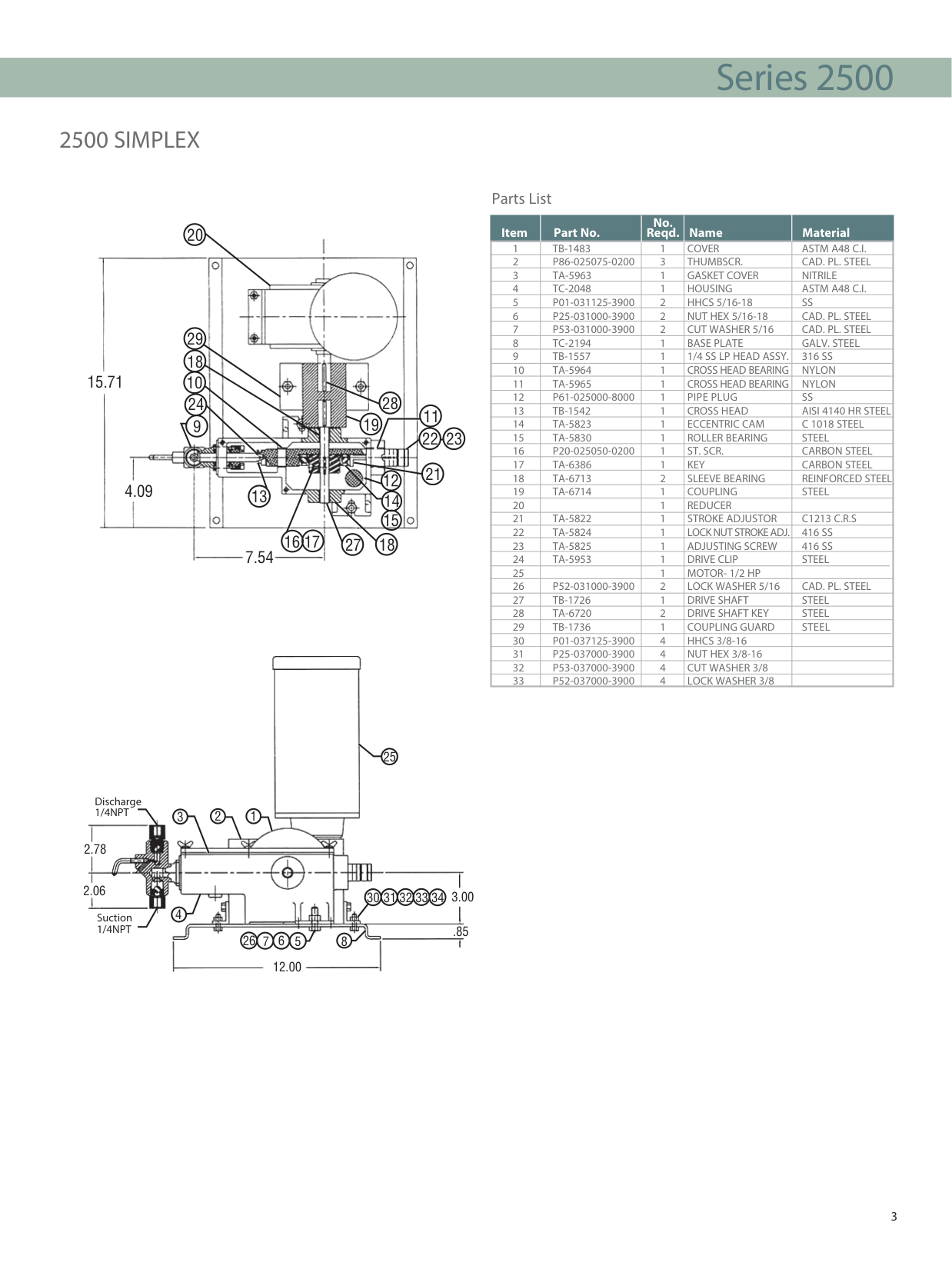
Simplex (Single Head)
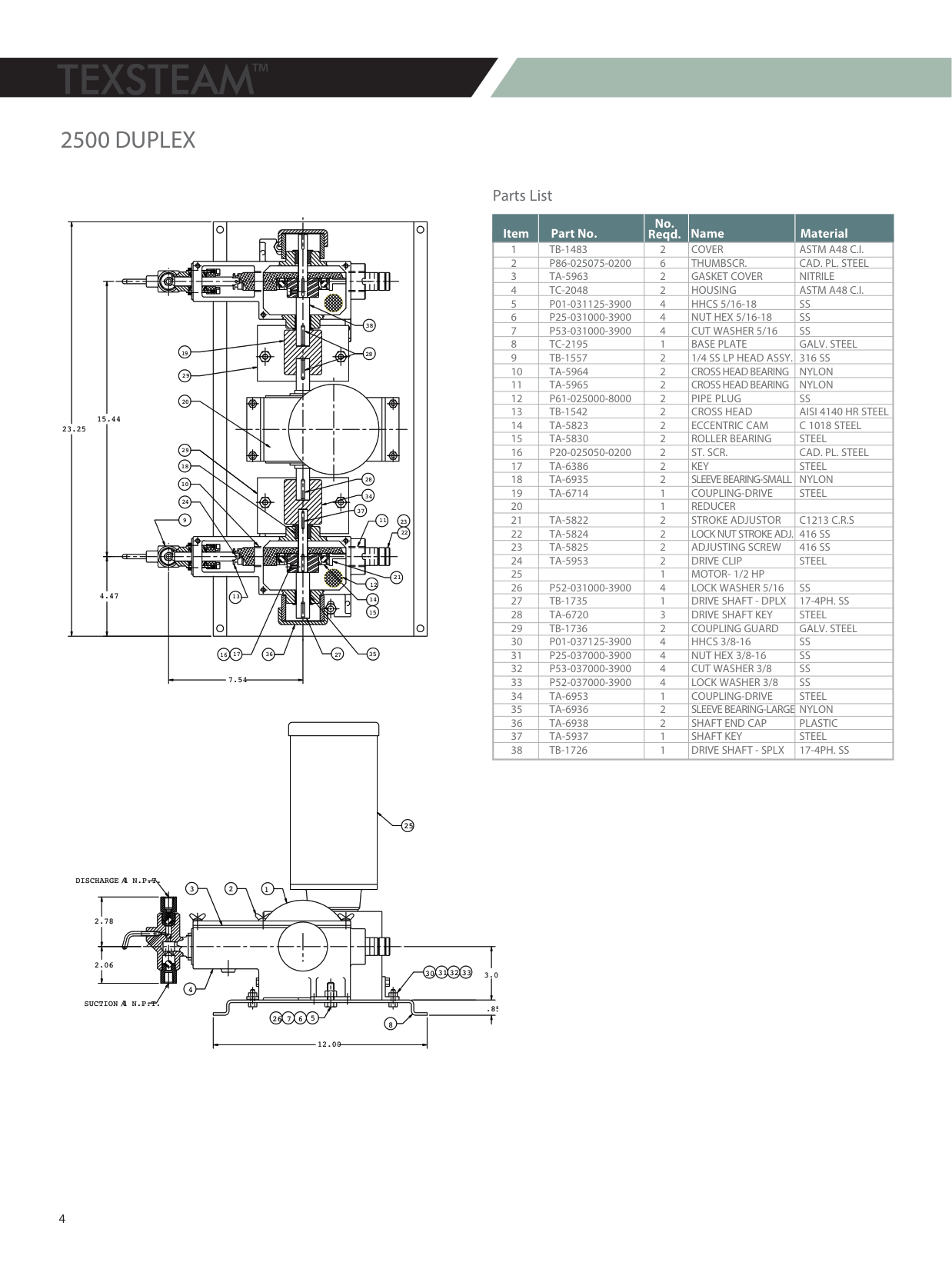
Duplex (Two Heads)
5. FLUID END PARTS BY PLUNGER SIZE
| Item | Description | Material | 3/16″ | 1/4″ | 3/8″ | 1/2″ |
|---|---|---|---|---|---|---|
| 1 | Body | SS | TC 2040 | TC 0291 | TC 0425 | TB 0349 |
| 2 | Gland Nut | 303-SS | TA 6353 (all sizes) | |||
| 3 | Plunger | 17-4PH | TA 6082 | TA 6079 | TA 6080 | TA 6081 |
| 4 | Gland | 303-SS | TA 5642 | TA 1463 | TA 0957 | TA 1219 |
| 5 | Plunger Packing — Buna-N | Buna-N | TA 3969 | TA 1461 | TA 1456 | TA 0959 |
| 5 | Plunger Packing — Hard | Hard | TA 3948 | TA 2295 | TA 1875 | TA 1874 |
| 5 | Plunger Packing — Viton | Viton | TA 3967 | TA 4102 | TA 4101 | TA 4103 |
| 5 | Plunger Packing — Teflon | Teflon | TA 3966 | TA 1642 | TA 1234 | TA 1012 |
| 9 | Head Assembly — 3/16″ | 316SS | TB-1560 | — | ||
| 9 | Head Assembly — 1/4″ | 316SS | — | TB-1557 | — | |
| 9 | Head Assembly — 3/8″ | 316SS | — | TB-1558 | — | |
| 9 | Head Assembly — 1/2″ | 316SS | — | TB-1559 | ||
6. KEY FEATURES
Pump Design
- Eccentric cam design — no oil required
- 316 SS heads standard
- Ceramic plunger option for longer packing life
- Each head independently coupled — field-friendly
- 1/2 HP motor standard; 1 or 3 phase, TEFC or explosion proof; 50 or 60 Hz
- Fluid connections: 1/4″ NPT suction (bottom) and discharge (top)
Maintenance
- Check gear reducer oil level before start-up
- Continuous run: oil change every 2,000 hours
- Intermittent: oil change every 2,500 running hours or 6 months
- Use Mobil SHC 634 (0°F to 135°F) or Texaco Meropia 460 (32°F to 100°F)
- Apply grease to cam bearing and crosshead monthly
- Do not over-tighten packing — can damage plunger
Texsteam 2500 Series NGS.IPG.0003b — © 2022 Natural Gas Solutions North America, LLC. All rights reserved.