
Picture this: It’s 3 AM, and your production supervisor is calling with the news that makes every facility manager’s blood run cold. “We’ve got scale buildup choking three wellheads, corrosion eating through our pipeline, and the whole system is backing up.”
The culprit? Your chemical injection system failed to deliver the precise amount of treatment chemicals your operation desperately needed. Now you’re staring down thousands of dollars in emergency repairs, lost production time, and the kind of regulatory headaches that keep you awake at night.
Here’s the brutal truth most equipment suppliers won’t tell you: Most chemical injection pumps on the market today are built to barely adequate specifications, with sloppy tolerances and unreliable delivery rates that turn your critical chemical protection into a dangerous guessing game.
The Hidden Costs of “Good Enough” Chemical Injection
When your chemical injection system delivers inconsistent flow rates, you’re not just risking equipment failure — you’re hemorrhaging money in ways that don’t show up on any daily report.
Over-injection wastes expensive chemicals and can damage your equipment or contaminate your product stream. Under-injection leaves your system vulnerable to the very problems you’re trying to prevent: scale, corrosion, and emulsification that can shut down your entire operation.
Industry studies show that facilities with unreliable chemical injection systems experience 47% more unplanned downtime and spend an average of $23,000 more per year on emergency repairs and chemical waste than operations running precision-controlled systems.
But the real nightmare scenario happens when inconsistent chemical delivery leads to catastrophic failure. Pipeline corrosion that forces an emergency shutdown. Scale buildup that chokes production to a crawl. Separator systems that fail because demulsifiers weren’t delivered in the precise concentrations required.
Every day you operate with an unreliable chemical injection system, you’re gambling with your facility’s uptime, your maintenance budget, and your peace of mind.
The worst part? Most operators don’t realize their injection system is failing until the damage is already done. By the time you notice irregular chemical consumption or see the early signs of scale or corrosion, you’re already behind the curve — and the repair bills are piling up.
The Engineering Solution That Changes Everything
What if you could eliminate the guesswork from chemical injection forever? What if you could deliver exactly the right amount of treatment chemicals, every time, with ±1% repeatability that makes your system bulletproof against the variables that destroy lesser equipment?
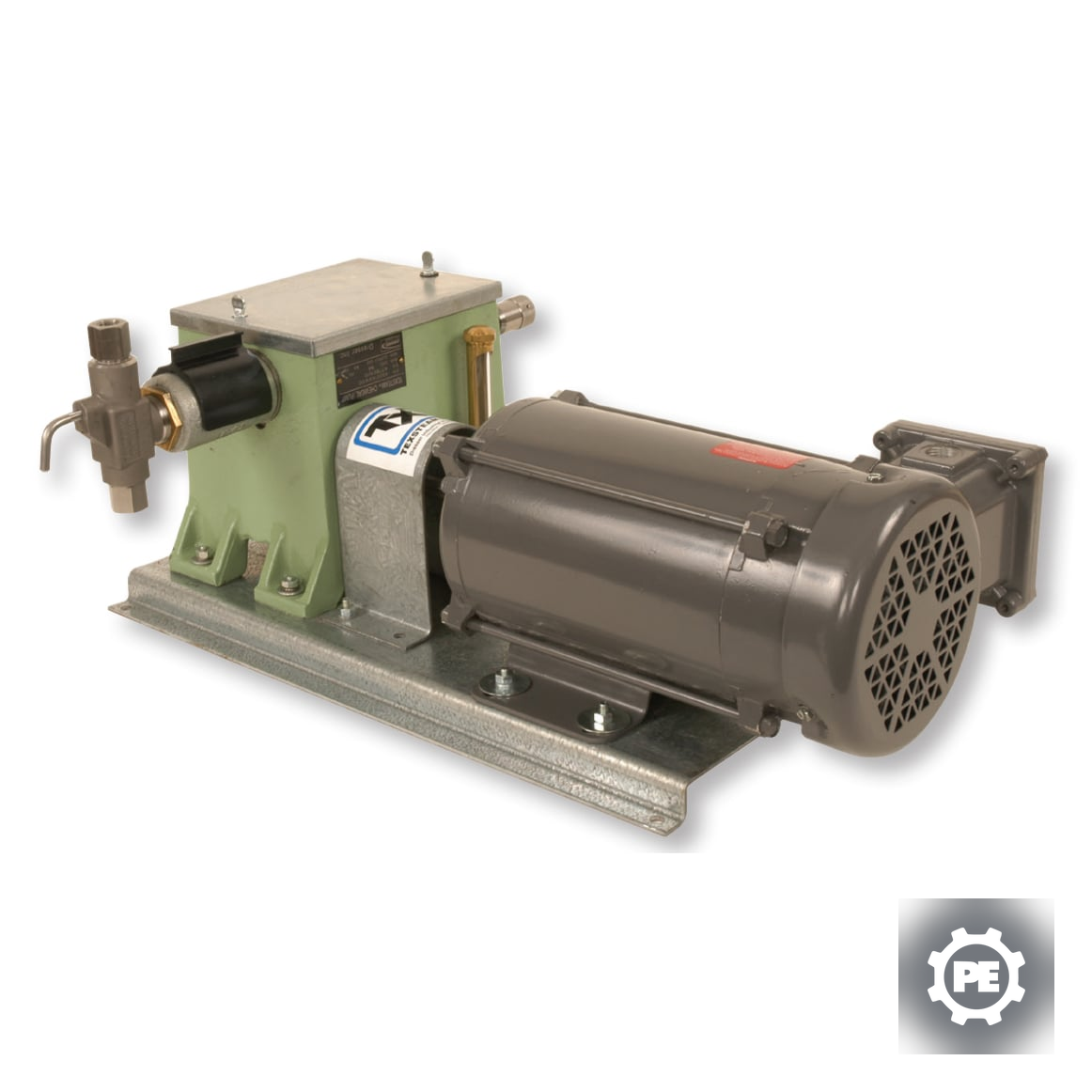
The Texsteam Series 4300 Electric Pump isn’t just another chemical injection system — it’s the precision-engineered solution that puts you in complete control of your chemical delivery, from the smallest wellhead operation to the most demanding multi-point pipeline applications.
Built by Dresser Natural Gas Solutions with decades of field-proven engineering, this isn’t some generic pump with fancy marketing. This is industrial-grade precision designed specifically for the brutal demands of oil and gas production, pipeline operations, and process plants where failure isn’t an option.
Why Precision Engineering Beats “Close Enough” Every Time
Here’s where the Series 4300 separates itself from every other chemical injection pump you’ve probably looked at: the integral worm gear drive system that delivers rock-solid reliability while giving you three different gear ratios (25:1, 50:1, and 100:1) to match your exact application requirements.
Most pumps force you to accept whatever flow range they happen to offer. The Series 4300 lets you dial in precisely the delivery rate you need, from as little as 0.063 gallons per day for micro-dosing applications up to 325 gallons per day for high-volume treatment operations.
Think about what this means for your operation: No more over-treating and wasting expensive chemicals. No more under-treating and risking system failure. Just precise, repeatable delivery that you can count on, shift after shift.
The micrometer stroke adjustment gives you 0–100% capacity change while the pump is running. That means you can fine-tune your chemical delivery in real-time without shutting down the system, losing production time, or calling in maintenance crews for simple adjustments.
But here’s the feature that really sets this system apart: up to 8 injection heads from one common motor. While your competitors are installing multiple pumps with multiple failure points, you’re running one precision-engineered system that handles multi-point injection with surgical accuracy.
Each injection head operates independently, so you can deliver different chemicals at different rates to different points in your system — all controlled from a single, reliable power unit. Scale inhibitor to the wellhead, corrosion inhibitor to the pipeline, demulsifier to the separator — each getting exactly the treatment it needs, when it needs it.
The pressure ratings tell the real story of this pump’s industrial-grade construction: up to 5,000 psig discharge pressure for high-pressure applications, with liquid ends available in ductile iron for standard service or stainless steel for the most corrosive chemical applications.
Those stainless steel liquid ends aren’t just marketing fluff — they’re your insurance against chemical compatibility problems that can destroy lesser pumps. When you’re injecting aggressive scale inhibitors or corrosive treatment chemicals, you need liquid ends that won’t deteriorate, contaminate your chemicals, or fail when you need them most.
The interchangeable liquid ends mean you can adapt the system to different chemicals or different flow requirements without replacing the entire pump. Adjust while the pump is running, swap out components for different applications, or upgrade capacity as your operation grows — all without starting over from scratch.
Six different plunger sizes (3/16″, 1/4″, 3/8″, 1/2″, 3/4″, 1″) give you precise control over flow rates and pressure capabilities. The smaller plungers handle high-pressure, low-volume applications like wellhead chemical injection. The larger plungers move more chemical at lower pressures for pipeline treatment and process applications.
The built-in priming valves eliminate the startup headaches that plague other injection systems. No more bleeding air, no more lost prime, no more service calls because the system won’t start properly after routine maintenance.
Built for Environments That Destroy Ordinary Equipment
The durable cast iron housing with oil sight gauge isn’t just about looking professional — it’s about surviving the conditions that kill lesser equipment. The gasketed gear box cover creates a positive moisture and dirt barrier that keeps your precision components running smoothly in environments where dust, humidity, and temperature swings are daily realities.
The drip-ring style barrier prevents chemical intrusion into the gear box, protecting your investment from the corrosive chemicals the system handles every day. This isn’t an afterthought — it’s engineered protection that keeps your maintenance costs low and your uptime high.
Motor options include single or three-phase configurations with TENV (Totally Enclosed Non-Ventilated) or explosion-proof enclosures for hazardous locations. This isn’t just compliance — it’s peace of mind that your system meets the safety requirements for oil and gas operations where explosive atmospheres are a constant concern.
For applications requiring even lower flow rates, the optional 10:1 external gear reducer takes you down to feed rates as low as half a pint per day. When you need to deliver expensive specialty chemicals in tiny, precise amounts, this is the capability that saves you thousands in chemical costs while ensuring adequate protection.
Real-World Applications Where Precision Saves Money
In oil and gas production, the Series 4300 delivers scale inhibitors, corrosion inhibitors, and demulsifiers at wellheads and separators with the precision that prevents costly downtime and equipment replacement. When you’re treating multiple wells from one central system, the ability to run up to 8 independent injection heads means each well gets exactly the treatment it needs based on its unique chemistry and production profile.
Pipeline and midstream operations demand precise metering of treatment chemicals over long pipeline runs where inconsistent injection can leave sections vulnerable or over-treated. The Series 4300’s flow rate accuracy ensures uniform protection across your entire system, from injection point to delivery terminal.
Process plants benefit from multi-point chemical injection into process streams with independent head adjustment for each injection point. Different process streams need different treatment levels, and the Series 4300 gives you the control to optimize each injection point without compromising the others.
The wide selection of chemical injection pumps available means you can find the exact configuration for your application, whether you need high-pressure capability for wellhead injection or high-volume capacity for pipeline treatment.
The Numbers That Matter When Uptime Is Everything
Let’s talk about the specifications that separate professional-grade equipment from the alternatives. Flow rates from 0.063 to 325 gallons per day per head give you the range to handle micro-dosing applications and high-volume treatment from the same platform. Discharge pressures up to 5,000 psig handle the most demanding high-pressure injection requirements.
The ±1% repeatability means you can count on consistent chemical delivery shift after shift, week after week. When chemical costs run thousands of dollars per month, 1% accuracy versus 5% or 10% accuracy saves serious money while providing better protection for your equipment.
For facilities requiring multiple injection points, running duplex systems doubles your flow rates while maintaining the same precision control. A single motor driving two injection heads gives you redundancy and capacity while minimizing maintenance requirements and installation complexity.
When you choose the Series 4300, you’re not just buying a pump — you’re investing in the precision and reliability that keeps your operation running smoothly while your competitors deal with emergency repairs and chemical waste.
Why Settling for “Good Enough” Costs More Than Precision
The choice is simple: Continue gambling with unreliable chemical injection that threatens your equipment, wastes your chemicals, and keeps you awake at night worrying about the next failure — or step up to the precision-engineered solution that gives you complete control over your chemical delivery.
The Texsteam brand represents decades of field-proven engineering specifically designed for the demanding requirements of oil and gas operations. When you need equipment that works the first time, every time, this is the solution that delivers.
Your operation deserves better than “close enough.” It deserves the precision, reliability, and peace of mind that comes from choosing equipment built to professional standards by engineers who understand that failure is not an option.
Chemical Injection Pumps — Integral Worm Gear Drive
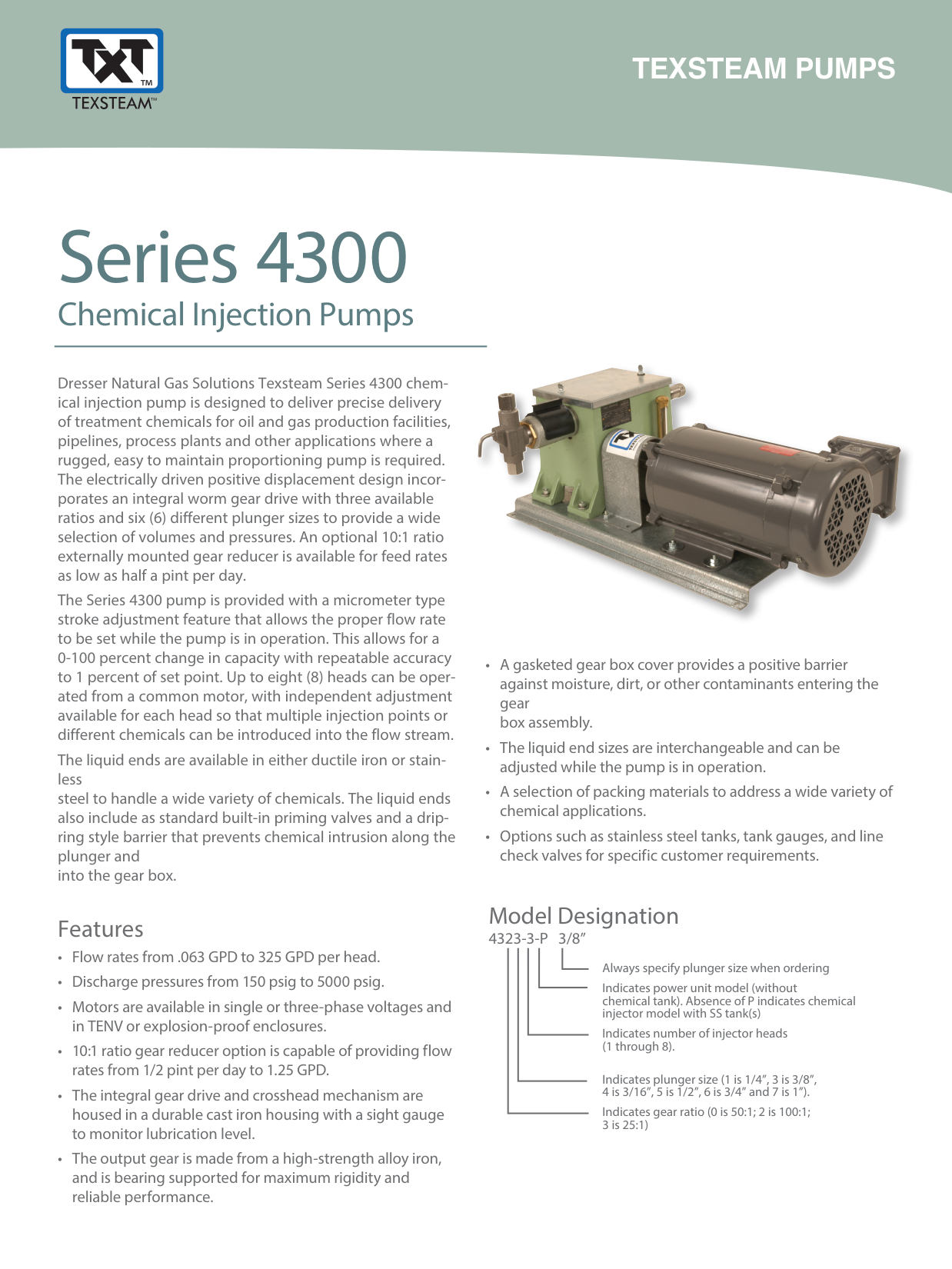
The Dresser Natural Gas Solutions Texsteam Series 4300 is an electrically driven positive displacement chemical injection pump with an integral worm gear drive. Designed for oil and gas production, pipelines, process plants, and any application requiring precise, repeatable chemical delivery.
- Flow rates: 0.063 to 325 GPD per head
- Discharge pressures: 150 to 5,000 psig
- Up to 8 injection heads from one common motor
- Micrometer stroke adjustment: 0–100% capacity change with ±1% repeatability
- Liquid ends in ductile iron or stainless steel
1. PRODUCT FEATURES
Drive & Motor
- Integral worm gear drive — 3 available ratios (25:1, 50:1, 100:1)
- High-strength alloy iron output gear, bearing-supported for rigidity
- Optional 10:1 external gear reducer for feed rates as low as 1/2 pint per day
- Motors: single or three-phase, TENV or explosion-proof enclosures
- Durable cast iron housing with oil sight gauge
- Gasketed gear box cover — positive moisture/dirt barrier
Liquid Ends & Adjustment
- Liquid ends interchangeable — adjust while pump is running
- Built-in priming valves standard
- Drip-ring style barrier prevents chemical intrusion into gear box
- 6 plunger sizes: 3/16″, 1/4″, 3/8″, 1/2″, 3/4″, 1″
- Wide selection of packing materials for diverse chemical applications
- Options: SS tanks, tank gauges, line check valves
2. MODEL DESIGNATION
Example: 4323-3-P 3/8″
| 43 | = 4300 Series |
| 0 / 2 / 3 | = Gear ratio: 0=50:1, 2=100:1, 3=25:1 |
| 1 / 3 / 4 / 5 / 6 / 7 | = Plunger size: 1=1/4″, 3=3/8″, 4=3/16″, 5=1/2″, 6=3/4″, 7=1″ |
| -1 to -8 | = Number of injector heads (1 through 8) |
| -P | = Power unit model (no tank); absence of P = with SS tank(s) |
| 3/8″ | = Always specify plunger size when ordering |
3. FLOW SPECIFICATIONS — SINGLE HEAD (Simplex, 60 Hz)
| Plunger Size | Max Discharge Pressure | 100:1 Ratio | 50:1 Ratio | 25:1 Ratio | ||||||
|---|---|---|---|---|---|---|---|---|---|---|
| Model | Min GPD | Max GPD | Model | Min GPD | Max GPD | Model | Min GPD | Max GPD | ||
| 3/16″ | 5,000 (Hard) / 3,000 (Soft) | 4324 | 0.063 | 2.5 | 4304 | 0.13 | 5 | 4334 | 0.25 | 10 |
| 1/4″ | 2,400 PSI | 4321 | 0.5 | 5 | 4301 | 1 | 10 | 4331 | 2 | 20 |
| 3/8″ | 1,200 PSI | 4323 | 1.2 | 12 | 4303 | 2.3 | 23 | 4333 | 4.6 | 46 |
| 1/2″ | 600 PSI | 4325 | 2.1 | 21 | 4305 | 4 | 40 | 4335 | 8 | 80 |
| 3/4″ | 300 PSI | 4326 | 4.6 | 46 | 4306 | 9.1 | 91 | 4336 | 18.2 | 182 |
| 1″ | 150 PSI | 4327 | 8.1 | 81 | 4307 | 6.3 | 63 | 4337 | 32.5 | 325 |
* For 50 Hz motors multiply Max GPD by 0.83
4. FLOW SPECIFICATIONS — DOUBLE HEAD (Duplex, 60 Hz)
| Plunger Size | Max Discharge Pressure | 100:1 Ratio | 50:1 Ratio | 25:1 Ratio | ||||||
|---|---|---|---|---|---|---|---|---|---|---|
| Model | Min GPD | Max GPD | Model | Min GPD | Max GPD | Model | Min GPD | Max GPD | ||
| 3/16″ | 5,000 (Hard) / 3,000 (Soft) | 4324-2 | 0.13 | 5 | 4304-2 | 0.26 | 10 | 4334-2 | 0.5 | 20 |
| 1/4″ | 2,400 PSI | 4321-2 | 1 | 10 | 4301-2 | 2 | 20 | 4331-2 | 4 | 40 |
| 3/8″ | 1,200 PSI | 4323-2 | 2.4 | 24 | 4303-2 | 4.6 | 46 | 4333-2 | 9.2 | 92 |
| 1/2″ | 600 PSI | 4325-2 | 4.2 | 42 | 4305-2 | 8 | 80 | 4335-2 | 16 | 160 |
| 3/4″ | 300 PSI | 4326-2 | 9.2 | 92 | 4306-2 | 18.2 | 182 | 4336-2 | 36.4 | 364 |
| 1″ | 150 PSI | 4327-2 | 16.2 | 162 | 4307-2 | 32.6 | 326 | 4337-2 | 65 | 650 |
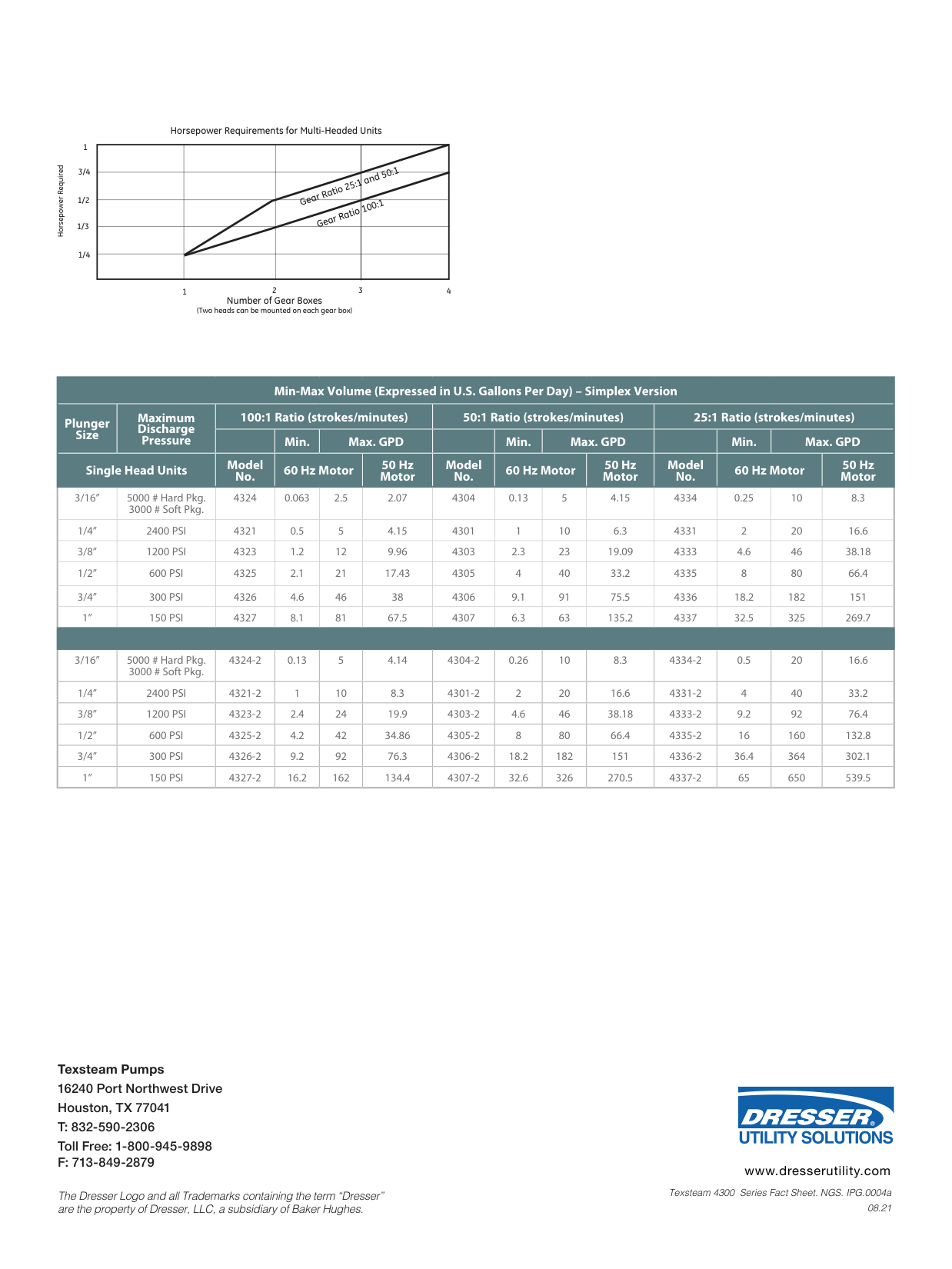
Horsepower requirements for multi-headed units by gear ratio and number of gear boxes.