
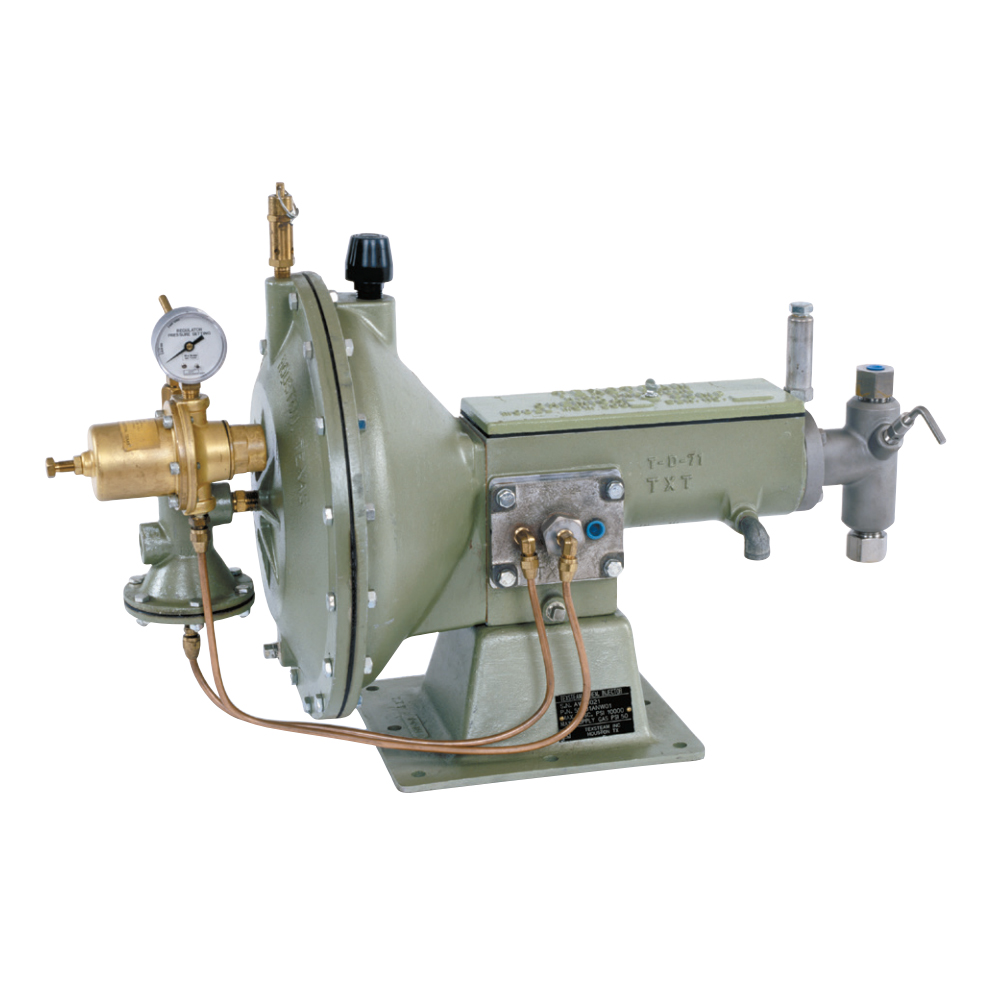
A gas-driven (pneumatic) chemical injection pump is sized by four numbers: the injection rate in gallons per day, the highest pressure at the injection point, the pressure of the gas that will drive it, and the chemical itself. This guide works through each one with the manufacturer’s published data for the Texsteam gas-driven line (Series 5000, 5100, MX-5 and MXG, made by Dresser Utility Solutions in Houston), then covers drive-gas consumption and the EPA vent rules that now decide whether a gas-driven pump may vent at all. No prices are quoted here; every figure links back to a manufacturer document or to the regulation text listed at the end.
Quick answer: which gas-driven chemical injection pump fits a remote methanol or inhibitor job?
- Low rate on low-pressure gas: a diaphragm-driven, spring-return plunger pump such as the Texsteam Series 5100. Dresser rates it for volumes up to 30 gallons per day on gas pressure as low as 8 psig, with high-pressure heads to 6,000 psi.
- Widest rate and pressure range on 15 to 50 psi drive gas: the Texsteam Series 5000, which spans 0.68 to 499.8 gallons per day across six plunger sizes and reaches 12,000 psig on the two smallest plungers with hard packing.
- Drive gas you want to capture instead of vent: the Texsteam MXG runs on 30 to 250 psig supply gas, and its exhaust can be recaptured when the receiving line pressure is below the pump’s exhaust pressure.
- Site with commercial line power: a natural gas-driven pump on a new or modified well site must have zero methane and VOC emissions under EPA Subpart OOOOb. Look at a solar or electric pump, at instrument air, or at routing the exhaust to a process.
- Choose the largest plunger that still covers your maximum injection pressure. On Dresser’s own chart a 1/4 inch plunger uses 306 standard cubic feet of gas per gallon at 1,000 psi on long stroke; a 1/2 inch plunger uses 92.
What four numbers decide the size of a chemical injection pump?
Rate, pressure, drive gas and chemical. Every manufacturer table is organised around them, and a quote request that is missing one of them comes back as a guess.
- Injection rate in gallons per day: normal, minimum and maximum. Methanol demand moves with the weather; Dresser even offers a temperature thermostat for methanol applications on its SolarLite pump.
- Highest pressure at the injection point, including line-pressure excursions, not only the normal flowing pressure.
- Drive gas pressure and quality: instrument air or well gas, sweet or sour, and the regulated pressure actually available at the pump.
- The chemical and the coldest ambient temperature, which together pick the packing and the head material.
Why the document revision matters: Dresser’s literature disagrees with itself by edition. The 2021 Texsteam catalog (NGS.IPG.0001c) lists the Series 5000 at “as high as 10,000 psi”; the June 2023 fact sheet (NGS.IPG.0005d), the installation manual and the Dresser product page say 12,000 psig. Model numbers moved too. The current fact sheet calls the 1 inch plunger 5007 and the 1-1/4 inch plunger 5008, while an older Series 5000 sheet still hosted by a distributor numbers the 1-1/4 inch plunger 5007. Ordering “a 5007” from the wrong sheet can get you the wrong plunger, so quote the plunger size, not only the model number, and ask which revision your supplier is quoting from.
How do plunger size and supply gas pressure set the maximum discharge pressure?
On a gas-over-plunger pump, a large gas-driven piston or diaphragm pushes a small plunger, so the discharge pressure is the drive pressure multiplied by an area ratio. A smaller plunger gives a higher ratio and a higher pressure ceiling, but moves less fluid per stroke.
Dresser states the rule outright for its Series 6100: (inlet gas pressure minus exhaust back pressure) times the power-to-fluid ratio equals the maximum fluid discharge pressure at stall. The Series 5000 fact sheet prints an operating ratio for every plunger:
| Model | Plunger | Operating ratio, gas/fluid | Max psig, hard packing | Max psig, soft packing | Max continuous GPD |
|---|---|---|---|---|---|
| 5001 | 1/4 in | 1000/1 | 12,000 | 3000 | 16 |
| 5003 | 3/8 in | 497/1 | 12,000 | 3000 | 43 |
| 5005 | 1/2 in | 264/1 | 10,000 | 3000 | 85 |
| 5006 | 3/4 in | 115/1 | 5,000 | 3000 | 160 |
| 5007 | 1 in | 66/1 | N/A | 3000 | 320 |
| 5008 | 1-1/4 in | 42/1 | N/A | 2000 | 500 |
Source: Texsteam Series 5000 fact sheet NGS.IPG.0005d (06.23). Maximum power gas pressure 50 psi; specify a TB-0040 regulator and TA-0129 gauge when the inlet gas pressure is over 50 psig.
The supply-pressure limit shows up in the manufacturer’s own tables. Dresser’s MX-5 manual lists the same 1/2 inch plunger at a maximum discharge of 3000 psi with 50 psi inlet, 8000 psi with 100 psi inlet and 10000 psi with 145 psi inlet, and warns that inlet pressures below 145 psi may not allow reaching the packing’s maximum pressure. The MX-5 fact sheet prints 4400 and 9200 psig for the first two points, another edition gap worth raising with the factory. If your regulated gas is low and your line pressure is high, ask the supplier to show the stall calculation for the plunger they propose.
Series 5100 vs Series 5000 vs MXG vs MX-5: which gas-driven pump fits which duty?
They differ in how they are driven, how much gas pressure they need and what happens to the exhaust. Shortlist on this table, then size the plunger.
| Series | Drive and supply gas | Rate | Max discharge | Exhaust |
|---|---|---|---|---|
| 5100 | Diaphragm with spring return; gas from 8 psig, diaphragm chamber max 35 psig | Up to 30 gal/day | 3000 psig standard packing on the fact sheet (the manual says 1500); 6000 psig high-pressure packing | Speed set by throttling the exhaust; exhaust port back-pressure must be zero psig |
| 5000 | Integral gas/air motor; as low as 15 psi (catalog), 50 psi maximum power gas | 0.68 to 499.8 gal/day | 12,000 psig on 1/4 and 3/8 in plungers, hard packing | “Sealed exhaust (optional)” on the drawing; no capture rating published |
| MXG | 30 to 250 psig supply; 1 to 60 strokes per minute | 0.11 to 62 gal/day (catalog) | 10,000 psi on the 3/16 in head (catalog) | Vent or recapture when line pressure is below pump exhaust pressure |
| MX-5 | 30 to 145 psi supply; 2 in stroke | 1 to 62 GPH | Set by inlet pressure (see above) | Able to recycle unused supply gas |
Sources: Texsteam fact sheets NGS.IPG.0005d, 0007a and 0008a; manuals NGS.IPG.0015a and 0063; catalog NGS.IPG.0001c; Texsteam pump portfolio pressure chart.
Two more manufacturer facts that matter on a remote pad: the Series 5100 fact sheet states ATEX certification from TÜV Rheinland, and Dresser rates the MXG for operation between -40°F and 140°F.
What we see in our own catalog: our Series 5000 listing carries 78 factory configurations, from the 5001 (1/4 inch) to the 5008 (1-1/4 inch), with ductile iron or stainless steel heads, Buna-N, Viton, Teflon and high-pressure packings, sour-gas trims, regulators and tank-and-base packages. The series name alone does not identify a pump; the configuration does.
How much drive gas does a pneumatic chemical injection pump use per gallon?
Every stroke of a gas-driven pump exhausts its power gas, so gas use is a running cost and, on well gas, an emission. Dresser charts it in standard cubic feet (SCF) of gas per gallon pumped, and two choices dominate it: plunger size and stroke length.
| Series 5000 plunger | SCF per gallon at 1,000 psi, long stroke | SCF per gallon at 1,000 psi, short stroke |
|---|---|---|
| 1/4 in (5001) | 306 | 756 |
| 3/8 in (5003) | 153 | 368 |
| 1/2 in (5005) | 92 | 212 |
| 3/4 in (5006) | 55.6 | 117 |
| 1 in (5007) | 32 | 62 |
| 1-1/4 in (5008) | 25 | 44 |
Source: Series 5000 gas consumption chart, fact sheet NGS.IPG.0005d. Dresser: “For inlet regulator sizing, double the requirement indicated.”
Worked example, using only Dresser’s chart: a well needs 10 gallons of methanol a day against 1,000 psi. On a 1/2 inch plunger at long stroke the pump exhausts about 920 SCF of drive gas a day (10 x 92). The same job on a 1/4 inch plunger at long stroke exhausts about 3,060 SCF a day (10 x 306), more than three times as much, and the regulator should be sized for double either figure. Over a year the 1/2 inch choice comes to roughly 336,000 SCF. Dresser’s Series 5100 chart shows the same pattern: a 1/2 inch plunger on the 1 inch stroke uses 62 SCF per gallon at 1000 psig, and 186 on the 1/3 inch stroke.
Which packing and wetted materials suit methanol and corrosion inhibitors?
Packing is chosen on three limits at once: chemical compatibility, pressure and temperature. Texsteam publishes the pressure and temperature limits; it does not publish a methanol-specific packing recommendation, and its MX-5 manual states that packing recommendations constitute no guarantee.
| Packing (MX-5, 1/2 in plunger) | Max pressure, psi | Temperature range, °F |
|---|---|---|
| Buna-N | 3000 | -40 to 250 |
| Teflon | 3000 | -80 to 450 |
| Viton/Teflon | 5000 | -20 to 400 |
| HP-Buna-N | 10000 | -40 to 250 |
| HP-Viton | 10000 | 0 to 450 |
| SDP | 10000 | -30 to 450 |
Source: Texsteam MX-5 manual NGS.IPG.0062. Dresser does not spell out “SDP”.
For the Series 5000, the manual lists Buna-N, Viton and Teflon packing to 3,000 psi and Buna-N HP above 3,000 psi; hard packing comes in Buna or Viton only. Standard heads are ductile iron with stainless steel trim, stainless heads are offered for highly corrosive service, and every model can be trimmed for sour gas. A pump with Teflon packing and a chrome-plated plunger needs no plunger lubrication.
Read the temperature column before the pressure column for winter methanol service: on the MX-5 table HP-Viton is rated only down to 0°F, while Teflon is rated to -80°F. Buna-N is the standard packing in the Series 5000 manual and appears on more than half of the 78 configurations we list, so treat it as the default to check against your chemical’s SDS and your coldest morning, not the default to accept.
What do EPA Subparts OOOOb and OOOOc require for natural gas-driven pumps?
For a well site where construction, modification or reconstruction started after December 6, 2022, the pump affected facility is the collection of natural gas-driven pumps on the site, and increasing the number of natural gas-driven pumps by one or more counts as a modification. On or after May 7, 2025 those pumps must comply with 40 CFR 60.5393b.
- Zero emissions to the atmosphere if the site has access to electrical power, defined as commercial line power available onsite with sufficient capacity, reliable and consistent; or if the site has no power but three or more natural gas-driven diaphragm pumps.
- No power and fewer than three diaphragm pumps: route the exhaust through a closed vent system to a process if a vapor recovery unit is onsite; otherwise to a control device achieving a 95.0 percent reduction. You are not required to install a control device or vapor recovery unit solely for this; if neither is on site, you certify that.
- Counting rule: a pump in which the fluid is displaced by a piston driven by a diaphragm is a piston pump, not a diaphragm pump, under the subpart’s definitions.
- Pumps not driven by natural gas, for example on instrument air, are not part of the pump affected facility.
- Existing sites (OOOOc): state plans are due to EPA by January 22, 2027, and Table 1 of the subpart sets the compliance date at 36 months after that deadline.
How this changes the pump choice, from the manufacturer documents: the Series 5100 manual requires zero back-pressure on its exhaust port for maximum performance, so ask the factory before designing a 5100 into a closed vent system. The MXG is documented for exhaust recapture, and the Series 6100 manual offers an exhaust manifold for back-pressure or pollution-control service. Rule text quoted here is the eCFR version of October 7, 2026. This is a buyer’s summary, not legal advice; confirm applicability with your environmental lead before you buy.
When is a solar chemical injection pump the better choice than a gas-driven one?
When the site has line power, when the exhaust cannot be routed, or when the drive gas is a cost you no longer want. Dresser describes its Texsteam iCIP as a zero emissions chemical injection pump that does not require any onsite power source, and its SolarLite pump as capable of pumping against pressures as high as 5,999 psi; the Texsteam pressure chart lists SolarLite at 5,000 psi, so confirm the figure for your plunger. Our Texsteam solar chemical injection pump overview covers that line.
The trade, in the numbers above: the 1/2 inch Series 5000 plunger in the worked example exhausts about 920 SCF a day to deliver 10 gallons of methanol at 1,000 psi; a solar pump exhausts none. Before switching, ask for the solar package’s battery autonomy and its rate at your injection pressure, because those decide whether it carries the well through a run of cloudy days.
What should a chemical injection pump quote request include?
- Chemical name, concentration and SDS.
- Rate: normal, minimum and maximum gallons per day.
- Maximum pressure at the injection point, including excursions.
- Drive medium (well gas or instrument air), sweet or sour, and the regulated pressure available.
- Coldest expected ambient temperature.
- Exhaust handling: vent, recapture or route, and whether the site has line power, a vapor recovery unit or a control device.
- Plunger size, head material and packing if you already know them, plus the document revision you sized from.
- Accessories: regulator and gauge (a TB-0040 and TA-0129 when inlet gas is over 50 psig on a Series 5000), tank and base, microswitch, sour-gas trim.
Send the list above to pesales@pe-energy.com or call 281-310-0628 and we will quote the Series 5000, 5100, MX-5 or MXG configuration that matches it.
Where do these numbers come from?
- Texsteam Series 5000 fact sheet, NGS.IPG.0005d (06.23): performance table, operating ratios, gas consumption chart.
- Series 5000 installation, operation and maintenance manual, NGS.IPG.0058e: packing options, supply limits, sour-gas trim.
- Texsteam chemical injection pump catalog, NGS.IPG.0001c: series overviews, MXG and Series 5000 catalog figures.
- Series 5100 fact sheet, NGS.IPG.0007a and Series 5100 manual, NGS.IPG.0015a.
- MXG brochure, NGS.IPG.0013a and MXG manual, NGS.IPG.0063.
- MX-5 fact sheet, NGS.IPG.0008a and MX-5 manual, NGS.IPG.0062.
- Series 6100 manual, NGS.IPG.0059a: the stall-pressure formula.
- Texsteam pump portfolio pressure capability chart, iCIP and SolarLite product pages.
- EPA rule text on eCFR: 60.5393b, 60.5365b, 60.5370b, 60.5430b and 60.5362c.
Summary: how to choose a gas-driven chemical injection pump
- Size on four numbers: gallons per day (normal, minimum, maximum), highest injection pressure, regulated drive-gas pressure and the chemical at your coldest temperature.
- Series 5100 for up to 30 gal/day on gas from 8 psig; Series 5000 for 0.68 to 499.8 gal/day and up to 12,000 psig on 15 to 50 psi gas; MXG when you want to recapture exhaust on 30 to 250 psig supply.
- Pick the largest plunger that covers your pressure: at 1,000 psi a 1/2 inch Series 5000 plunger uses 92 SCF per gallon on long stroke, a 1/4 inch plunger 306.
- Check packing temperature limits as well as pressure: HP-Viton on the MX-5 table stops at 0°F, Teflon goes to -80°F.
- Under EPA Subpart OOOOb, a natural gas-driven pump on a site with line power must have zero emissions; quote the plunger size and the document revision, not just the model number.