
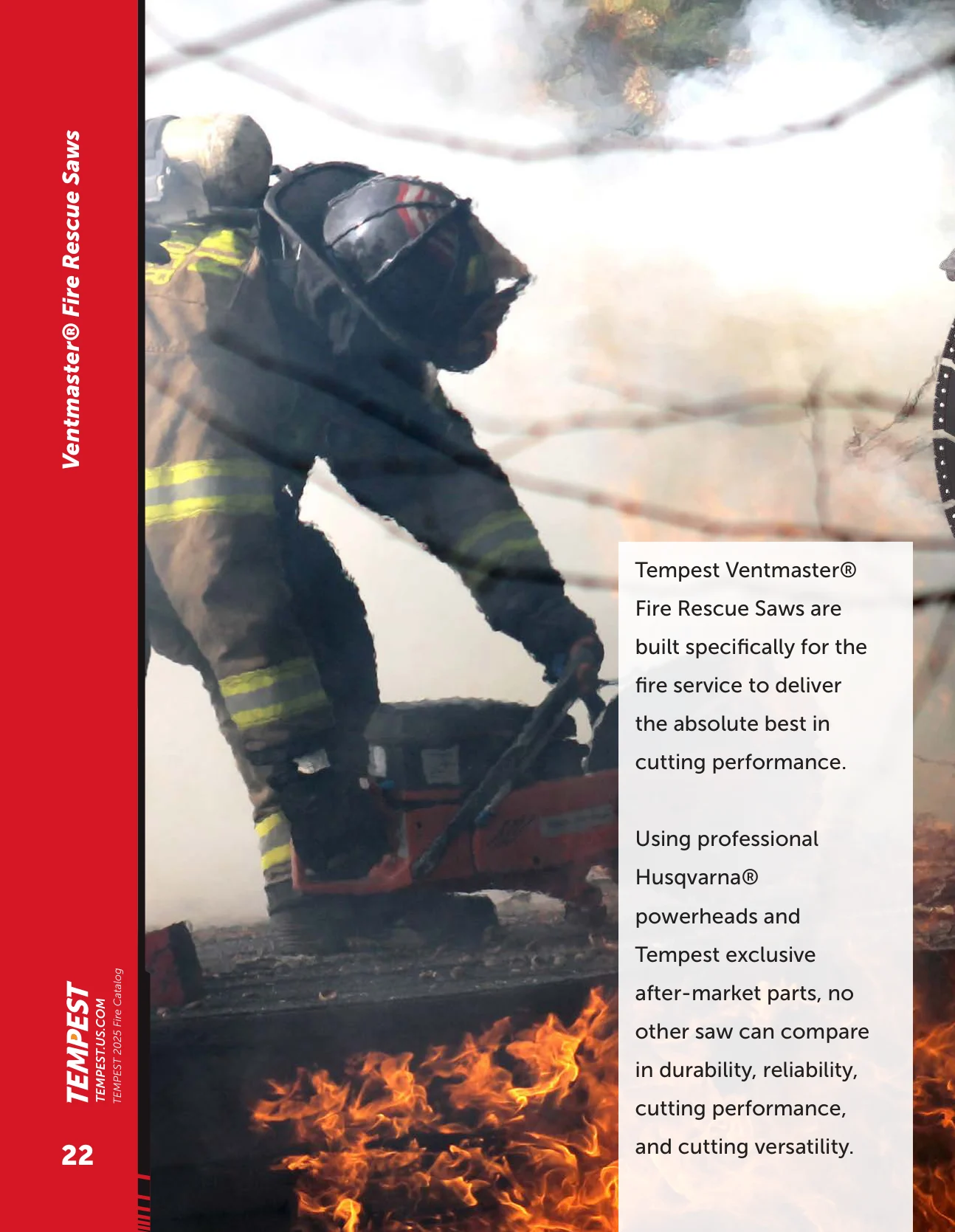
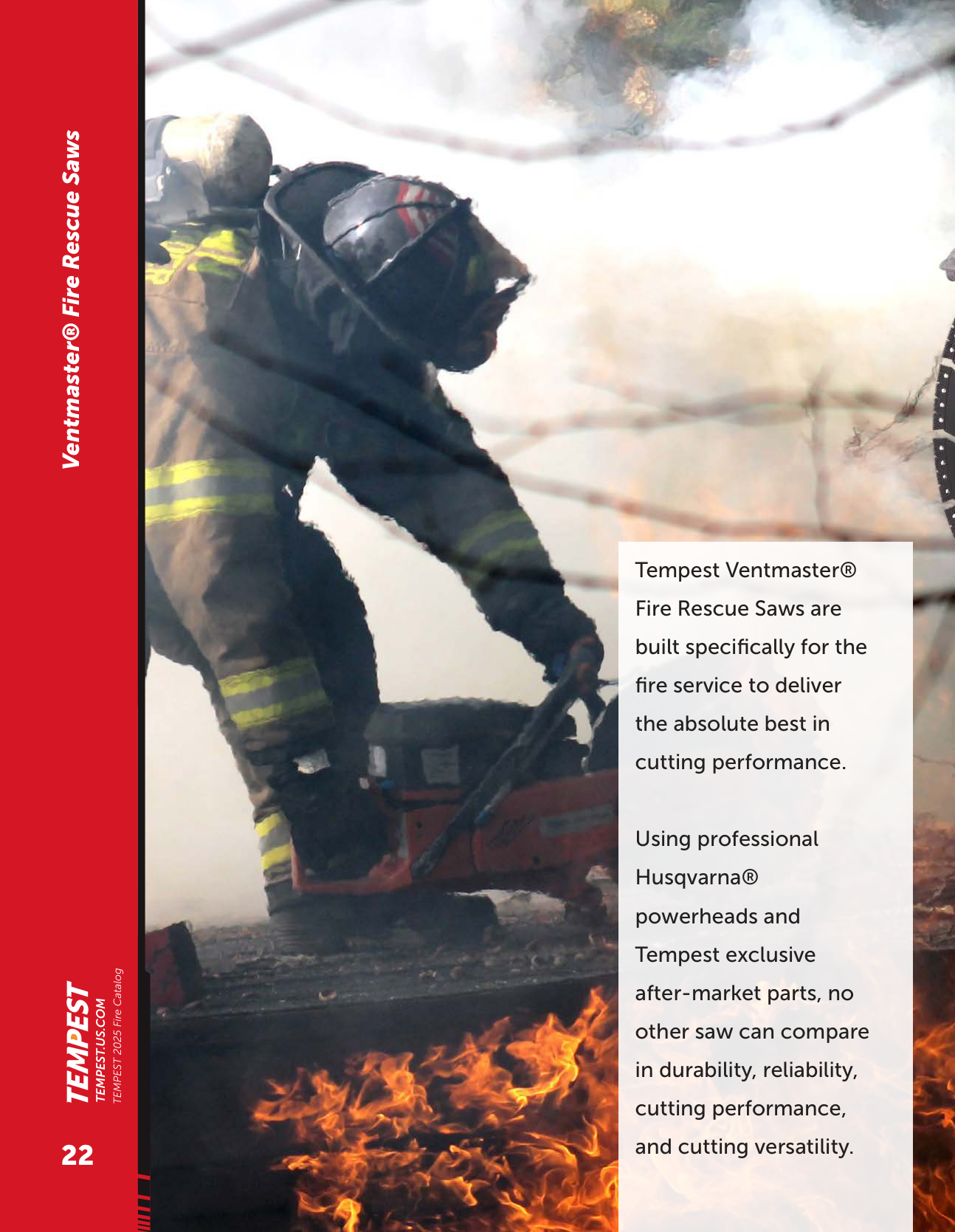
A gasoline saw that won’t start in the first ten seconds of a roof ventilation operation is not a tool problem. It is a tactics problem. Crews lose those seconds to priming, choking, and pull-cord attempts while smoke conditions deteriorate below them. The Tempest VentMaster K1 removes that variable entirely. Battery power means the saw is operational the instant the trigger is pulled, and the patented KIS-360 depth gauge means every cut stops exactly where the firefighter intends, protecting hidden structural members, electrical, and utilities beneath the roof deck. No exhaust. No cold-start delay. No over-penetration.
What is the Tempest VentMaster K1 and what problem does it solve on the fire ground?
The Tempest VentMaster K1 is a battery-powered cutoff saw purpose-built for structural ventilation operations, manufactured by Tempest in Fresno, California. It replaces gasoline-powered rotary saws in scenarios where exhaust contamination, noise interference, or cold-start reliability create unacceptable operational risk.
The K1’s distinguishing design feature is the patented KIS-360 depth gauge system (item TV426-007 as a standalone component), which provides precise, adjustable cutting depth control during roof and wall ventilation cuts. That single feature addresses one of the most consequential failure modes in ventilation cutting: over-penetration into structural elements, wiring, or plumbing concealed beneath a roof deck. The saw runs on the Husqvarna battery platform, using either BLI 200 or BLI 300 battery configurations, which allows departments already running Husqvarna battery tools to share power sources across their inventory.
How does the KIS-360 depth gauge prevent over-penetration during ventilation cutting?
The KIS-360 is a patented depth-limiting system that mounts to the VentMaster K1 and physically restricts blade penetration to a pre-set depth. The firefighter adjusts the gauge before the cut, and the system prevents the blade from traveling beyond that setting regardless of downward force applied during the cut.
Over-penetration is not a minor quality concern. On residential roof decks, hidden rafter members, electrical wiring runs, and HVAC ductwork sit within inches of the sheathing surface. A blade that runs deeper than the deck thickness can strike a rafter, deflect unpredictably, or sever a live electrical conductor. The KIS-360 system converts a depth judgment call, which under smoke and physical stress conditions is unreliable, into a mechanical stop. The complete depth gauge assembly is available as item TV426-007 for departments that need to retrofit or replace the gauge independently of the saw body. This is the kind of engineering detail that separates a ventilation-specific tool from a repurposed construction saw.
What advantages does battery power give the K1 over gasoline cutoff saws for ventilation operations?
Battery power on the K1 delivers three operationally distinct advantages over gasoline: zero exhaust emissions in the cutting environment, significantly lower acoustic output during operation, and instant start with no priming or pull-cord sequence required.
Zero exhaust matters in partially enclosed ventilation scenarios, attic spaces, and interior operations where gasoline combustion byproducts add to an already degraded atmosphere. The K1 produces no exhaust at the point of operation, which eliminates one contamination source for crews working without SCBA or in egress-limited positions. Low noise output directly improves command and crew communication on the fire ground during active cutting, a factor that gasoline rotary saws consistently work against given their high decibel output at operating RPM. Instant deployment is the third advantage: no choke setting, no primer bulb, no cord pull sequence. The saw cuts when the trigger is pulled. In a ventilation operation where seconds of delay translate to worsening interior conditions, that immediate readiness is a functional performance specification, not a convenience feature.
What Husqvarna battery configurations are compatible with the VentMaster K1?
The VentMaster K1 is compatible with the Husqvarna BLI 200 and BLI 300 battery configurations. The BLI 300 provides extended runtime relative to the BLI 200, which is relevant for sustained ventilation operations or multi-structure responses where recharging between cuts is not practical.
Tempest’s decision to build the K1 on the Husqvarna battery platform rather than a proprietary cell system has a direct procurement implication. Departments running Husqvarna battery-powered tools elsewhere in their inventory, including chainsaws and other cutting equipment, can use the same batteries and chargers across those tools and the K1. That shared platform reduces the number of distinct charger types a department must stock and maintain, and it allows spare batteries staged for one tool to serve as emergency backup for the K1. Blade and battery kits are available in configured combinations; departments with specific runtime requirements should confirm kit configurations at the point of order to ensure the battery capacity matches the operational tempo expected on their response area.
What blade options does the VentMaster K1 support, and when should each be used?
The K1 is compatible with the full VentMaster blade line, spanning diamond segment blades for masonry and iron, carbide-tipped blades for wood, and non-diamond abrasive blades for concrete and steel cutting applications.
The blade selection determines what substrate the saw can cut effectively, and choosing incorrectly degrades both blade life and cut speed. The Multi-Use VentMaster Diamond Blade (TV406-074) covers general structural ventilation cutting where material type is mixed or uncertain. The Concrete VentMaster Diamond Blade (TV406-081) is specified for masonry and concrete substrates, while the Ductile Iron VentMaster Diamond Blade (TV406-091) addresses pipe and iron structural members encountered in industrial or older construction settings. For wood-frame roof and wall construction, the Carbide Tipped Wood Cutting Blade (TV406-105) provides the correct tooth geometry for that material. Abrasive options are available separately for concrete (TV406-003) and steel (TV406-009) where diamond blades are not specified. Having the correct blade staged with the saw before deployment eliminates a material-matching failure at the point of use, which is a detail worth addressing at apparatus setup rather than on the roof. You can review the Tempest official product site for full blade specification data.
How does the K1 compare to the base and standard VentMaster K1 configurations available from PE Energy?
The VentMaster K1 is available in multiple build configurations that differ primarily in included accessories rather than the core saw platform. Understanding which configuration matches a department’s existing inventory prevents duplicate purchasing of components already on hand.
The base configuration, available as the Tempest Ventmaster TV402-110 Base K1 Cutoff Saw, provides the saw body without additional accessories, which suits departments that are sourcing blades and batteries through separate kit configurations. The standard configuration, the Tempest Ventmaster TV402-120 Standard K1 Cutoff Saw, adds components appropriate for departments equipping a saw from scratch. Kit configurations that bundle the depth gauge are available as the Tempest Ventmaster TV402-100B K1 Ventmaster K1-DG-14 Kit and the Tempest Ventmaster TV402-100E K1 variant, which differ in their included accessories. Departments that want the full option configuration with depth gauge included but no blade or charger can order through item TV402-100 (K1-DG-14 Basic Full Option). Selecting the right configuration at purchase avoids paying for components a department already stocks.
What are the primary applications for the Tempest VentMaster K1 on the fire ground?
The K1 is designed for structural fire ground operations where precision depth control and exhaust-free operation provide a measurable advantage over gasoline-powered rotary saws.
Roof ventilation on residential and light commercial structures is the primary application. The KIS-360 depth gauge is most valuable in this context, where the cut must penetrate the roof deck without striking rafters below. Wall breaching for ventilation openings follows the same logic: adjustable depth prevents blade contact with internal framing and utilities. Enclosed or attic space operations where gasoline exhaust would degrade air quality for working crews represent a specific scenario where battery power provides a safety advantage that gasoline tools cannot replicate. Multi-alarm responses where extended battery runtime from a BLI 300 configuration maintains saw availability across multiple cuts without recharge are also a practical use case. Departments that want to compare the full option kit can review the Tempest Ventmaster TV402-150 K1 configuration alongside the depth-gauge kit variants to match their operational requirements. The K1 is manufactured in the USA by Tempest, headquartered at 4708 N. Blythe Avenue, Fresno, California.
When is the VentMaster K1 the right tool, and when is it not?
The K1 is the right cutoff saw when the operation requires precision depth control, zero exhaust, low acoustic output, or instant deployment from a cold state. It is purpose-built for structural ventilation, not for prolonged heavy-duty demolition or applications where battery runtime cannot be managed between deployments.
Departments that run the Husqvarna battery platform across multiple tools will find the K1 integrates without additional infrastructure investment in chargers or battery formats. The KIS-360 system earns its specification justification specifically in roof and wall cuts where over-penetration risk is present. Where cutting substrates are confirmed and consistent, selecting the correct blade from the VentMaster line before staging the saw eliminates the most common field failure mode: using a wood blade on masonry or an abrasive disc on material that would perform better under a diamond segment. The K1 is not a substitute for a gasoline saw in every scenario. High-volume cutting operations with long runtimes and no opportunity for battery exchange favor gasoline power. In every other ventilation context, the K1’s combination of depth control, battery convenience, and zero exhaust makes it the more capable and controllable option. For compliance and apparatus standards reference, departments should also consult the NFPA 1901 standard for automotive fire apparatus when specifying tool inventory for new apparatus builds.
Tempest Fire
VentMaster® K1 Battery Cutoff Saw
KIS-360 Depth Gauge | Battery Powered | Made in USA
Overview
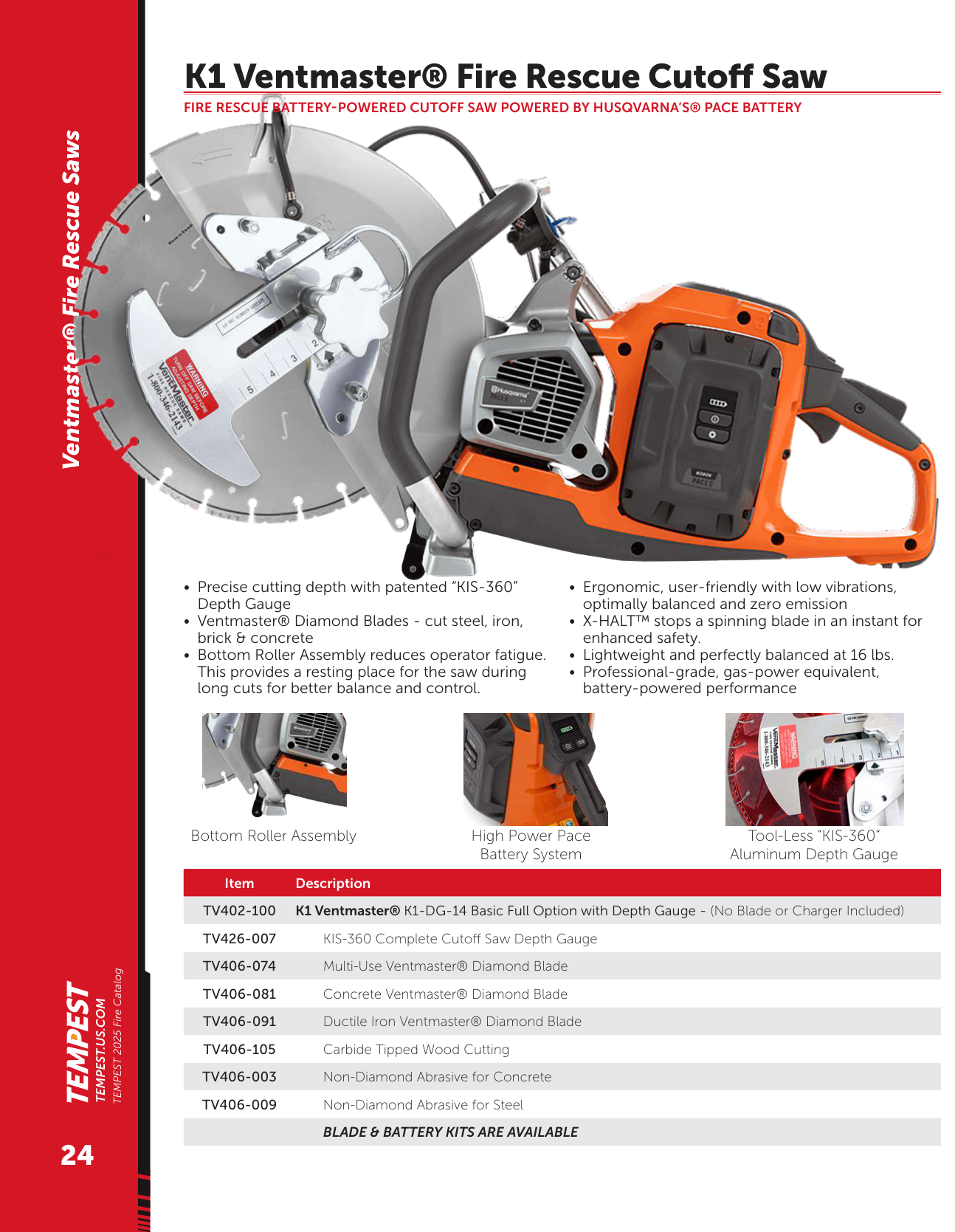
The Tempest VentMaster® K1 is a battery-powered cutoff saw purpose-built for fire ground ventilation operations. Combining the precision of the patented KIS-360 depth gauge system with battery power, the K1 gives crews a zero-exhaust, low-noise cutting solution for structural ventilation in any environment.
The K1 uses Husqvarna batteries and chargers — available in BLI 200 or BLI 300 configurations for extended runtime. The KIS-360 depth gauge provides precise, adjustable cutting depth control, preventing over-penetration during roof and wall ventilation.
Key Features
Patented KIS-360 Depth Gauge
Precise cutting depth control with the patented KIS-360 system — adjustable to prevent over-penetration on roofs and walls, protecting firefighters from hidden structural elements and utilities.
Battery Powered — No Exhaust
Zero exhaust emissions — ideal for enclosed or partially enclosed ventilation operations where gasoline exhaust would contaminate the work environment or create additional hazards.
Husqvarna Battery Platform
BLI 200 and BLI 300 Husqvarna® batteries available — departments running other Husqvarna battery tools can share the platform.
VentMaster® Diamond Blades
Compatible with the full VentMaster® blade line — multi-use, concrete, ductile iron diamond blades, plus carbide wood and abrasive options for any cutting material.
Low Noise Operation
Significantly quieter than gasoline-powered saws — improved crew communication on the fire ground during cutting operations.
Quick Deployment
No priming, no choke, no pull cord — battery power means the saw is ready to cut the instant it’s needed. Critical time savings at the start of a ventilation operation.
Models & Ordering Information
| Item No. | Description |
|---|---|
| TV402-100 | K1 VentMaster® K1-DG-14 Basic Full Option with Depth Gauge (No Blade or Charger Included) |
| TV426-007 | KIS-360 Complete Cutoff Saw Depth Gauge |
| TV406-074 | Multi-Use VentMaster® Diamond Blade |
| TV406-081 | Concrete VentMaster® Diamond Blade |
| TV406-091 | Ductile Iron VentMaster® Diamond Blade |
| TV406-105 | Carbide Tipped Wood Cutting Blade |
| TV406-003 | Non-Diamond Abrasive for Concrete |
| TV406-009 | Non-Diamond Abrasive for Steel |
Blade & battery kits available. Contact for kit configurations.
Manufacturer: Tempest — 4708 N. Blythe Avenue, Fresno, California 93722 USA — tempest.us.com