
There is a specific moment in firefighting and industrial fire suppression when the foam system question becomes critical: you are standing at a vehicle fire, a flammable liquid spill, or a confined-space structure fire, and the suppression agent you need is not mounted to a truck that has not arrived yet. Foam suppression in those situations comes down to what a single responder can carry and connect in seconds. The Tempest UPRIM was engineered exactly for that gap. It converts 2.6 gallons of foam concentrate into over 13,000 gallons of medium-expansion foam, connects directly to any hose or apparatus, and requires no pump, no power source, and no proportioner calibration to operate. That combination of portability, output ratio, and zero-setup deployment changes what is possible when a foam-capable vehicle is not on scene.
What is the Tempest UPRIM and how does it generate foam?
The Tempest UPRIM is a portable, self-contained medium-expansion foam unit that connects directly to a standard fire hose or apparatus water supply. It uses the energy of the incoming water flow to aspirate and proportion foam concentrate without requiring any external power source, pump, or electronic control system.
The unit holds 2.6 gallons of foam concentrate and generates over 13,000 gallons of medium-expansion foam, representing an expansion ratio that covers large suppression areas from a container portable enough for a single firefighter to carry. The full kit (item I30.00.035) ships with both a low expansion nozzle (I30.80.131) and a medium expansion nozzle (I30.80.132), giving the operator the ability to select expansion ratio on-site based on fire type and structure geometry. The manufacturer is Tempest, headquartered in Fresno, California, a recognized manufacturer of firefighting tools and equipment.
What does a 13,000-gallon foam output from 2.6 gallons of concentrate actually mean in the field?
Medium-expansion foam works by introducing air into a foam solution to produce a stable, voluminous blanket that floods a space, smothers oxygen supply, and suppresses flammable vapor release. The expansion ratio governs coverage area and suppression speed. A higher ratio means more volume from the same concentrate, which is the core operational advantage of the UPRIM.
At 2.6 gallons of concentrate generating over 13,000 gallons of finished foam, the UPRIM operates at an expansion ratio that places it firmly in the medium-expansion category, appropriate for three-dimensional hazards, enclosed spaces, and liquid fuel fires where a deep foam blanket is required. For comparison, low-expansion foam typically runs at ratios below 20:1 and is used for direct flame knockdown on fuel spills. Medium-expansion foam at ratios from roughly 20:1 to 200:1 is suited for flooding confined spaces and suppressing flammable vapor. The UPRIM’s included low expansion nozzle extends its utility to surface-level fuel fires as well, making the full kit a versatile two-mode system rather than a single-application tool.
How does the UPRIM connect and deploy without power or a pump?
The UPRIM connects directly to a standard fire hose or fire apparatus outlet. Water pressure from the supply line drives the proportioning and foam generation process internally. There is no external pump, no generator, and no electronic controller to configure or power up before deployment.
Filling the unit requires no pump either. The design eliminates the two most common causes of foam system deployment delay: proportioner calibration errors and power supply unavailability. This matters operationally because in vehicle fires, industrial spills, and hazmat scenarios, suppression speed in the first minutes determines whether a fire is controlled or allowed to grow. Because the UPRIM connects at the hose level rather than at the apparatus plumbing level, it can be staged and deployed by a single responder without waiting for an apparatus operator to configure the truck’s foam system. Wherever a hose can reach, the UPRIM can generate foam.
Why does Tempest recommend BIO-EX Fluorine-Free Foam for the UPRIM?
Tempest recommends BIO-EX Fluorine-Free Foam as the concentrate for use with the UPRIM. Fluorine-free foam, also called F3 or PFAS-free foam, contains no per- and polyfluoroalkyl substances, which are the synthetic chemicals associated with environmental persistence and regulatory restrictions on AFFF use near waterways and sensitive ecosystems.
Regulatory pressure on PFAS-containing foams has intensified at both the federal and state level, with multiple jurisdictions restricting or phasing out AFFF use in training and non-emergency applications. BIO-EX Fluorine-Free Foam compatibility makes the UPRIM deployable in environmentally sensitive locations, industrial sites with stormwater discharge controls, and jurisdictions where AFFF restrictions are already in force. For industrial fire suppression operations near waterways, drainage systems, or soil-permeable surfaces, the ability to use a PFAS-free concentrate is not a preference but an operational and compliance requirement. The UPRIM’s compatibility with BIO-EX concentrate means the unit is ready for the regulatory environment as it currently stands and as it is likely to tighten.
Low expansion vs. medium expansion nozzle: when should you use each?
The full UPRIM kit (I30.00.035) includes both the low expansion nozzle (I30.80.131) and the medium expansion nozzle (I30.80.132). The choice between them is determined by fire geometry, hazard type, and the suppression objective on scene.
Low expansion foam, produced by the low expansion nozzle, generates a denser, heavier blanket with lower air content. It is suited for direct application to liquid fuel fires, flammable spill containment, and vehicle fires where the foam needs to maintain contact with a burning surface without being easily displaced by wind or heat convection. Medium expansion foam, produced by the medium expansion nozzle, generates a lighter, more voluminous blanket and is better suited for flooding enclosed spaces, suppressing vapor above flammable liquid pools, and filling confined-geometry fires such as transformer vaults, dumpster fires, or equipment bays. Having both nozzles in a single portable kit means a responder does not need to return to a vehicle or request a different unit to address a fire that transitions from surface to three-dimensional.
What fire types and hazard categories is the UPRIM designed to address?
The UPRIM is rated for all types of firefighting and industrial suppression operations. Tempest lists structural fires, vehicle fires, industrial spills, and hazmat scenarios as the primary application categories, covering both municipal firefighting use and industrial emergency response.
Industrial fire suppression presents specific challenges that vehicle-mounted foam systems are not always positioned to address quickly. A flammable liquid spill in a refinery, chemical plant, or pipeline facility may occur in an area that apparatus cannot reach directly. A portable foam unit that one person can carry to the point of hazard and connect to a standpipe or hose bibb closes that response gap. The UPRIM’s portability also makes it viable as a supplemental suppression resource on industrial sites where a fixed foam system exists but additional coverage is needed for secondary spill containment or simultaneous ignition at multiple points.
Applications: where the Tempest UPRIM is deployed in firefighting and industrial operations
Municipal fire departments use the UPRIM as a portable foam suppression resource for vehicle fires on roadways and structural fires in buildings where apparatus access is restricted by geography, terrain, or confined urban corridors. The unit’s single-responder portability means it can be staged in a compartment and carried to a fire without waiting for a second crew member.
Industrial facilities including refineries, chemical processing plants, and pipeline operations deploy portable foam units for first-response suppression of flammable liquid spills and equipment fires before fixed suppression systems activate or before off-site apparatus arrives. In these environments, the UPRIM pairs with other firefighting equipment to form a complete suppression capability. Facilities managing hazmat response benefit from the unit’s BIO-EX Fluorine-Free Foam compatibility, which avoids introducing PFAS compounds into containment areas or drainage systems.
PE Energy stocks Tempest firefighting equipment including the UPRIM Portable Foam Unit and related foam suppression tools. For complete foam system components and firefighting tools, browse the firefighting equipment category at PE Energy. The UPRIM full kit, including both nozzle types, is available as a single-order item alongside other Tempest Fire products carried by PE Energy. Additional portable suppression and firefighting consumables, including foam concentrates and nozzle accessories, are available through the PE Energy fire suppression product line. For industrial safety and response equipment that complements foam suppression operations, the PE Energy safety equipment category covers PPE, detection, and emergency response tools suited for petrochemical and oilfield environments.
When is the UPRIM the right foam unit, and when is it not?
The UPRIM is the right choice when portability, speed of deployment, and independence from vehicle-mounted foam systems are the primary operational requirements. If a first responder or industrial safety team needs foam suppression capability that one person can carry, connect to a hose, and operate in under a minute without power, the UPRIM’s design addresses all three requirements simultaneously.
It is not a substitute for a fixed proportioned foam system on an apparatus when large-scale sustained foam application is the mission. The 2.6-gallon concentrate capacity is matched to the portable format; operations requiring continuous foam application over extended suppression periods will need a concentrate resupply plan or a vehicle-mounted system with greater reservoir capacity. For hazmat scenarios in PFAS-restricted jurisdictions, the UPRIM’s BIO-EX Fluorine-Free Foam compatibility makes it operationally compliant in ways that legacy AFFF-configured units are not. Facilities and departments making a foam equipment purchase decision should evaluate the UPRIM alongside fixed and apparatus-mounted options, with the UPRIM occupying the portable first-response role in that suppression equipment hierarchy.
Tempest Fire
UPRIM Portable Foam Unit
2.6 Gallons Generates 13,000+ Gallons of Foam | Simple & Instantly Ready
Overview
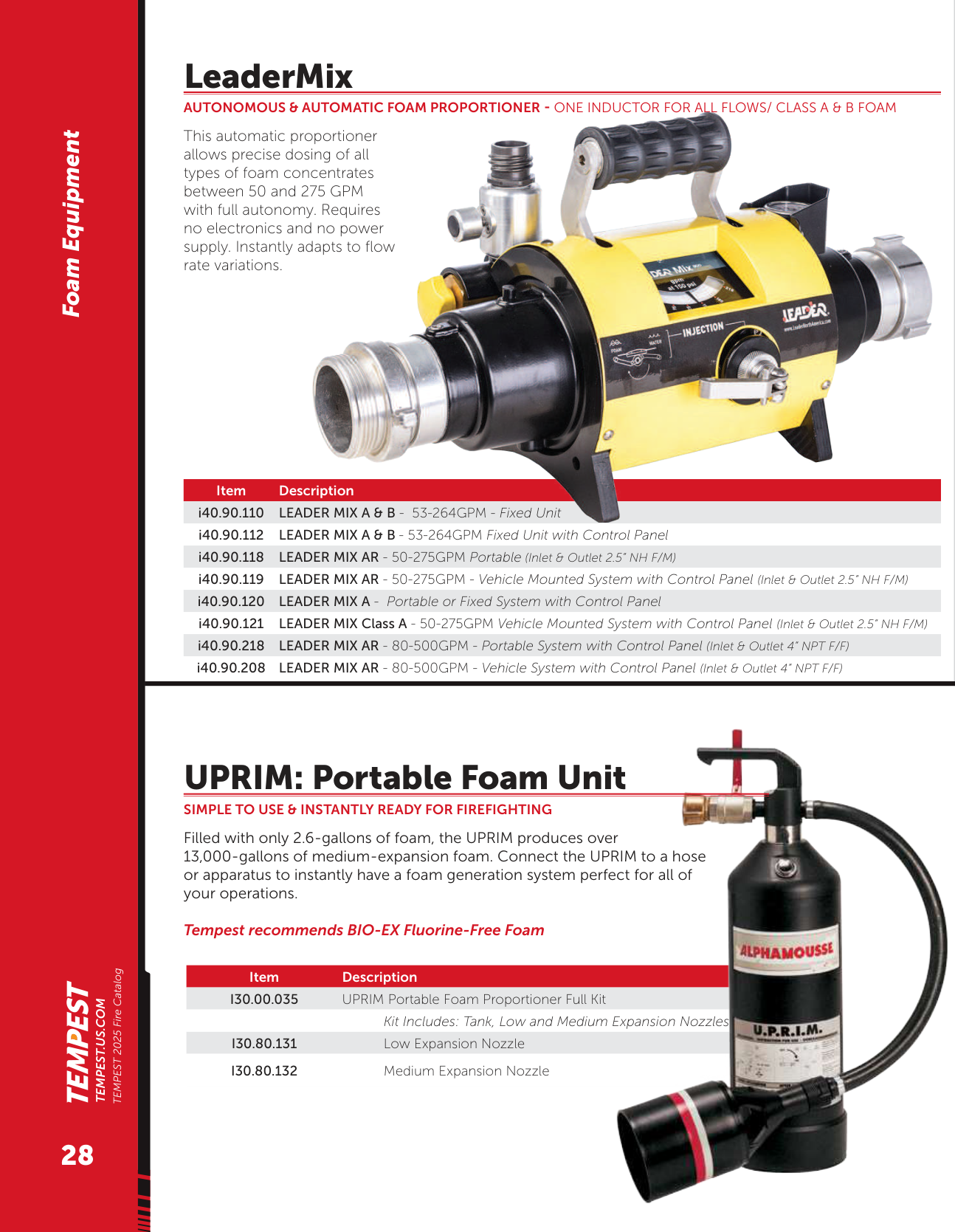
The Tempest UPRIM is a portable foam unit that produces over 13,000 gallons of medium-expansion foam from just 2.6 gallons of foam concentrate. Simple to use and instantly ready, the UPRIM connects directly to a hose or apparatus — providing an immediately deployable foam generation system for all types of firefighting and industrial suppression operations.
Filling the UPRIM requires no pump, no power, and no complex setup. It serves as a complete portable foam generation solution wherever a water source and hose connection are available. Tempest recommends BIO-EX Fluorine-Free Foam for use with the UPRIM.
Key Features
2.6 Gallons = 13,000+ Gallons
Extraordinary foam expansion ratio — 2.6 gallons of foam concentrate produces over 13,000 gallons of medium-expansion foam. Massive suppression coverage from a portable, compact unit.
Simple & Instantly Ready
Connect to a hose or apparatus and you have an immediately operational foam system. No complex plumbing, no proportioner setup, no power requirements.
Low & Medium Expansion Nozzles
Full kit includes both low and medium expansion nozzles — apply foam at different expansion ratios depending on the fire type, structure, or industrial hazard being addressed.
All-Purpose Foam Application
Suitable for all types of firefighting and industrial suppression operations — structural fires, vehicle fires, industrial spills, and hazmat scenarios where rapid foam application is needed.
Portable Design
Portable enough to be carried by one person to any location. No vehicle-mounted system required — deploy foam generation anywhere a hose can reach.
Fluorine-Free Foam Compatible
Tempest recommends BIO-EX Fluorine-Free Foam — compatible with PFAS-free concentrate for regulatory compliance and environmental protection in sensitive locations.
Models & Ordering Information
| Item No. | Description |
|---|---|
| I30.00.035 | UPRIM Portable Foam Proportioner Full Kit (Tank, Low and Medium Expansion Nozzles) |
| I30.80.131 | Low Expansion Nozzle |
| I30.80.132 | Medium Expansion Nozzle |
Technical Specifications
| Type | Portable Medium-Expansion Foam Unit |
| Concentrate Volume | 2.6 gallons |
| Foam Output | Over 13,000 gallons of medium-expansion foam |
| Nozzle Types | Low Expansion and Medium Expansion (included in full kit) |
| Power Required | None — connects to hose or apparatus |
| Foam Recommendation | BIO-EX Fluorine-Free Foam (Tempest recommended) |
Manufacturer: Tempest — 4708 N. Blythe Avenue, Fresno, California 93722 USA — tempest.us.com