
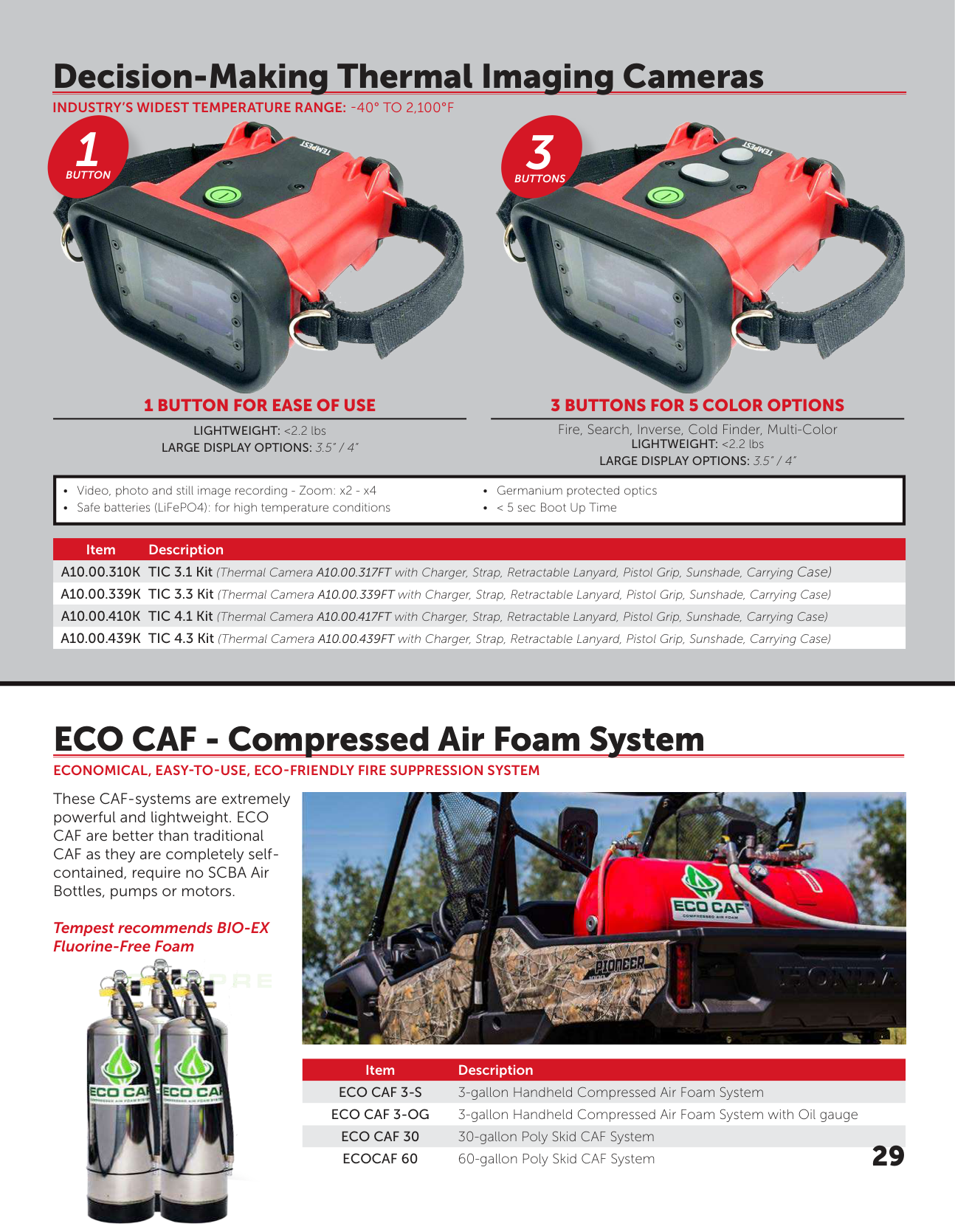
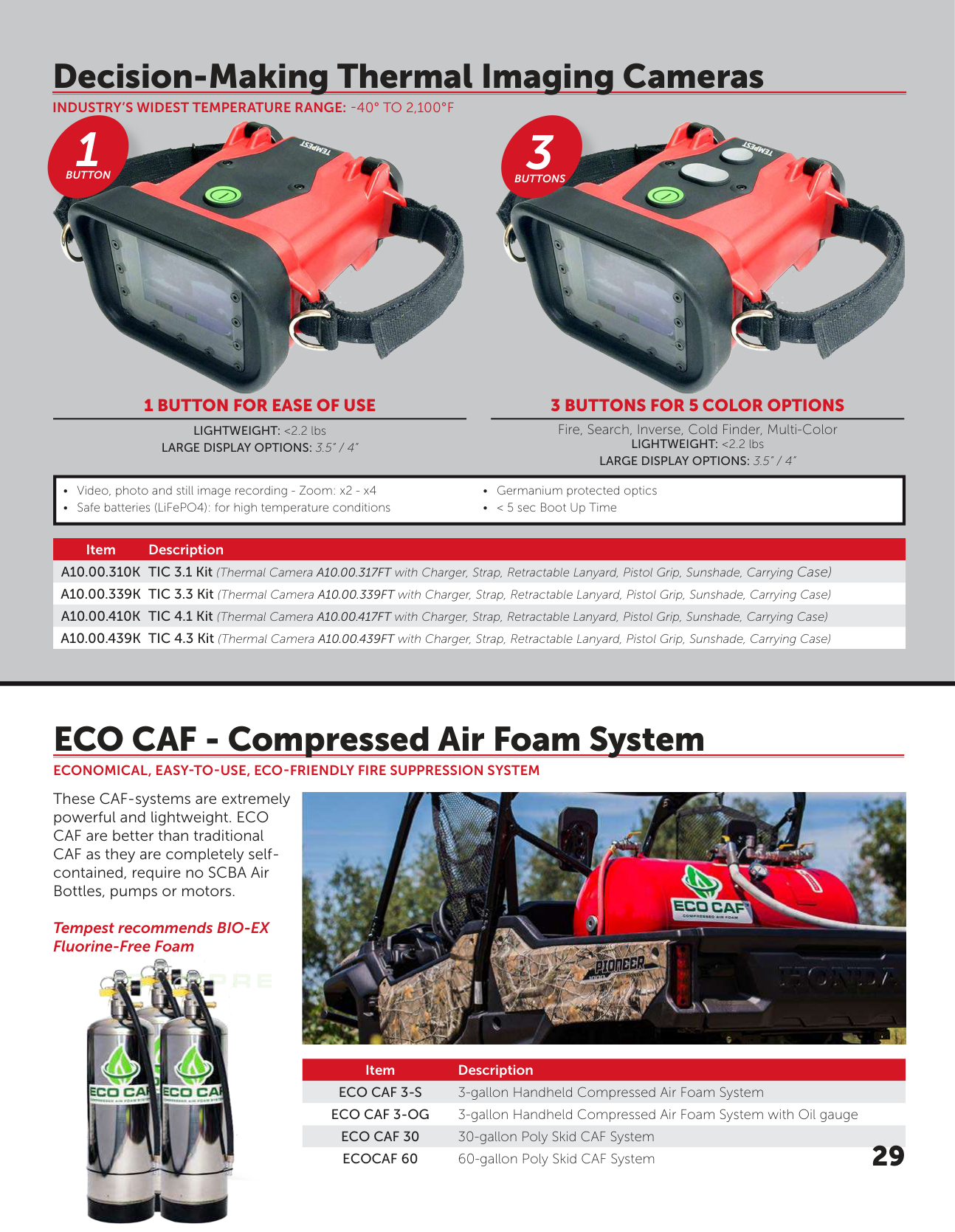
A thermal imaging camera that fails to boot in time, overheats its own battery in a structure fire, or clips out at 1,000°F is not a tool — it is a liability. Structural firefighters and industrial inspectors work at opposite ends of the thermal spectrum, and most cameras are built for one or the other. The Tempest TIC series was engineered to cover both, with a rated temperature range of -40°F to 2,100°F, a LiFePO4 battery chemistry that resists thermal runaway, and Germanium-protected optics that maintain image fidelity in conditions that degrade standard lens materials. If you are selecting a TIC for fire ground operations, a petrochemical facility, or both, the engineering decisions behind this camera deserve a close look.
What temperature range do the Tempest TIC cameras cover?
The Tempest TIC series operates across a range of -40°F to 2,100°F, which is the widest range in its product class. That span covers cold-storage inspections on the low end and active structure fire or industrial furnace conditions on the high end.
Most competing fire-service TICs are tuned for the 32°F to 1,200°F band that covers common interior attack scenarios. A structural fire in a fully involved wood-frame building can push surface temperatures past 1,800°F, and electrical arc flash events in industrial substations can exceed 2,000°F. The TIC series does not clip at those levels. On the low side, cold-storage facilities and outdoor winter industrial inspections can generate meaningful false negatives on cameras limited to 32°F or higher; the -40°F floor closes that gap completely.
Why do Tempest TIC cameras use Germanium optics instead of standard lens materials?
Germanium is the preferred optical material for thermal imaging because it transmits mid-wave and long-wave infrared radiation far more efficiently than glass or most polymers. Tempest specifies Germanium-protected optics across the entire TIC line to preserve image resolution and thermal sensitivity in high-heat firefighting environments.
Standard lens materials degrade when repeatedly exposed to the radiant heat loads found on a fire ground. Germanium retains its transmission characteristics under those conditions, which means the image the firefighter sees at the 20-minute mark of an interior attack remains as sharp as it was at entry. For industrial inspection applications, the same optical durability matters around high-temperature process equipment, where lens fogging or thermal distortion in cheaper materials introduces measurement error into what should be a precision diagnostic task.
What makes LiFePO4 batteries safer than standard lithium-ion batteries in fire conditions?
Lithium Iron Phosphate (LiFePO4) chemistry is thermally stable at elevated temperatures, meaning it does not enter thermal runaway under the heat loads encountered during fire ground operations. Standard lithium-ion cells use cobalt-oxide cathode chemistry that becomes unstable above roughly 150°C, creating a risk of rapid uncontrolled exothermic reaction.
Tempest specified LiFePO4 cells for the TIC series precisely because the camera operates in environments that could stress a conventional lithium-ion pack to failure. The structural stability of the iron phosphate bond means the battery can absorb ambient heat from a burning building without the runaway feedback loop. For an industrial buyer operating in refineries or chemical plants with strict hazardous-area protocols, LiFePO4 chemistry also presents a lower risk profile during storage and transport compared to cobalt-based cells.
What are the five color imaging modes, and when does each one matter operationally?
The TIC series offers five selectable color palettes: Fire, Search, Inverse, Cold Finder, and Multi-Color. Each palette is optimized for a different detection task, and the camera provides three dedicated hardware buttons for switching modes without navigating menus, which is essential when operating in structural gloves.
Fire mode maps the hottest regions in high-contrast warm tones, optimized for locating seat-of-fire and hot spots in smoke-filled interiors. Search mode enhances contrast across mid-range temperatures, useful for victim location. Inverse reverses the thermal gradient display, which can help distinguish objects that blend into a Fire-mode image. Cold Finder highlights the coldest areas in the scene, critical for locating a person in cold-weather search-and-rescue or for detecting cold-gas leaks in industrial inspection. Multi-Color provides the broadest temperature differentiation across the full 2,140°F span, suited for industrial surveys where understanding relative temperature distribution across equipment is the primary objective.
TIC 3.1 vs TIC 3.3 vs TIC 4.1 vs TIC 4.3: which model should you choose?
The four models in the Tempest TIC series split across two display sizes: the 3.x series uses a 3.5-inch display and the 4.x series uses a 4-inch display. Within each display size, the .1 and .3 variants offer configuration differences suited to different deployment roles.
The larger 4-inch display of the TIC 4.1 and TIC 4.3 provides more screen real estate for interpreting thermal gradients in complex industrial scenes or during command-level fire ground assessment where the operator has slightly more time to read the image. The 3.5-inch TIC 3.1 and TIC 3.3 are lighter and more compact, which favors the attack crew member who needs the camera mounted or carried without compromising mobility in tight spaces. All four models share the identical -40°F to 2,100°F temperature range, all five color modes, the LiFePO4 battery, Germanium optics, 2x to 4x zoom, and sub-5-second boot time. Weight across all models remains under 2.2 lbs. Each kit includes a charger, strap, retractable lanyard, pistol grip, sunshade, and carrying case.
How fast does the Tempest TIC boot, and why does boot time matter at a fire scene?
The Tempest TIC series reaches full operational status in under 5 seconds from a cold start. On a fire ground, the time between pulling a camera from a rig compartment and having a working thermal image is not a minor convenience metric — it directly affects entry decision-making.
A camera that takes 30 to 45 seconds to initialize forces the officer or entry crew to either wait, losing critical seconds, or enter without thermal intelligence. The sub-5-second boot of the TIC series means the camera is reading the environment before the crew reaches the door. The 2x to 4x zoom extends this advantage further: a crew can assess thermal conditions from a safer standoff distance before committing to an entry point, which reduces the risk of entering above a compromised floor or directly into a fire gas layer.
Does the Tempest TIC series support post-incident documentation?
Yes. All TIC series models include on-board video recording, photo capture, and still image documentation as standard features. This is not an optional accessory module; it is built into every kit regardless of model.
Post-incident documentation from a TIC has four distinct uses: fire investigation and cause-and-origin analysis, insurance claim support with timestamped thermal imagery, after-action review during crew training, and industrial audit trails for predictive maintenance programs. For industrial buyers, the recording capability transforms the TIC from a real-time detection tool into a calibrated inspection record. An inspector scanning electrical switchgear or rotating equipment can capture thermal images as evidence of abnormal heat signatures, creating a date-stamped record that supports maintenance scheduling or warranty claims without relying on hand-written notes or separate photography equipment. NFPA 1 and NFPA 72 inspection programs increasingly expect documented thermal survey records, and the TIC series produces them natively. You can review NFPA fire protection standards and code resources to understand where thermal documentation requirements appear in fire inspection programs.
Where are Tempest TIC cameras used across fire service and industrial applications?
The TIC series is deployed across structural firefighting, hazmat operations, industrial predictive maintenance, cold-storage facility inspection, and search-and-rescue operations. The -40°F to 2,100°F range eliminates the need to carry separate cameras for hot-side and cold-side applications.
In structural firefighting, crews use the TIC to identify fire location through smoke, detect heat-compromised structural members, and locate victims. In hazmat operations, the Cold Finder mode identifies cryogenic gas releases or pressure-vessel cold spots that indicate internal phase changes. Industrial facilities use the Multi-Color mode for scanning electrical panels, motor bearings, heat exchangers, and refractory-lined vessels where temperature distribution across a surface reveals equipment condition. For fire departments seeking a single TIC that transitions between engine company use and hazmat unit deployment without reconfiguration, the TIC series handles both without compromise.
PE Energy stocks the full Tempest TIC line. The Tempest A10.00.318FT TIC 3.1 Thermal Imaging Camera and the Tempest A10.00.330FT TIC 3.3 Thermal Imaging Camera are the compact 3.5-inch display options suited for attack crews prioritizing mobility. For operations where display real estate improves command-level scene reading, the Tempest A10.00.418FT TIC 4.1 Thermal Imaging Camera and the Tempest A10.00.437FT TIC 4.3 Thermal Imaging Camera provide the 4-inch display in the same proven platform. The full selection is also available through the Thermal Imaging Cameras Catalog for side-by-side comparison.
When is the Tempest TIC the right call, and when is it not?
The Tempest TIC series is the right specification when the operating environment demands verified performance across the full thermal spectrum, when battery chemistry safety is a non-negotiable requirement, or when a single camera must serve both firefighting and industrial inspection roles. The LiFePO4 battery, Germanium optics, sub-5-second boot, and 2,140°F temperature span address the specific failure modes that compromise other TICs in demanding conditions.
The TIC series is not the right call when the application is limited to low-intensity building energy audits or HVAC diagnostics where a narrower-range, lower-cost radiometric camera with direct temperature readout and PC connectivity is the practical choice. The TIC series is built for operational field conditions, not laboratory-grade metrology. If the requirement is traceable calibration to ASTM E1897 or ISO 18434 accuracy standards for formal thermographic certification programs, a dedicated industrial radiometric instrument with higher accuracy tolerance specifications is the appropriate tool. For every application that sits at the intersection of physical durability, wide thermal range, and rapid deployment, the Tempest TIC series covers the ground that narrower cameras cannot. Review Tempest’s official product specifications and certification documentation to confirm fit against your department or facility requirements before purchase.
Tempest Fire
Thermal Imaging Cameras (TIC)
-40° to 2,100°F Range | Germanium Optics | LiFePO4 Battery | Fire & Industrial
Overview
The Tempest TIC series thermal imaging cameras deliver the industry’s widest temperature range — from -40°F to 2,100°F — making them suitable for both structural firefighting and industrial thermal inspection applications. With LiFePO4 (lithium iron phosphate) batteries rated for high-temperature conditions and Germanium-protected optics, the TIC series is built for demanding environments.
Available in 3.5-inch and 4-inch display models (TIC 3.1/3.3 and TIC 4.1/4.3), each with 5 color options: Fire, Search, Inverse, Cold Finder, and Multi-Color. Video, photo, and still image recording standard. Under 5-second boot time for immediate field deployment.
Key Features
Industry-Widest Temp Range
-40°F to 2,100°F temperature range — covers the full spectrum from industrial cold storage inspection to active structure fire conditions exceeding 2,000°F. No other TIC in this class matches this range.
Germanium Protected Optics
Germanium-protected optics maintain imaging quality under extreme conditions. Superior thermal transmission and durability compared to standard lens materials in firefighting environments.
LiFePO4 Safe Batteries
Lithium Iron Phosphate (LiFePO4) battery chemistry — rated for high-temperature conditions encountered during fire ground operations. Thermally stable, not prone to thermal runaway.
5 Color Imaging Modes
Fire, Search, Inverse, Cold Finder, and Multi-Color modes. 3 dedicated buttons for fast mode switching in gloved conditions — no menu navigation required during active operations.
Video, Photo & Still Recording
On-board video recording, photo capture, and still image documentation — critical for post-incident analysis, insurance documentation, and training review.
<5 Second Boot Time
Boots in under 5 seconds — the camera is operational nearly instantly from a cold start. With 2x–4x zoom, details are visible from safe distances at active fire scenes.
Models & Ordering Information
| Item No. | Description |
|---|---|
| A10.00.310K | TIC 3.1 Kit (3.5″ Display — Charger, Strap, Retractable Lanyard, Pistol Grip, Sunshade, Carrying Case) |
| A10.00.339K | TIC 3.3 Kit (3.5″ Display — Charger, Strap, Retractable Lanyard, Pistol Grip, Sunshade, Carrying Case) |
| A10.00.410K | TIC 4.1 Kit (4″ Display — Charger, Strap, Retractable Lanyard, Pistol Grip, Sunshade, Carrying Case) |
| A10.00.439K | TIC 4.3 Kit (4″ Display — Charger, Strap, Retractable Lanyard, Pistol Grip, Sunshade, Carrying Case) |
Technical Specifications
| Temperature Range | -40°F to 2,100°F (Industry’s Widest) |
| Display Options | 3.5″ (TIC 3.x) | 4″ (TIC 4.x) |
| Color Modes | 5 Modes: Fire, Search, Inverse, Cold Finder, Multi-Color |
| Battery | LiFePO4 — safe for high-temperature conditions |
| Optics | Germanium Protected |
| Zoom | 2x – 4x |
| Recording | Video, Photo, Still Image |
| Boot Time | <5 Seconds |
| Weight | <2.2 lbs. |
Manufacturer: Tempest — 4708 N. Blythe Avenue, Fresno, California 93722 USA — tempest.us.com