
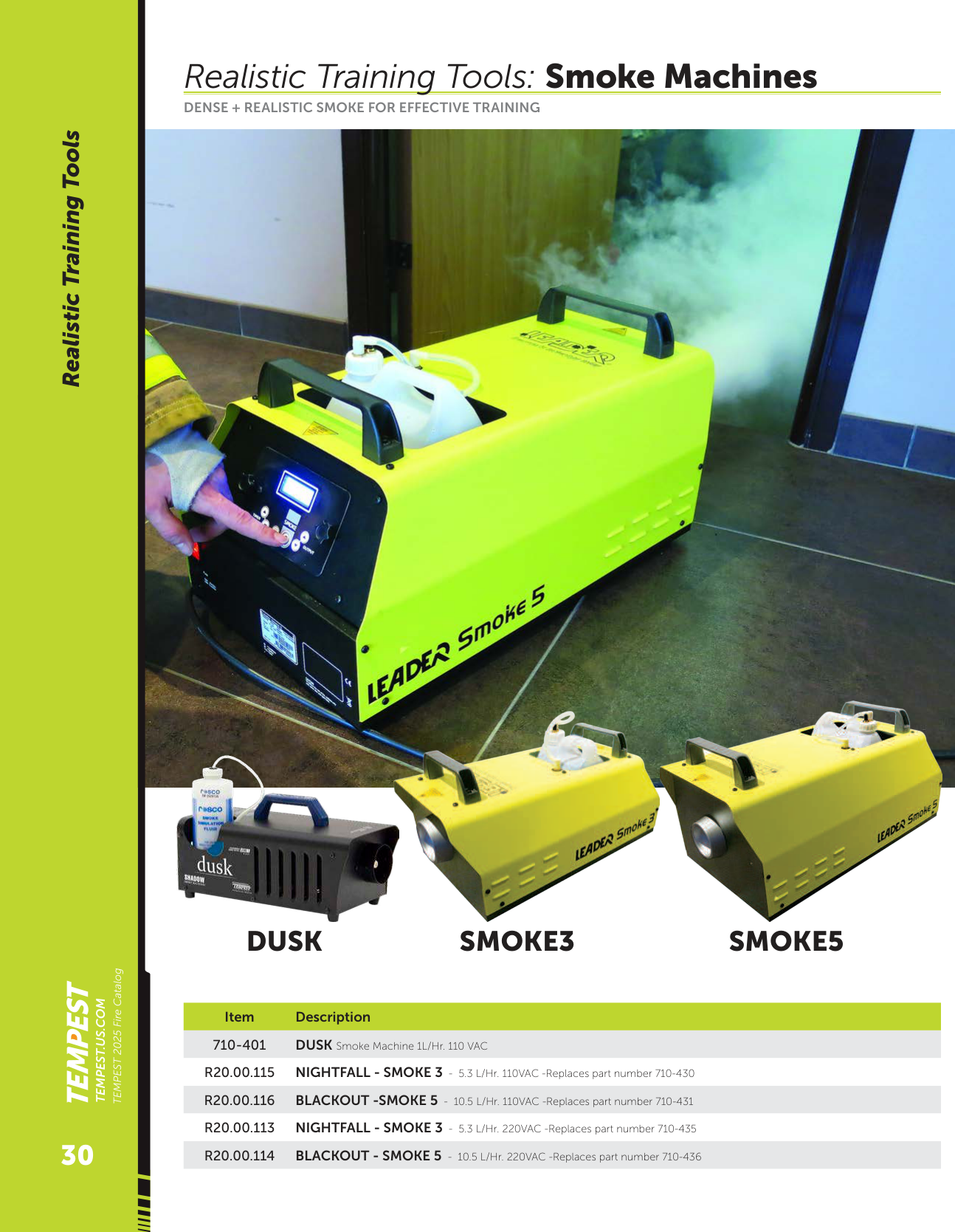
Firefighters who have never trained in zero-visibility conditions are not prepared for zero-visibility fires. That is the core problem smoke training equipment exists to solve. When a crew runs a search and rescue evolution in a brightly lit, obstacle-free corridor, they build confidence in the wrong environment. The moment they enter a smoke-charged structure, every orientation cue disappears. Tempest smoke machines replicate that disorientation deliberately and safely, filling a room, a floor, or an entire multi-story training tower with thick, realistic smoke that forces crews to rely on SCBA protocols, thermal imaging, and hands-on search techniques rather than visual reference. Three output models, two voltage configurations, and a portable form factor make these machines the practical choice for training officers who need repeatable, controllable conditions across any facility size.
What are Tempest smoke machines and how do they work for fire training?
Tempest smoke machines are electrically powered fluid-based smoke generators designed specifically to produce dense, realistic smoke for firefighter training scenarios. They vaporize a water-based smoke fluid at a controlled rate to generate thick, low-residue smoke that mimics fire ground visibility conditions without introducing actual combustion hazards into the training environment.
The Tempest lineup covers three output levels. The DUSK (item 710-401) produces 1 L/hr, scaled for small rooms and confined-space scenarios. The SMOKE3 / NIGHTFALL (items R20.00.115 and R20.00.113) steps up to 5.3 L/hr for medium training structures. The SMOKE5 / BLACKOUT (items R20.00.116 and R20.00.114) tops out at 10.5 L/hr for large training towers and complex multi-room evolutions. All models are manufactured by Tempest, headquartered at 4708 N. Blythe Avenue, Fresno, California, and available through PE Energy’s Training Equipment Catalog.
What output level is right for the training facility size?
Matching smoke output to facility volume is the most critical selection decision. Under-filling a space leaves too much visibility and removes the training stimulus. Over-filling a space too quickly reduces the instructor’s ability to control scenario timing and crew safety monitoring.
At 1 L/hr, the DUSK is purpose-built for single rooms, closets, stairwells, and confined-space evolutions where a small, controlled smoke volume is all that is needed. The SMOKE3 / NIGHTFALL at 5.3 L/hr handles medium-sized training facilities, apartment floor simulations, and scenarios where smoke needs to propagate across multiple connected rooms without redeploying units. For a multi-story training tower, a live-fire building simulation, or any evolution requiring full-structure smoke density, the SMOKE5 / BLACKOUT at 10.5 L/hr is the appropriate choice, and multiple units can be deployed simultaneously to scale volume further. The Tempest Dusk Smoke Generator is the practical starting point for departments that primarily run small-structure or confined-space drills.
How do Tempest smoke machines support SCBA and thermal imaging training?
SCBA proficiency and thermal imaging camera operation both require realistic sensory conditions to develop correctly. Classroom or clear-air drills build procedural memory but do not develop the instinctive mask management, body position discipline, and camera-reading skills that zero-visibility conditions demand.
Tempest machines produce smoke dense enough to reduce firefighter orientation cues to a level that replicates zero-visibility search and rescue scenarios. That density is what makes the SCBA drill functionally valid: crews must manage air consumption, maintain crew communication, and navigate by touch and protocol rather than sight. For thermal imaging camera operators, realistic smoke provides the actual visual interference that separates trained from untrained camera use. A thermal imaging unit functions differently when a firefighter is reading it through dense smoke while low-crawling than when reading it in a clear training room. Tempest smoke creates that training gap and forces operators to close it. Ventilation tactic training also benefits directly: crews must observe actual smoke movement patterns to learn how positive pressure ventilation, hydraulic ventilation, and natural ventilation affect smoke travel through a structure.
What voltage options are available and why does it matter for deployment?
Tempest smoke machines are available in 110V AC and 220V AC configurations, covering North American standard power supply and international electrical infrastructure without the need for step-down transformers or power adapters on site.
The DUSK (710-401) is offered in 110V. Both SMOKE3 / NIGHTFALL and SMOKE5 / BLACKOUT carry dual-voltage SKUs: 110V versions (R20.00.115 and R20.00.116) for North American training facilities, and 220V versions (R20.00.113 and R20.00.114) for international academies, military installations, and industrial brigade training centers operating on 220V infrastructure. For departments that deploy equipment internationally or operate mutual-aid training programs across borders, ordering the correct voltage variant at purchase eliminates field compatibility failures. Running a 110V unit on a 220V circuit without a transformer will damage the machine and interrupt training operations. The dual-voltage product lineup removes that risk by building the correct power specification into each ordered unit from the factory.
How does a portable smoke machine improve training scenario flexibility?
Fixed smoke systems installed in a single room limit training to that room. A portable machine repositions with the scenario, which is how most actual fire department training is structured: one crew runs a search evolution on floor two while another runs a ventilation drill on floor one.
Tempest smoke machines are compact and designed to be positioned anywhere inside a training facility or simulated structure. A training officer can move a unit between rooms, floors, or evolutions during a single training day without complex setup or fixed installation requirements. For departments running multiple concurrent evolutions, deploying two or more units simultaneously scales smoke density across a larger structure. A combination approach, for example, placing a DUSK in a confined stairwell while running a SMOKE5 / BLACKOUT in the main training bay, allows instructors to manage different visibility conditions in different zones simultaneously. This scenario flexibility directly supports command and control training, where company officers must account for smoke conditions in multiple parts of a structure at the same time.
What training evolutions are most effectively supported by smoke machine use?
Smoke machines are not single-purpose tools. The visibility conditions they create are directly applicable to the full range of interior firefighting skill sets that require zero or near-zero visibility to train authentically.
Tempest machines are documented to support the following training evolutions: SCBA drills, thermal imaging camera operator training, fire attack tactics, search and rescue exercises, ventilation training, and command and control practice. Each of these disciplines has a different smoke density and spatial requirement. SCBA confidence courses typically use moderate smoke density in a confined maze structure, making the DUSK or SMOKE3 / NIGHTFALL the right fit. Fire attack tactic training in a training tower requires the SMOKE5 / BLACKOUT to fill vertical structure volume effectively. Command and control training, where officers are directing crews through radio without visual confirmation of conditions, benefits from the most realistic, densest smoke environment the facility can safely support. Training officers sourcing complementary live-fire equipment can also review the Leader PYROS 3 Flame Generator and the Leader GF42 Flame Generator to build a complete, multi-hazard training scenario alongside smoke deployment.
How do Tempest smoke machines compare to other fire training smoke options?
The primary alternatives to purpose-built smoke machines for fire training are theatrical foggers, cold-smoke generators, and actual smoke from live-fire training. Each alternative has meaningful limitations that the Tempest lineup avoids.
Theatrical foggers designed for entertainment applications are not rated for fire training environments and typically produce lower-density output inadequate for realistic zero-visibility simulation. Cold-smoke systems used in certain prop fire environments produce visible but non-realistic smoke that thermal imaging cameras read differently than actual fire ground smoke conditions. Live-fire smoke is authentic but uncontrollable, non-repeatable, and unsuitable for the early-stage skill development where controlled conditions are pedagogically essential. Tempest machines produce smoke described by the manufacturer as dense and realistic-looking, calibrated specifically to simulate fire ground visibility conditions. The Tempest official product site documents the product family across the DUSK, NIGHTFALL, and BLACKOUT model names with corresponding output specifications. The three-tier output structure (1 L/hr, 5.3 L/hr, 10.5 L/hr) allows training programs to match smoke production precisely to facility volume rather than compensating with workarounds like multiple theatrical units or partial live fire.
Where are Tempest smoke machines used in practice?
Fire training smoke machines from the Tempest lineup are applicable across the full range of fire service and industrial brigade training environments. Municipal fire academies use them in training towers and burn buildings to condition new recruits to interior attack conditions before live-fire exposure. Industrial fire brigades at refineries, petrochemical plants, and offshore facilities use them during scheduled training evolutions to maintain interior firefighting proficiency for plant emergency response teams. Airport ARFF departments run tabletop and facility-based training with smoke machines to rehearse aircraft interior rescue under simulated smoke conditions. Military fire protection units use the 220V NIGHTFALL and BLACKOUT models (R20.00.113 and R20.00.114) at international installations where 110V power is not available.
Search and rescue teams, including technical rescue companies and swift water teams with confined-space rescue mandates, use the DUSK (710-401) for low-volume confined-space simulations where a high-output machine would overwhelm a small space. Departments building out a full training equipment program can browse the complete Training Equipment Catalog at PE Energy to source smoke machines alongside flame generators, thermal imaging accessories, and other fire training apparatus in a single procurement.
When is a Tempest smoke machine the right choice, and when is it not?
Tempest smoke machines are the right choice when a department needs repeatable, controllable, realistic smoke conditions across multiple training evolutions without introducing actual combustion risk. They are appropriate for facility-based training programs, SCBA certification courses, thermal imaging operator development, and any training program where instructor control of visibility conditions is a safety and curriculum priority.
They are not substitutes for live-fire training. Departments that need to develop fire behavior reading skills, suppression muscle memory under actual heat stress, and nozzle control under real fire conditions still require live-fire evolutions conducted under NFPA guidelines. Smoke machine training and live-fire training are complementary, not interchangeable. For large-structure or multi-story training towers where a single unit may be insufficient to fill the entire volume, multiple SMOKE5 / BLACKOUT machines deployed simultaneously are the correct scaling approach rather than attempting to overrun a lower-output unit. Departments with exclusively international power infrastructure should specify the 220V SKUs (R20.00.113 and R20.00.114) at the point of order rather than purchasing 110V units and adapting them in the field. For the full Tempest product range and additional training equipment options, the PE Energy Sitemap provides a complete navigation index of available product categories and brands.
Tempest Fire Training
Smoke Machines for Fire Training
DUSK | SMOKE3 | SMOKE5 | Dense & Realistic Smoke | 110V & 220V
Overview
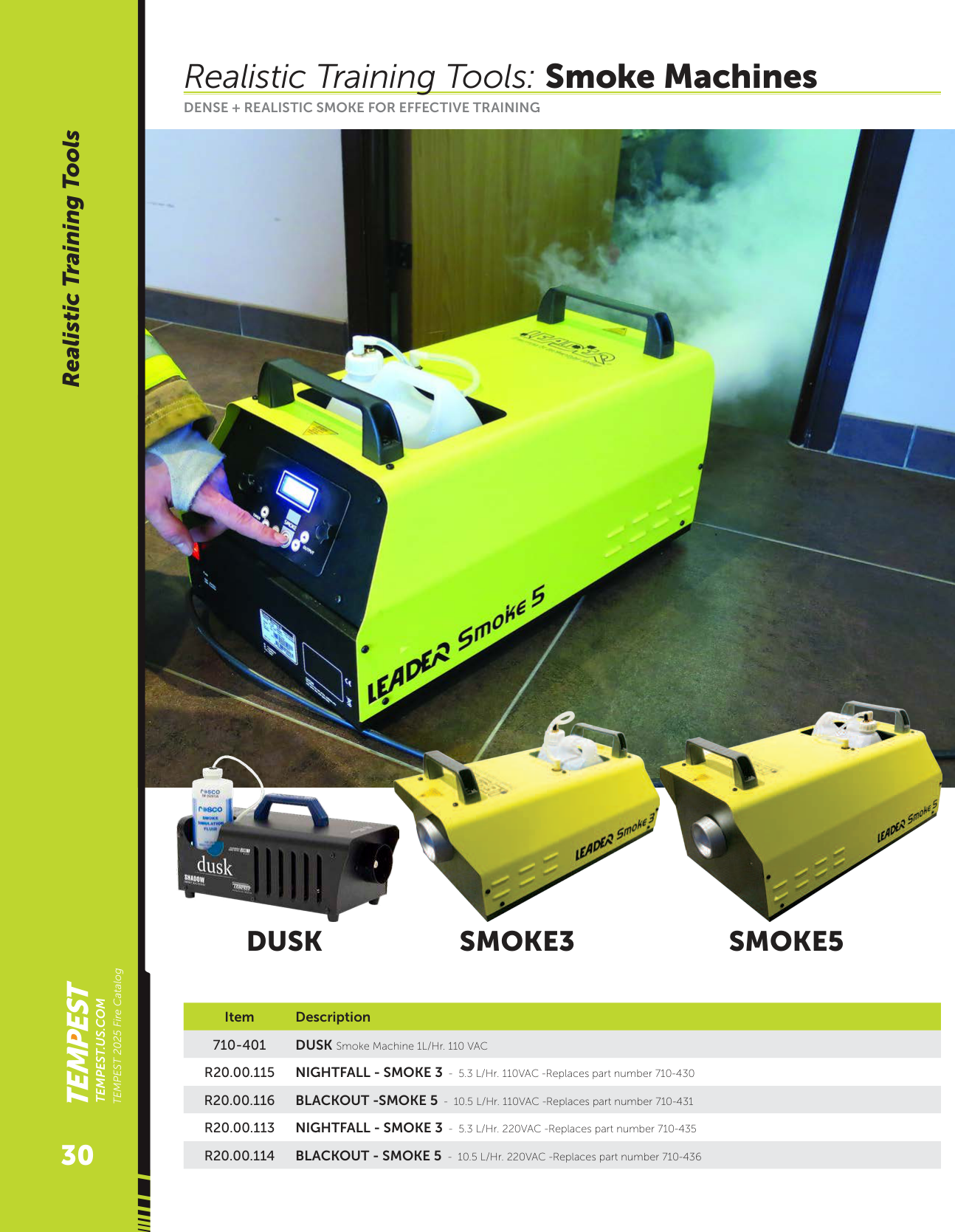
Tempest smoke machines provide dense, realistic smoke for effective fire training. Available in three output levels — DUSK (1 L/hr), SMOKE3 / NIGHTFALL (5.3 L/hr), and SMOKE5 / BLACKOUT (10.5 L/hr) — the Tempest smoke machine lineup scales to any training facility size or scenario complexity.
Each machine produces thick, realistic-looking smoke that simulates fire ground conditions for firefighter visibility training, search and rescue drills, ventilation tactics practice, and thermal imaging camera operator training. Available in 110V and 220V configurations for international deployment.
Key Features
Dense + Realistic Smoke
Produces thick, realistic smoke that effectively simulates fire ground visibility conditions — reducing firefighter orientation cues to replicate zero-visibility search and rescue scenarios.
Three Output Levels
DUSK: 1 L/hr for small spaces. SMOKE3/NIGHTFALL: 5.3 L/hr for medium training areas. SMOKE5/BLACKOUT: 10.5 L/hr for large training facilities and complex scenario evolution.
110V & 220V Options
Available in both 110V AC (North America) and 220V AC (international) versions — deploy at any training facility worldwide without power adapter complications.
Effective Firefighter Training
Supports SCBA drills, thermal imaging training, fire attack tactics, search and rescue exercises, ventilation training, and command and control practice under realistic visibility conditions.
Portable Design
Compact units that can be positioned anywhere in a training facility or simulated structure. Move between rooms, floors, or training evolutions without complex setup.
Scalable Output
Multiple machines can be deployed simultaneously to fill large training structures. Scale from a single apartment room to a multi-story training tower by selecting the appropriate model quantity and output level.
Models & Ordering Information
| Item No. | Description | Output | Voltage |
|---|---|---|---|
| 710-401 | DUSK Smoke Machine | 1 L/hr | 110 VAC |
| R20.00.115 | NIGHTFALL — SMOKE3 | 5.3 L/hr | 110 VAC |
| R20.00.116 | BLACKOUT — SMOKE5 | 10.5 L/hr | 110 VAC |
| R20.00.113 | NIGHTFALL — SMOKE3 | 5.3 L/hr | 220 VAC |
| R20.00.114 | BLACKOUT — SMOKE5 | 10.5 L/hr | 220 VAC |
Manufacturer: Tempest — 4708 N. Blythe Avenue, Fresno, California 93722 USA — tempest.us.com