
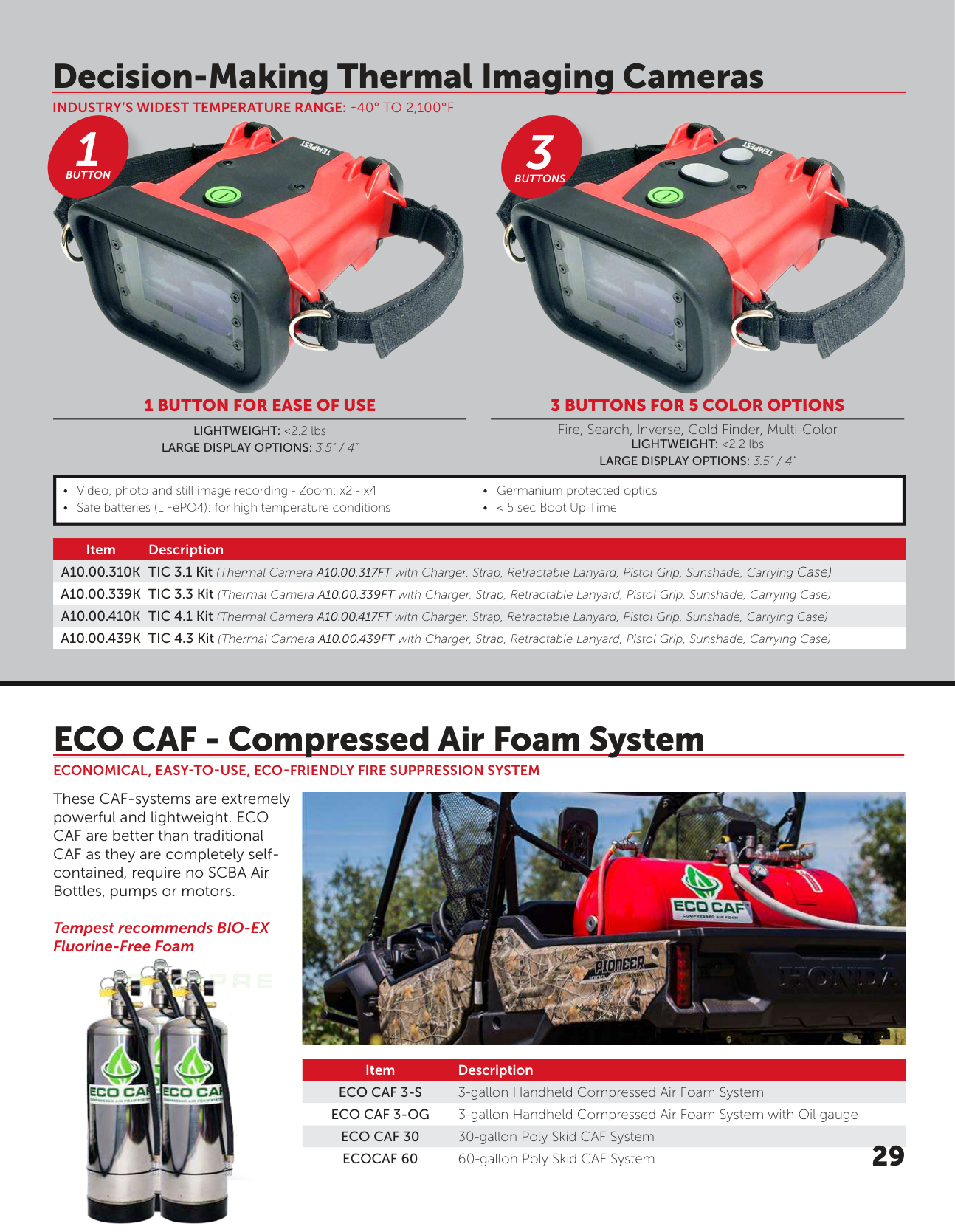
Tempest ECO CAF Compressed Air Foam System: Self-Contained PFAS-Free Fire Suppression in 3, 30, and 60-Gallon Configurations
Most compressed air foam systems demand a stack of support equipment before a single gallon of foam hits a fire. SCBA air bottles, external pumps, motors, and dedicated operators add weight, setup time, and points of failure at the worst possible moment. Crews working wildland interface, industrial facilities, or municipal structures cannot always afford that overhead. The Tempest ECO CAF is built around the opposite philosophy: a completely self-contained compressed air foam system that requires none of that supporting hardware, ships in configurations from a 3-gallon handheld unit up to a 60-gallon poly skid, and pairs with BIO-EX Fluorine-Free Foam to meet increasingly strict PFAS regulations. Here is what that actually means in practice.
What is a compressed air foam system and how does the Tempest ECO CAF work?
A compressed air foam system (CAF) blends water, foam concentrate, and compressed air simultaneously to produce a homogeneous foam solution with greater adhesion, longer drain time, and deeper fuel penetration than water alone. The Tempest ECO CAF achieves this without relying on SCBA air bottles, external pumps, or electric motors, making the entire system mechanically independent from the apparatus or support infrastructure around it.
That self-contained design is the core engineering departure from conventional CAF units. Traditional compressed air foam systems pull compressed air from a breathing air supply or apparatus-mounted compressor, tying deployment to vehicle readiness. The ECO CAF carries everything needed for foam generation in its own housing, so a firefighter can advance with the 3-gallon ECO CAF 3-S independently of the engine or pump operator. For the 30-gallon and 60-gallon skid versions, the same independence applies at the apparatus or trailer mount level, removing the motor and pump maintenance cycle that drives downtime in conventional skid CAF installations.
What are the differences between the ECO CAF 3-S, ECO CAF 3-OG, ECO CAF 30, and ECOCAF 60?
Tempest offers four distinct ECO CAF models, each matched to a different operational scale. The ECO CAF 3-S is the baseline 3-gallon handheld unit. The ECO CAF 3-OG adds an oil gauge for real-time monitoring of pressure and concentrate levels during deployment. The ECO CAF 30 is a 30-gallon poly skid system, and the ECOCAF 60 scales that platform to 60 gallons for extended suppression operations.
The oil gauge option on the ECO CAF 3-OG is a meaningful operational difference, not just a convenience feature. In complex suppression scenarios such as structure interiors, confined spaces, or multi-point ignition events, knowing remaining concentrate volume without breaking deployment rhythm allows the incident commander to time relief rotations and refill cycles accurately. The 30-gallon and 60-gallon poly skid configurations are designed for mounting on apparatus, trailers, or fixed platforms, providing sustained foam application capacity that a handheld unit cannot. The poly construction on both skid models resists corrosion from foam concentrate exposure, which is a documented failure mode in steel-framed skid systems used in coastal or high-humidity environments.
Why does the ECO CAF not require SCBA air bottles or an external pump?
The ECO CAF system is self-pressurized and self-contained, meaning the compressed air source, foam concentrate reservoir, and delivery mechanism are all housed within the unit itself. No external air supply from breathing air cylinders is needed, and no motorized pump is required to move solution through the system.
This matters for two distinct operational reasons. First, SCBA air bottles are a finite, regulated, life-safety resource on the fireground. Diverting them to a foam system creates a supply conflict that fire departments operating under NFPA 1901 apparatus standards must carefully manage. Second, motors and pumps introduce mechanical failure modes, power dependency, and maintenance intervals. Eliminating those components from the ECO CAF design reduces the number of parts that can fail during an incident response. For departments operating in areas with limited access to electrical infrastructure or dedicated apparatus support, such as wildland-urban interface zones or remote industrial sites, that reliability profile is directly relevant to mission success. The National Fire Protection Association standard framework for apparatus and suppression equipment increasingly emphasizes operational independence and rapid deployment capability, both of which the ECO CAF architecture directly addresses.
Is the Tempest ECO CAF compatible with PFAS-free foam concentrates?
Yes. Tempest recommends BIO-EX Fluorine-Free Foam for use with all ECO CAF models. BIO-EX is a PFAS-free foam concentrate, meaning it contains no per- and polyfluoroalkyl substances, the synthetic fluorinated compounds currently subject to federal and state environmental regulations in the United States.
The regulatory pressure on PFAS-containing fire suppression agents has accelerated sharply. Aqueous film-forming foam (AFFF) products containing PFAS are restricted or banned at training facilities, near municipal watersheds, and on sites governed by state-level discharge regulations. The ECO CAF’s compatibility with BIO-EX Fluorine-Free Foam positions it for deployment in exactly those environmentally sensitive contexts: airports adjacent to wetlands, industrial facilities under EPA consent orders, and municipal fire departments transitioning away from legacy AFFF inventory. Fluorine-free foam concentrates do not compromise suppression performance when matched to a properly engineered CAF delivery system, and the ECO CAF’s controlled air-to-solution ratio is designed to maximize the performance characteristics of modern fluorine-free formulations. For detailed guidance on PFAS regulations in fire suppression, the EPA PFAS information and resources page provides current regulatory status and compliance timelines.
How lightweight is the ECO CAF 3-S handheld unit, and why does weight matter for firefighter operations?
The ECO CAF 3-S is specified to weigh less than typical backpack-carried firefighting equipment, making it a genuinely portable suppression tool that a single firefighter can carry and deploy without assistance. That weight profile matters because handheld suppression tools are only useful when they reach the point of attack without fatiguing the operator in transit.
Wildland firefighters, industrial brigade members, and structural attack crews all operate under cumulative load constraints. A firefighter in full PPE carrying SCBA, tools, and radio has limited margin for additional equipment weight. A compressed air foam system that replaces that weight burden rather than adding to it changes the calculus entirely. The 3-gallon capacity is sized for rapid initial attack, vehicle and equipment fires, and point-of-origin structural suppression before a larger apparatus line is charged. When the operation requires sustained flow beyond 3 gallons, the ECO CAF 30 or ECOCAF 60 skid systems pick up where the handheld leaves off, creating a scalable suppression architecture across a single product family.
What failure modes does the ECO CAF design eliminate compared to traditional CAF systems?
Traditional CAF systems fail at several predictable points: air supply depletion or contamination from shared SCBA bottles, motor or pump mechanical failure, proportioning system clogging from concentrate residue, and power interruption to electric-drive components. The ECO CAF’s self-contained architecture removes the air supply dependency and the motor and pump failure modes entirely.
Proportioning accuracy is another failure mode in conventional CAF installations. When the pump speed, air pressure, and water flow are not precisely matched, foam quality degrades, producing either wet foam with poor adhesion or dry foam that does not penetrate fuel surfaces effectively. The ECO CAF’s integrated design controls that ratio internally, removing the variable of operator-adjusted proportioning during high-stress deployment. The poly skid construction on the ECO CAF 30 and ECOCAF 60 specifically addresses the corrosion failure mode common in steel-framed skid systems, where foam concentrate residue and moisture combine to accelerate rust at welds and fittings. Poly construction does not rust, does not require paint maintenance, and does not develop the pinhole leaks at corroded weld joints that cause concentrate loss and pressure drop in aged steel skid systems.
Where are ECO CAF compressed air foam systems most commonly deployed?
ECO CAF systems are deployed across municipal fire departments, industrial fire brigades, wildland-urban interface operations, and aviation ground support. The 3-gallon handheld models suit initial attack and firefighter-carried rapid response, while the skid configurations serve apparatus-mounted and fixed-platform installations.
At PE Energy, the Tempest ECO CAF product family is available alongside a broader range of firefighting suppression equipment and apparatus components. Departments and industrial facilities sourcing compressed air foam systems can find the Tempest ECO CAF system product page for current model availability and configuration details. Industrial operations requiring foam suppression as part of a broader fire protection program can also explore Tempest fire equipment products at PE Energy, which includes nozzles, tools, and suppression accessories from the same manufacturer. Facilities managing PFAS compliance alongside suppression system upgrades will find the ECO CAF’s BIO-EX compatibility particularly relevant. Teams building out mobile attack units can review firefighting equipment available through PE Energy to source complementary suppression tools, hose, and nozzle hardware in a single procurement process. The ECOCAF 60 skid in particular is suited to petrochemical facilities, airfields, and municipal stations where extended foam application duration is a design requirement for suppression system coverage.
When is the ECO CAF the right tool, and when is it not?
The Tempest ECO CAF is the right choice when the operation requires immediate, apparatus-independent foam suppression, when PFAS-free foam is mandated or preferred, and when the operational environment cannot support the logistical footprint of a conventional CAF installation with external air, motors, and pumps.
The ECO CAF is not the right tool for operations requiring continuous, high-volume foam application over extended periods where a fixed-pump, engine-driven CAF system fed by an unlimited water supply would outperform any self-contained configuration. High-rise structure fires requiring multiple sustained attack lines, or large-area petrochemical spill fires demanding thousands of gallons of foam solution, exceed what any self-contained skid system in the 60-gallon class is designed to deliver. In those applications, the ECO CAF 30 or ECOCAF 60 functions best as a rapid initial-attack or supplemental system alongside larger apparatus-driven suppression. Matching the system to the hazard scale is the critical deployment decision, and the ECO CAF family’s range from 3 to 60 gallons provides enough coverage to be the primary suppression tool in the majority of municipal, industrial, and wildland-interface incident types where fire departments and brigade teams actually deploy foam.
Tempest Fire
ECO CAF Compressed Air Foam System
Economical | Easy-to-Use | Eco-Friendly | Self-Contained
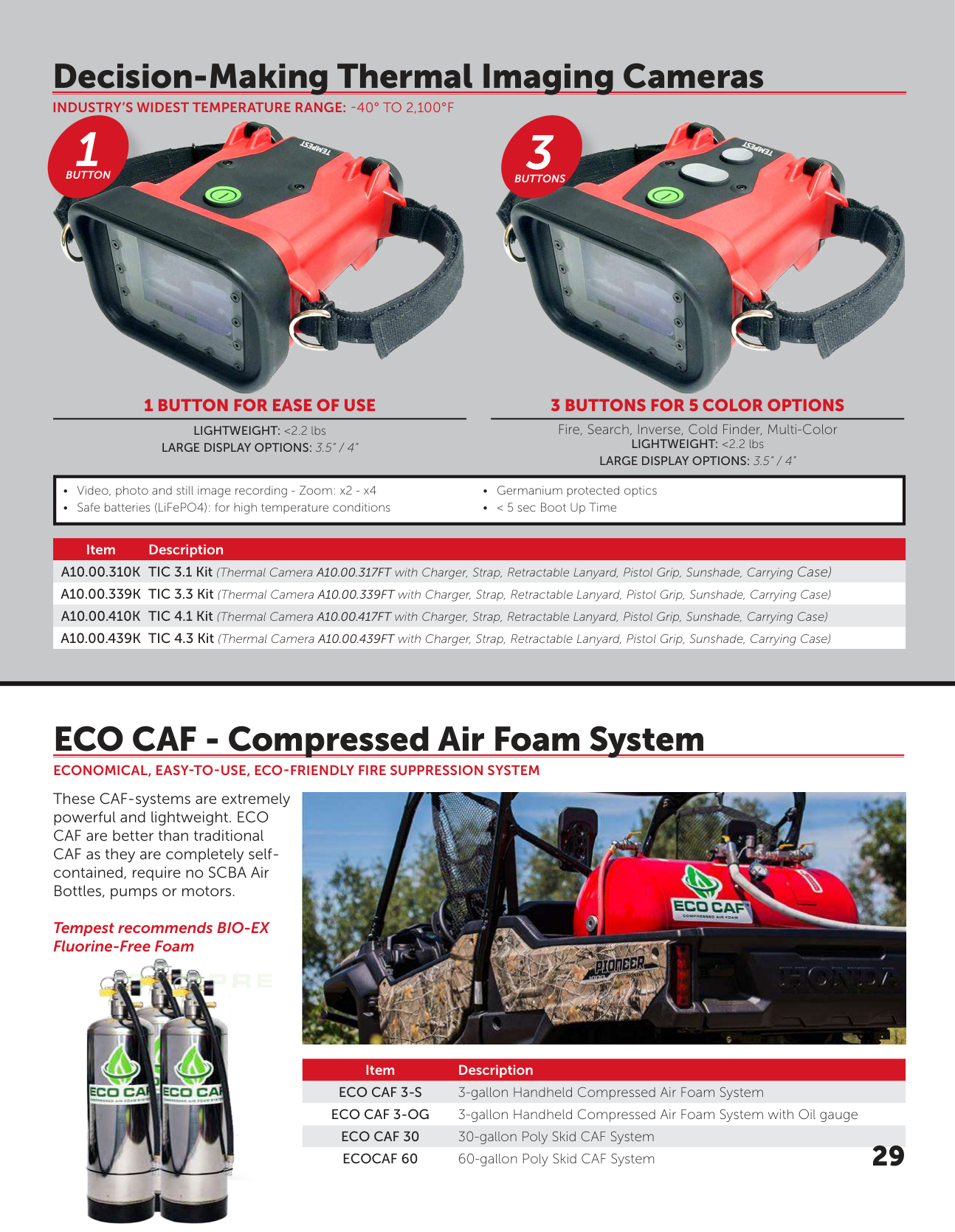
Overview
The Tempest ECO CAF is a compressed air foam (CAF) system that is better than traditional CAF systems — completely self-contained, requiring no SCBA air bottles, no pumps, and no motors. Lightweight and extremely powerful, the ECO CAF is available in 3-gallon handheld, 30-gallon skid, and 60-gallon skid configurations.
The handheld ECO CAF 3-S weighs less than traditional CAF systems, making it ideal for firefighter-carried operations. All ECO CAF systems are compatible with BIO-EX Fluorine-Free Foam for PFAS-free foam suppression.
Key Features
No SCBA Air Bottles Required
Better than traditional CAF — completely self-contained with no SCBA air bottles, no external pumps, and no motors. Independent operation without specialized support equipment.
Extremely Powerful & Lightweight
The 3-gallon handheld model weighs under typical backpack weight while delivering powerful foam suppression. Carry it anywhere, deploy immediately on any fire type.
Multiple Configurations
3-gallon handheld (ECO CAF 3-S / 3-OG with oil gauge), 30-gallon poly skid, and 60-gallon poly skid — scale the system to the operation size.
Oil Gauge Option
ECO CAF 3-OG includes an oil gauge for monitoring pressure and concentrate levels during operation — critical for precise foam management in complex suppression scenarios.
Eco-Friendly
Compatible with BIO-EX Fluorine-Free Foam — PFAS-free suppression for environmentally sensitive applications, municipal watersheds, and locations with strict environmental regulations.
Skid Systems for Larger Operations
30-gallon and 60-gallon poly skid versions for extended operations — mount on apparatus, trailers, or platforms for sustained foam application in industrial and structural firefighting.
Models & Ordering Information
| Item No. | Description |
|---|---|
| ECO CAF 3-S | 3-Gallon Handheld Compressed Air Foam System |
| ECO CAF 3-OG | 3-Gallon Handheld Compressed Air Foam System with Oil Gauge |
| ECO CAF 30 | 30-Gallon Poly Skid CAF System |
| ECOCAF 60 | 60-Gallon Poly Skid CAF System |
Technical Specifications
| Type | Compressed Air Foam (CAF) System — Self-Contained |
| Capacities | 3 gallon (handheld), 30 gallon (skid), 60 gallon (skid) |
| External Requirements | None — no SCBA air bottles, no pumps, no motors |
| Foam Recommendation | BIO-EX Fluorine-Free Foam (Tempest recommended) |
| Options | Standard or with Oil Gauge (3-gallon handheld) |
Manufacturer: Tempest — 4708 N. Blythe Avenue, Fresno, California 93722 USA — tempest.us.com