
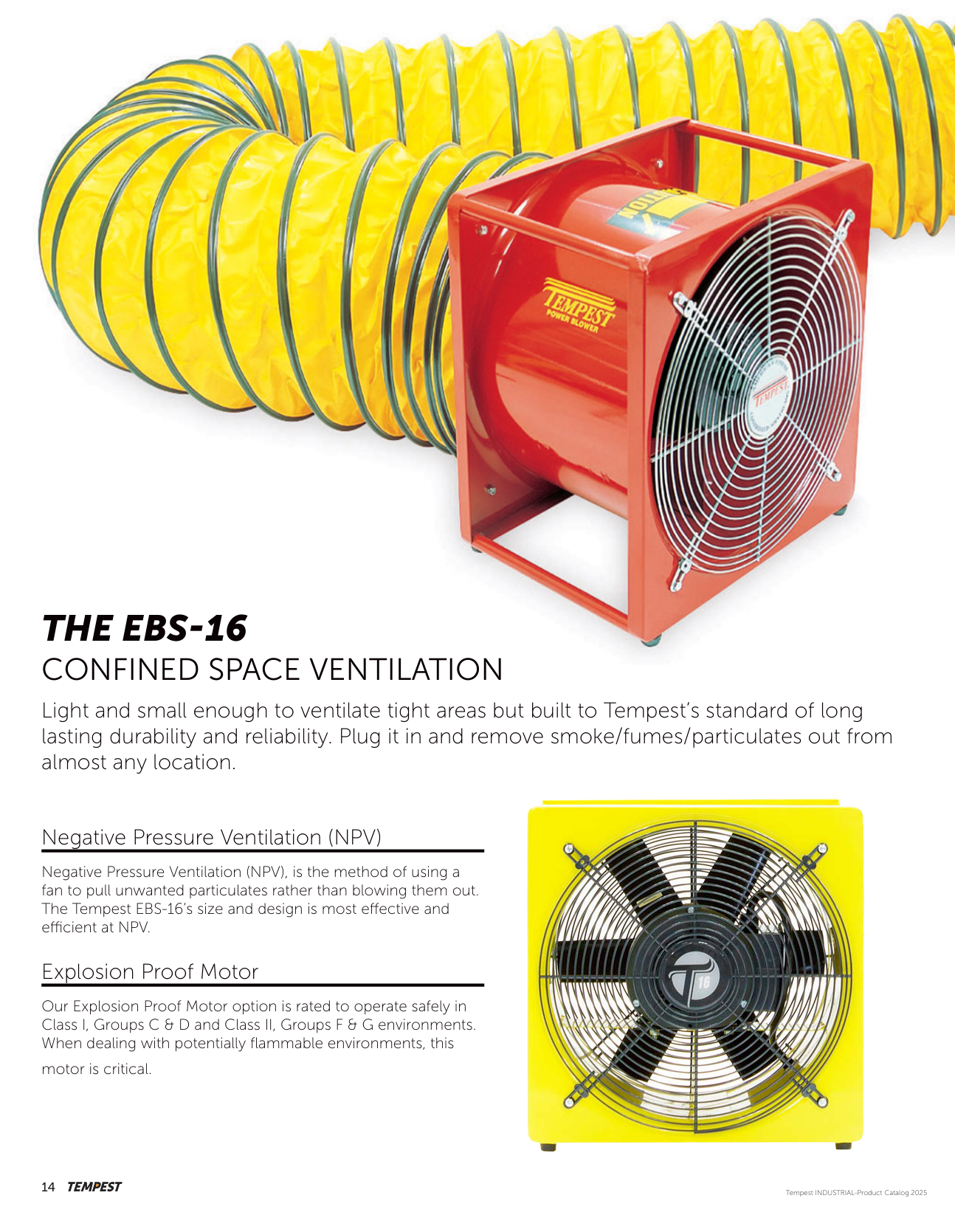
Confined space entry failures rarely happen because the work crew was careless. They happen because the ventilation equipment was too large to position correctly, too weak to clear a deep vessel before entry, or simply not rated for a flammable atmosphere. The Tempest EBS-16 was engineered around exactly those failure scenarios: a 16-inch fan compact enough to fit where standard ventilation equipment cannot, rated for Class I and Class II hazardous locations in its explosion-proof configuration, and optimized for negative pressure ventilation so it pulls contaminants out rather than pushing fresh air in and displacing a problem rather than removing it. When the geometry is tight, the atmosphere is unknown, and getting it wrong is not an option, the EBS-16’s specification set becomes the deciding factor.
What is the Tempest EBS-16 and how does it differ from standard industrial fans?
The Tempest EBS-16 is a 16-inch electric confined space ventilation fan designed for negative pressure ventilation (NPV) in industrial and emergency-response applications. Unlike general-purpose blowers, it is purpose-built for restricted spaces — tanks, vessels, vaults, pits, and tunnels — where physical access and atmospheric hazards define the equipment selection, not just airflow volume.
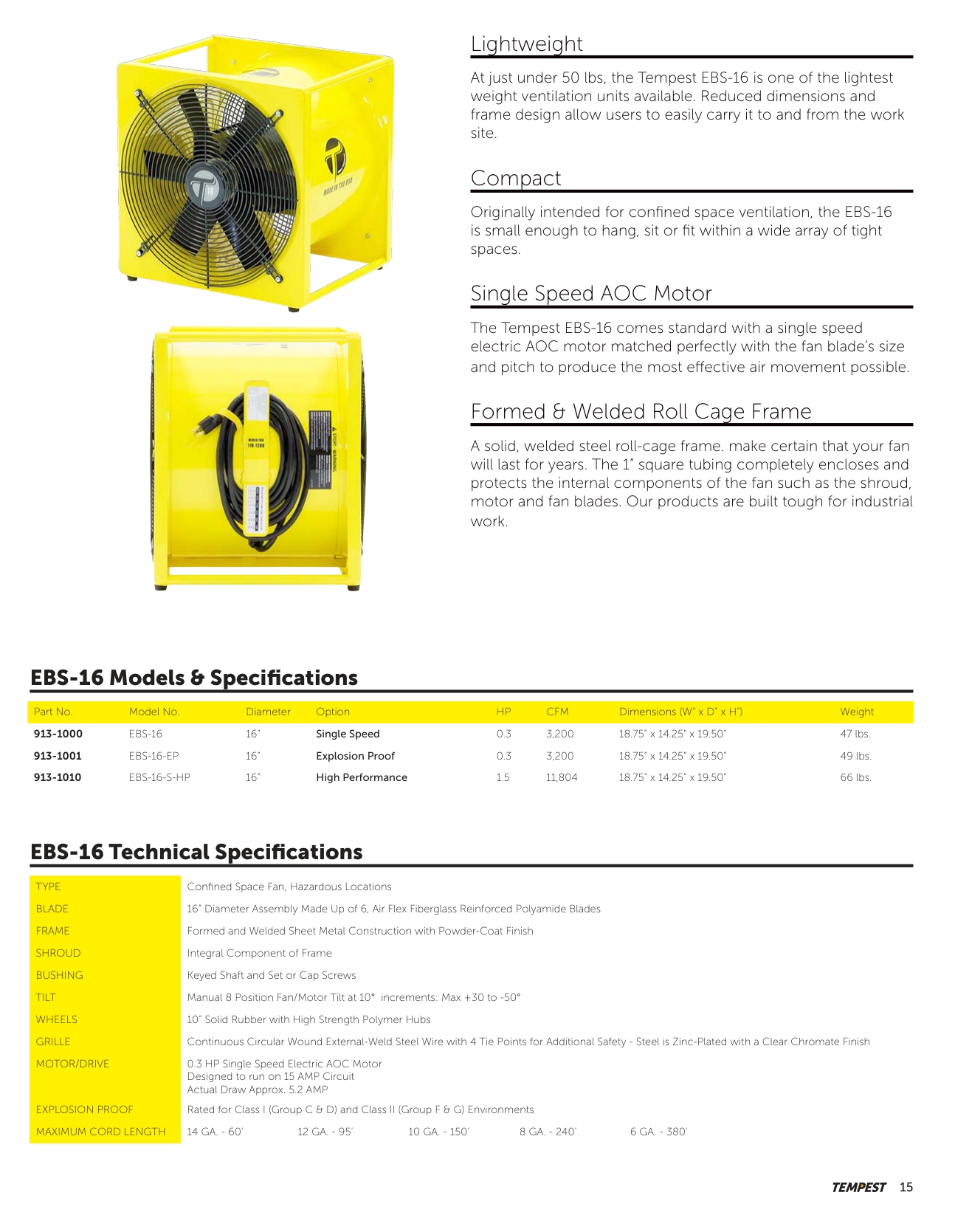
At 18.75 inches wide by 14.25 inches deep by 19.50 inches tall and weighing 47 lbs in the standard configuration, the EBS-16 is sized to pass through confined space entry openings that exclude larger fans. The blade assembly uses six AirFlex fiberglass reinforced polyamide blades on a 16-inch diameter, providing structural resilience in environments where blade contact with a frame or foreign object is a real risk. The formed and welded sheet metal roll-cage frame with powder-coat finish is designed to handle hanging applications, meaning the fan can be suspended at the entry point of a vessel or tunnel rather than placed on the floor, which is often the most effective NPV position.
How does negative pressure ventilation work in a confined space entry?
Negative pressure ventilation (NPV) positions the fan to exhaust air out of the confined space, creating a lower-pressure zone inside that draws fresh replacement air through any available opening. This approach physically removes contaminants — smoke, hydrogen sulfide, hydrocarbon vapors, welding fumes, particulates — rather than diluting them by pushing air in. For confined spaces with a single entry point, NPV is often the only viable method.
The EBS-16’s 8-position locking tilt system, adjustable in 10-degree increments from +30 degrees upward to -50 degrees downward, allows the exhaust stream to be directed precisely at the entry opening. This range matters inside tanks and below-grade vaults where the fan must be angled downward to direct air out through a manhole or hatch. In positive pressure mode, the same tilt range lets the operator direct fresh air to a specific area of the space. The 10-inch solid rubber wheels with high-strength polymer hubs allow repositioning on rough industrial surfaces without assistance, which is practical when a single worker is completing the setup.
What does the EBS-16-EP explosion-proof rating cover, and when is it required?
The EBS-16-EP carries an explosion-proof motor rated for Class I Groups C and D (flammable gases and vapors, including ethylene and propane) and Class II Groups F and G (combustible dusts, including carbon black and grain dust). This rating is required by OSHA confined space entry regulations when permit-required confined spaces contain or may contain flammable atmospheres, which is a routine condition in oil and gas processing, chemical manufacturing, tank cleaning, and utility infrastructure.
The EBS-16-EP weighs 49 lbs — only 2 lbs more than the standard model — because the explosion-proof motor replaces the standard AOC motor without requiring a redesign of the frame or blade assembly. The airflow output remains 3,200 CFM at 0.3 HP, and the electrical draw remains approximately 5.2 amps on a 15-amp circuit. For operations in refineries, petrochemical plants, and offshore vessel entries where a Class I or Class II rating is a non-negotiable permit condition, the EBS-16-EP eliminates the need to choose between compact size and hazardous location compliance.
When should you specify the EBS-16-S-HP high-performance model instead of the standard unit?
The EBS-16-S-HP is the correct selection when the confined space volume, contaminant concentration, or entry timeline demands higher airflow than the standard 3,200 CFM unit can deliver. Equipped with a 1.5 HP motor, the EBS-16-S-HP produces 11,804 CFM — nearly 3.7 times the output of the standard model — while maintaining the same 16-inch compact footprint.
The trade-off is weight: 66 lbs versus 47 lbs for the standard unit, which still qualifies as a single-worker-manageable unit but begins to approach the upper limit of solo deployment in field conditions. The EBS-16-S-HP is particularly appropriate for larger tanks and vessels where the confined space volume requires rapid atmospheric clearing before entry, or for utility tunnels with extended run lengths where 3,200 CFM is insufficient to establish adequate air movement at the far end. When the space is truly tight and the volume is small, the standard 3,200 CFM unit avoids unnecessary motor weight and electrical load.
What electrical supply does the EBS-16 require, and how far can it operate from the power source?
The standard EBS-16 and EBS-16-EP run on the 0.3 HP AOC motor drawing approximately 5.2 amps on a 15-amp circuit, making them compatible with standard industrial 120V service. Extension cord length directly affects motor performance and is a common field problem when fans are deployed inside deep tanks or underground infrastructure.
Tempest specifies maximum cord lengths by wire gauge to prevent voltage drop from degrading motor output: 14 AWG is rated to 60 feet, 12 AWG to 95 feet, 10 AWG to 150 feet, 8 AWG to 240 feet, and 6 AWG to 380 feet. These are hard limits, not guidelines. Exceeding the rated cord length for a given wire gauge will reduce airflow, increase motor temperature, and shorten motor service life. For confined space entries at depth — underground vaults, subsurface utility tunnels, below-grade process vessels — the 8 AWG or 6 AWG options allow reliable operation at distances that would be impractical with lighter cord.
How does the EBS-16 frame and blade design hold up in industrial confined space conditions?
The roll-cage frame is formed and welded sheet metal with a powder-coat finish, providing the structural rigidity needed for hanging applications at a confined space entry. The integral shroud is part of the frame rather than a separate attached component, which removes a potential failure point under the mechanical stress of hanging or repeated repositioning.
The six AirFlex fiberglass reinforced polyamide blades offer a combination of flexibility and chemical resistance that standard aluminum or polypropylene blades do not match. In environments where solvent vapors, acidic off-gases, or hydrocarbon condensate may contact the blade surface, polyamide composite construction resists degradation that would cause a standard blade to become brittle or delaminate over time. The steel wire grille uses continuous circular wound external-weld construction with zinc-plating and clear chromate finish, providing corrosion resistance in wet confined spaces such as tanks, wet wells, and culverts. Four tie points on the grille support secure attachment when the fan is positioned over a manhole or vessel opening in NPV mode.
What are the primary industrial applications for the Tempest EBS-16?
The EBS-16 covers a specific band of confined space ventilation problems: spaces that are too small for 18- or 20-inch fans, too hazardous for non-explosion-proof equipment, or require true NPV rather than dilution ventilation. The most common deployment scenarios in industrial settings include:
Oil and gas processing and storage vessels: The Tempest EBS-16 Electric-Powered Smoke Ejector in its EBS-16-EP configuration is the standard selection for confined space entries into crude oil storage tanks, separator vessels, and gas processing equipment where flammable vapor concentrations must be cleared before a permit can be issued. The Class I Group C and D rating directly addresses the hydrocarbon vapor environment present in these entries.
Chemical plant and refinery vessels: Confined space entries into reactors, heat exchangers, and process vessels at chemical facilities require Class II Group F and G coverage for combustible dust environments in addition to vapor ratings. The EBS-16-EP’s dual Class I and Class II certification covers both hazard types from a single unit, simplifying equipment inventory for facility safety teams.
Utility tunnels and underground infrastructure: The Tempest Single-Speed Electric Smoke Ejector product family and the EBS-16-S-HP at 11,804 CFM address longer tunnel runs where the standard 3,200 CFM unit cannot move sufficient air volume. The 10-inch solid rubber wheels and compact dimensions allow the unit to be transported through access shafts and repositioned along tunnel lengths.
Post-maintenance atmospheric clearing: After welding, grinding, coating application, or chemical cleaning inside enclosed equipment, the EBS-16 clears residual fumes and particulates before the space is released for inspection or return to service. The tilt mechanism allows precise airflow direction toward the area of highest contamination.
For securing the fan at a confined space entry opening, Tempest Quick Release Hold Downs, Special for 16″ fans are designed to mate with the EBS-16 frame dimensions, providing a stable positive-pressure or NPV seal at the entry point without improvised rigging. For applications requiring hydraulic power rather than electrical supply, the Tempest WD-18 Hydraulic Powered Fan provides an alternative where electrical hazards or supply limitations make the electric units impractical. For industrial positive pressure ventilation where a larger-format electric PPV fan is the correct selection, the Super Vac 716-EVS 7 Series Electric PPV represents the adjacent product category.
When is the EBS-16 the right call, and when is it not?
The EBS-16 is the correct selection when the confined space is too small to accept a standard 18-inch or larger fan, when a Class I or Class II explosion-proof rating is a permit condition, when true NPV is required rather than positive pressure dilution, and when a single worker must handle all setup and positioning without mechanical assistance. The EBS-16-EP at 49 lbs and the standard unit at 47 lbs both meet that single-worker threshold in most conditions.
The EBS-16 is not the correct selection when the confined space is large enough to benefit from a higher-flow unit and physical access is not a constraint. At 3,200 CFM in its standard configuration, the EBS-16 will clear small vessels efficiently but will require extended run times in large-volume spaces. The EBS-16-S-HP at 11,804 CFM addresses this within the same compact frame, but it carries no explosion-proof rating in the high-performance configuration. When both maximum airflow and hazardous location certification are required simultaneously, the equipment selection involves a trade-off that should be evaluated against the specific space geometry, contaminant type, and applicable permit conditions.
Designed, fabricated, and built in the USA at Tempest’s Fresno, California facility, the EBS-16 product line reflects a consistent engineering philosophy: solve the specific mechanical and safety constraints of confined space ventilation without adding size or weight that compromises deployability. The Tempest Industrial official product specifications provide full documentation for all three EBS-16 configurations, including motor data sheets and hazardous location certification references for compliance verification.
Tempest Industrial
EBS-16 Confined Space Ventilation Fan
Negative Pressure Ventilation | Explosion-Proof Option | Made in the USA
Overview
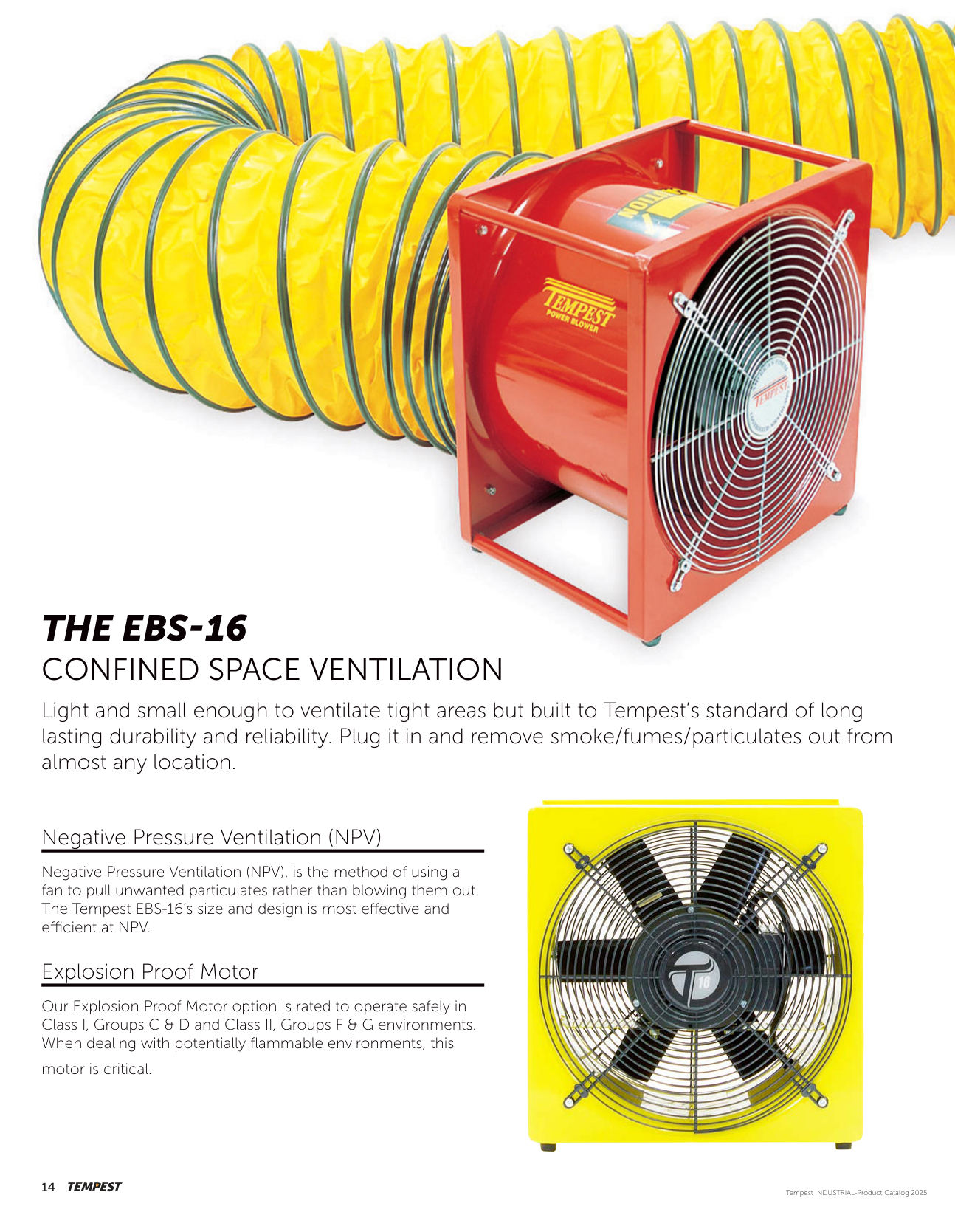
The Tempest EBS-16 is a compact 16-inch confined space ventilation fan built for tight industrial spaces where standard fans cannot fit or be effectively positioned. Light and small enough to ventilate the most restricted areas, the EBS-16 is engineered to Tempest’s standard for long-lasting durability and reliability.
Purpose-designed for Negative Pressure Ventilation (NPV) — pulling smoke, fumes, and hazardous particulates out rather than blowing them — the EBS-16 also operates in positive pressure mode. Available with an explosion-proof motor (Class I & II rated) and a high-performance 1.5 HP variant delivering 11,804 CFM for larger confined space challenges.
Key Features
Negative Pressure Ventilation (NPV)
The EBS-16’s design is optimized for NPV — pulling contaminants out of confined spaces. Effective for smoke, fumes, and hazardous particulates from almost any location.
Compact & Lightweight
At under 50 lbs and 18.75″ × 14.25″ × 19.50″, the EBS-16 fits into — and can be hung or positioned within — tight confined spaces that larger fans cannot access.
Explosion-Proof Option
EBS-16-EP is rated Class I (Groups C & D) and Class II (Groups F & G) for confined spaces in oil & gas, chemical, and other flammable atmosphere environments.
8-Position Locking Tilt
Manual tilt in 10° increments from +30° upward to -50° downward. Position airflow precisely for any confined space geometry — tanks, pits, vessels, tunnels.
Formed & Welded Roll-Cage Frame
Sheet metal roll-cage construction with powder-coat finish. Structural integrity for hanging applications and rough handling while remaining manageable by a single worker.
High-Performance Option
EBS-16-S-HP with 1.5 HP motor delivers 11,804 CFM — scaling up to the ventilation performance of larger fans within the same compact footprint.
Models & Ordering Information
| Part No. | Model | Configuration | HP | CFM | Weight |
|---|---|---|---|---|---|
| 913-1000 | EBS-16 | Single Speed | 0.3 | 3,200 | 47 lbs. |
| 913-1001 | EBS-16-EP | Explosion Proof — Class I & II | 0.3 | 3,200 | 49 lbs. |
| 913-1010 | EBS-16-S-HP | High Performance | 1.5 | 11,804 | 66 lbs. |
Technical Specifications
| Type | Confined Space Fan, Hazardous Locations |
| Blade Assembly | 16″ Diameter — 6 AirFlex Fiberglass Reinforced Polyamide Blades |
| Frame | Formed and Welded Sheet Metal Construction with Powder-Coat Finish |
| Shroud | Integral Component of Frame |
| Bushing | Keyed Shaft and Set or Cap Screws |
| Tilt | Manual 8-Position — 10° Increments — Max +30° to -50° |
| Wheels | 10″ Solid Rubber with High Strength Polymer Hubs |
| Grille | Continuous Circular Wound External-Weld Steel Wire — 4 Tie Points — Zinc-Plated with Clear Chromate Finish |
| Motor / Drive | 0.3 HP Single Speed Electric AOC Motor — 15 AMP Circuit — Actual Draw Approx. 5.2 AMP |
| Explosion Proof Rating | Class I (Group C & D) and Class II (Group F & G) |
| Dimensions (W × D × H) | 18.75″ × 14.25″ × 19.50″ |
| Maximum Cord Length | 14 GA — 60′ | 12 GA — 95′ | 10 GA — 150′ | 8 GA — 240′ | 6 GA — 380′ |
| Origin | Designed, Fabricated & Built in the USA |
Typical Applications
- Confined space entry — tanks, vessels, pits, vaults, tunnels
- Oil & gas confined space ventilation with explosion-proof requirement
- Negative pressure smoke and fume extraction
- Post-maintenance atmospheric clearing in enclosed equipment
- Utility tunnels and underground infrastructure ventilation
- Chemical plant confined space entries
Manufacturer: Tempest — 4708 N. Blythe Avenue, Fresno, California 93722 USA — tempest.us.com