
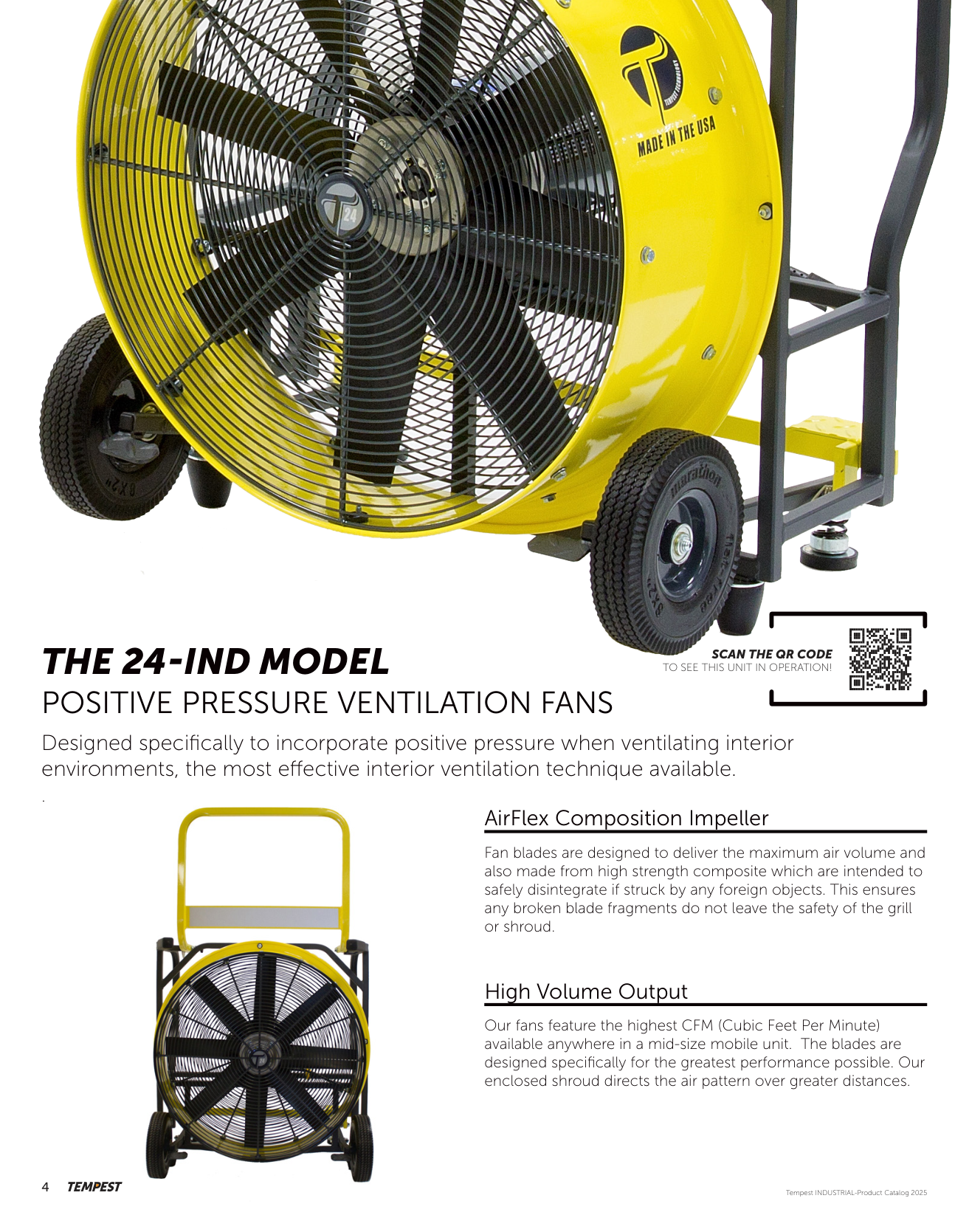
Ventilating a confined space or enclosed process area in a refinery is not the same problem as clearing smoke from a residential structure fire. The atmosphere can be actively flammable, the geometry is irregular, and the wrong equipment — a standard fan with a sparking motor or a plastic housing that shatters unpredictably — creates a new hazard instead of eliminating one. The Tempest 24-IND was purpose-built for exactly that operating environment: Class I and Class II hazardous locations where positive pressure ventilation has to work fast, safely, and without creating an ignition source. At up to 15,663 CFM in variable-speed configuration, it moves enough air to clear large enclosed volumes quickly. What follows is a detailed breakdown of how it does that and where it belongs.
What is the Tempest 24-IND and what does it do?
The Tempest 24-IND is a 24-inch industrial positive pressure ventilation fan designed for hazardous industrial environments. It uses PPV technique — forcing a high-velocity air column into an enclosed space through an entry point to push contaminated air out through a controlled exhaust opening — which is the most effective interior ventilation method available for confined spaces and process enclosures.
The fan is available in four distinct configurations: standard single speed at 120V/60Hz (Part No. 913-1260), a 220V/50Hz international variant (913-1278), an explosion-proof model rated for Class I and Class II hazardous locations (913-1261, the 24-IND-EP), and a variable-speed model (913-1263, the 24-IND-VSR). The single-speed and explosion-proof versions run on a 1.0 HP Totally Enclosed Fan-Cooled (TEFC) motor and deliver 12,867 CFM. The variable-speed model steps up to a 2.0 HP TEFC motor and reaches 15,663 CFM at maximum output. All models are designed, fabricated, and built in the USA at Tempest’s Fresno, California facility.
How does the AirFlex Composition Impeller protect personnel and equipment?
The AirFlex Composition Impeller uses eight fiberglass-reinforced polyamide blades that are engineered to disintegrate safely if struck by a foreign object, rather than shattering into high-velocity shrapnel or bending into the shroud. In industrial environments where debris, tool drops, and loose material are realistic hazards, this failure mode matters significantly.
Fiberglass-reinforced polyamide carries a higher tensile strength-to-weight ratio than standard polypropylene blades, which allows the 24-inch diameter assembly to move more air per revolution while remaining non-sparking. This is a critical material choice in Class I (flammable gas and vapor) environments: a metallic blade striking a foreign object in a hydrocarbon-laden atmosphere could produce an ignition-capable spark. The AirFlex design eliminates that risk mode. The eight-blade configuration on a 24-inch diameter disc delivers the 12,867 CFM output that distinguishes the 24-IND from smaller-diameter industrial fans in the same class.
What does the Turbo 2000 Tapered Shroud contribute to airflow performance?
The Turbo 2000 Tapered Shroud is a tapered aluminum housing that accelerates the air column discharged by the impeller. Tempest states the tapered geometry increases air velocity by 30% compared to a straight shroud of equivalent diameter, while maintaining a smaller overall profile that improves maneuverability in tight corridors and doorways.
The same Turbo 2000 shroud design is used across Tempest’s global firefighting PPV fan line, which means it has been performance-validated across a wide range of operational conditions. For industrial users, the practical implication is that the 24-IND does not need to be placed as close to an entry point as a straight-shroud competitor to achieve an effective air seal. The shroud’s aluminum construction also eliminates corrosion risk in humid or chemically active environments, where a steel shroud would require significantly more maintenance to maintain structural integrity over time.
What hazardous location ratings does the 24-IND-EP carry?
The 24-IND-EP explosion-proof model is rated for Class I, Groups C and D environments and Class II, Groups F and G environments. Class I covers locations where flammable gases or vapors are present — Groups C and D specifically include ethylene and propane/natural gas type atmospheres common in refinery and petrochemical settings. Class II covers combustible dust environments, with Groups F and G covering carbonaceous dusts and grain/wood/plastic dusts respectively.
The explosion-proof rating applies to both the motor and the switch — two common ignition sources that standard industrial fans leave unprotected. The 24-IND-EP runs on 120V/60Hz with approximately 14 AMP draw, and weighs 95 lbs., only 5 lbs. more than the standard single-speed model. The TEFC motor enclosure prevents internal sparks or heat from contacting the surrounding atmosphere, which is the mechanical basis of the explosion-proof classification under NFPA 70 (National Electrical Code) Article 500 hazardous location classifications. For confined space entry in a refinery or chemical plant, specifying any fan without Class I/II ratings in a potentially flammable atmosphere is an OSHA compliance risk under 29 CFR 1910.146.
How does the variable-speed 24-IND-VSR differ from the standard single-speed model?
The 24-IND-VSR upgrades the motor to 2.0 HP and increases maximum airflow output to 15,663 CFM, a 21.7% increase over the 12,867 CFM of the 1.0 HP single-speed models. Variable speed control allows operators to dial airflow down for smaller confined spaces where maximum CFM would overpressurize the exhaust opening or create excessive turbulence inside the work zone.
The tradeoff is weight: the 24-IND-VSR weighs 119 lbs., compared to 90 lbs. for the single-speed model. For fixed or semi-permanent installations in processing plants where the fan is moved infrequently, the weight penalty is manageable. For applications requiring rapid repositioning — emergency fume evacuation during an unplanned release, for example — the 90 lb. standard model on 8-inch non-pneumatic steel hub wheels is faster to deploy. The 8-inch never-flat wheels are engineered to navigate grating, pipe, mud, and debris without deflating, which eliminates one of the primary failure modes of pneumatic-wheeled fans in industrial field conditions.
What cord gauge and length limitations apply to the 24-IND?
Extension cord gauge directly affects available voltage at the motor, and undersized cords cause voltage drop that reduces airflow, increases motor temperature, and shortens motor life. Tempest publishes maximum cord length specifications by gauge for the 24-IND: 14 AWG supports up to 60 feet, 12 AWG to 95 feet, 10 AWG to 150 feet, 8 AWG to 240 feet, and 6 AWG to 380 feet.
In practice, refinery and chemical plant deployments often involve long runs from the nearest safe power source to the hazardous area boundary. An operator placing the fan 200 feet from the panel needs 8 AWG cord minimum — a detail that is frequently overlooked when procurement specifies only the fan and not the power supply infrastructure. Violating these cord length limits does not just reduce CFM; it can create enough resistive heating in the cord to become an ignition source in a Class I atmosphere, which directly defeats the purpose of specifying the explosion-proof 24-IND-EP in the first place.
How does the Winning Step tilt system work in field conditions?
The Winning Step tilt system locks the fan at the desired angle automatically without levers or knob tightening. The operator lifts the front of the fan to the target angle and the mechanism engages without a separate locking step, which matters during emergency deployments where speed and cognitive load are competing demands.
For PPV technique to work at maximum efficiency, the air cone discharged from the shroud must seal the entire entry opening — typically a door or hatch. That seal requires precise vertical angle adjustment depending on the fan’s setback distance from the opening and the height of the entry point. A tilt system that requires knob tightening introduces the possibility of the angle slipping under vibration, reducing the cone seal and dropping effective CFM into the space. The automatic lock-on-lift mechanism eliminates that failure mode. The full-width flip-up handle complements this by providing a stable carry grip for the 90 lb. (or 95/119 lb.) frame across industrial terrain, then folding flat for low-profile operation in spaces with overhead clearance limitations.
Where is the Tempest 24-IND used in oil, gas, and chemical operations?
The 24-IND covers the full range of industrial PPV applications where flammable, toxic, or oxygen-deficient atmospheres require forced ventilation before or during personnel entry. Primary deployments include oil and gas platforms, onshore refineries, petrochemical processing plants, and chemical manufacturing facilities with Class I or Class II classified areas.
Confined space entry ventilation under OSHA 29 CFR 1910.146 is one of the highest-frequency use cases: vessels, tanks, sumps, and pipe galleries all require continuous airflow to maintain safe oxygen levels and reduce flammable vapor concentrations below the lower explosive limit before and during entry. Post-maintenance atmospheric clearing — purging a vessel after repair work involving solvents or catalysts — is a second high-volume application. Emergency smoke and fume evacuation following an unplanned release or fire event rounds out the core use profile.
For teams that also need negative-pressure or smoke-ejector capability, the Tempest Single-Speed Electric Smoke Ejector provides complementary exhaust-mode ventilation from the same manufacturer. For operations comparing electric PPV options across brands, the Super Vac V18-EX Valor Series Electric PPV is an alternative 18-inch class fan worth evaluating for applications where a smaller footprint is the primary constraint.
When is the 24-IND the right call, and when is it not?
The Tempest 24-IND is the correct specification when you are ventilating a classified hazardous location (Class I Groups C/D or Class II Groups F/G) and need a fan that can legally and safely operate in that atmosphere — particularly in its 24-IND-EP explosion-proof configuration. Its 12,867 to 15,663 CFM output range, welded square steel tubing frame, and non-pneumatic steel hub wheels make it appropriate for sustained industrial use where consumer or light-commercial fans would fail within weeks.
It is not the right call for applications requiring intrinsically safe (IS) certification to IECEx or ATEX standards for international export markets with those specific regulatory frameworks — the 24-IND-EP carries NEC/NFPA 70 Class/Group ratings applicable to North American classification systems. It is also not sized for very small confined spaces (under roughly 1,000 cubic feet) where 12,867 CFM would create excessive turbulence and pressure differential, making the smaller-footprint or variable-speed option more appropriate. Facilities requiring ATEX-rated equipment for European deployment should confirm the applicable directive compliance before specifying the 24-IND-EP for those sites.
For most North American oil, gas, chemical, and heavy industrial PPV requirements, the 24-IND’s combination of Class I/II explosion-proof rating, 24-inch AirFlex impeller, Turbo 2000 shroud geometry, and USA-built steel construction makes it one of the most complete purpose-built industrial PPV fans available at its size class. Consult the Tempest official product page for current configuration availability and regional compliance documentation.
Tempest Industrial
24-IND Positive Pressure Ventilation Fan
Designed for Hazardous Industrial Environments | Made in the USA
Overview
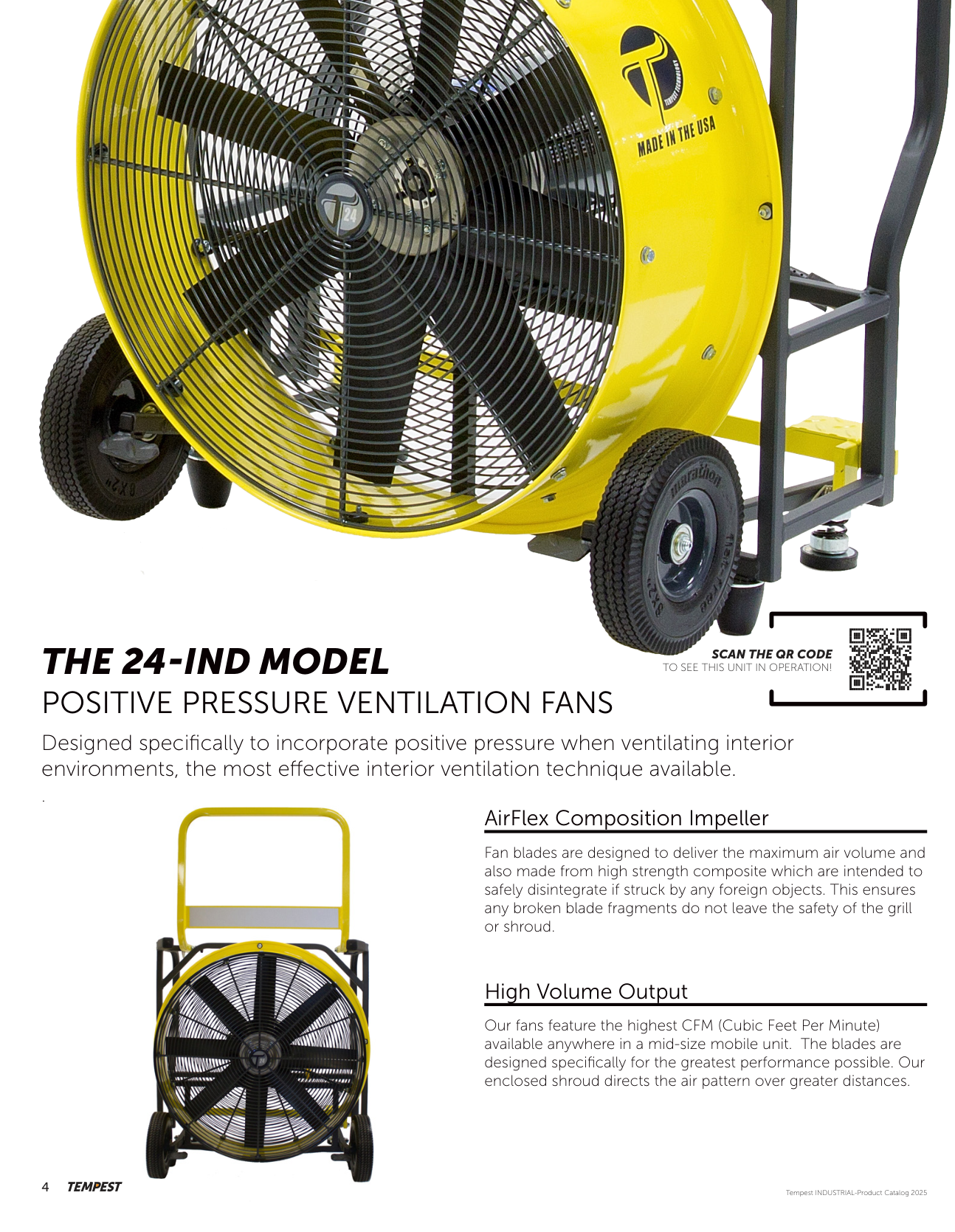
The Tempest 24-IND is a 24-inch industrial positive pressure ventilation (PPV) fan engineered specifically to ventilate interior environments in hazardous locations. Using the most effective interior ventilation technique available, the 24-IND delivers up to 12,867 CFM (15,663 CFM in variable speed configuration) for rapid clearance of smoke, fumes, and airborne hazards.
Available in four configurations — standard single speed, 220V/50Hz international, explosion-proof (Class I & II rated), and variable speed — the 24-IND is built to handle the demands of oil & gas facilities, refineries, chemical plants, and other hazardous industrial settings.
Key Features
AirFlex Composition Impeller
Eight fiberglass-reinforced polyamide blades deliver maximum CFM while safely disintegrating if struck by foreign objects — protecting the grille and shroud.
Turbo 2000 Tapered Shroud
The same proven shroud used on Tempest’s global firefighting fan line. Maximizes air velocity by 30% with a smaller shroud profile for faster, more aggressive ventilation.
Explosion-Proof Option
The 24-IND-EP is rated for Class I (Groups C & D) and Class II (Groups F & G) environments, with explosion-proof motor and switch for safe operation in flammable atmospheres.
8″ Non-Pneumatic Wheels
Never-flat high-strength steel hub wheels navigate rocks, mud, pipe, and glass. Get the fan where it’s needed, fast.
Flip-Up/Fold-Down Handle
Full-width handle locks firmly in position for transport. Folds down for compact storage or low-profile operation.
“Winning Step” Tilt
Intuitive tilt-locking system requires no levers or knob tightening — quickly set the angle and the fan locks into position automatically.
Models & Ordering Information
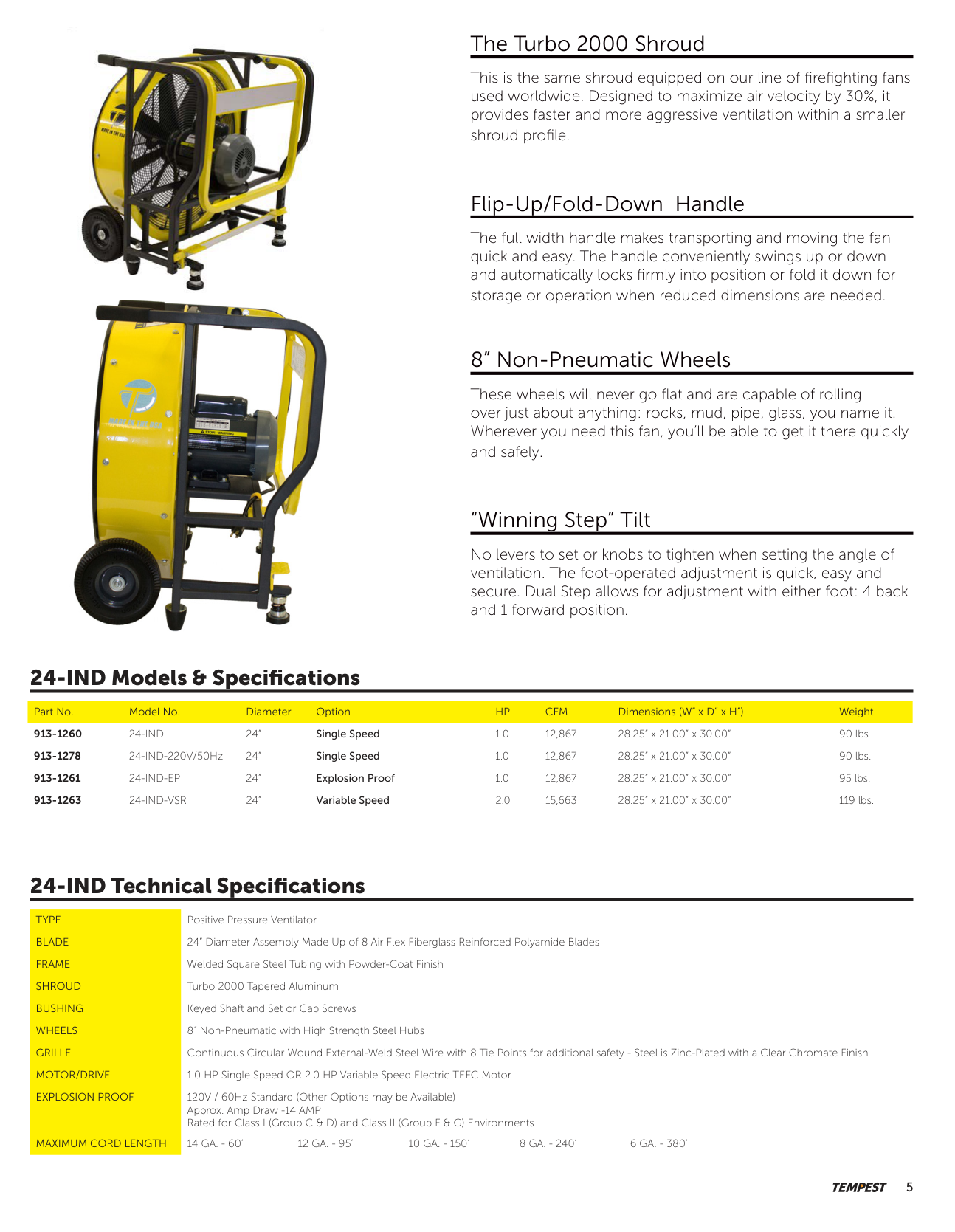
| Part No. | Model | Configuration | HP | CFM | Weight |
|---|---|---|---|---|---|
| 913-1260 | 24-IND | Single Speed — 120V/60Hz | 1.0 | 12,867 | 90 lbs. |
| 913-1278 | 24-IND-220V/50Hz | Single Speed — 220V/50Hz | 1.0 | 12,867 | 90 lbs. |
| 913-1261 | 24-IND-EP | Explosion Proof — Class I & II | 1.0 | 12,867 | 95 lbs. |
| 913-1263 | 24-IND-VSR | Variable Speed | 2.0 | 15,663 | 119 lbs. |
Technical Specifications
| Type | Positive Pressure Ventilator — Industrial / Hazardous Locations |
| Blade Assembly | 24″ Diameter — 8 AirFlex Fiberglass Reinforced Polyamide Blades |
| Frame | Welded Square Steel Tubing with Powder-Coat Finish |
| Shroud | Turbo 2000 Tapered Aluminum |
| Bushing | Keyed Shaft and Set or Cap Screws |
| Wheels | 8″ Non-Pneumatic with High Strength Steel Hubs |
| Grille | Continuous Circular Wound External-Weld Steel Wire — 8 Tie Points — Zinc-Plated with Clear Chromate Finish |
| Motor / Drive | 1.0 HP Single Speed OR 2.0 HP Variable Speed Electric TEFC Motor |
| Explosion Proof Rating | Class I (Group C & D) and Class II (Group F & G) — 120V/60Hz Standard — Approx. 14 AMP Draw |
| Dimensions (W × D × H) | 28.25″ × 21.00″ × 30.00″ |
| Maximum Cord Length | 14 GA — 60′ | 12 GA — 95′ | 10 GA — 150′ | 8 GA — 240′ | 6 GA — 380′ |
| Origin | Designed, Fabricated & Built in the USA |
Typical Applications
- Oil & gas facilities — platforms, refineries, processing plants
- Chemical plants and manufacturing with flammable atmospheres (Class I, II)
- Confined space entry ventilation
- Industrial warehouses and assembly facilities
- Emergency smoke and fume evacuation
- Post-maintenance atmospheric clearing
Manufacturer: Tempest — 4708 N. Blythe Avenue, Fresno, California 93722 USA — tempest.us.com