

While you’re reading this, moisture is silently infiltrating your critical industrial equipment.
Every breath your hydraulic systems take. Every temperature fluctuation in your bulk storage tanks. Every operational cycle pulls contaminated air — loaded with water vapor, dirt particles, and corrosive elements — directly into the heart of your most expensive machinery.
And here’s the brutal truth: Most industrial facilities are using breather systems that are completely inadequate for their actual operating conditions. They’re designed for light-duty applications but thrown into extreme environments where they fail catastrophically.
The result? Premature equipment failure, contaminated lubricants, unexpected downtime, and maintenance costs that spiral out of control faster than you can write the repair orders.
The Hidden Destroyer That’s Costing You More Than You Realize
Let me paint you a picture of what moisture contamination actually does to your equipment.
When water enters your hydraulic reservoir or lubricant system, it doesn’t just sit there harmlessly. It starts a chain reaction of destruction that accelerates with every operating hour.
First, it attacks your lubricants. Water breaks down the chemical bonds in your expensive synthetic oils, destroying their protective properties and creating acidic compounds that eat metal from the inside out.
Second, it creates the perfect breeding ground for bacterial growth. These microorganisms produce acids that accelerate corrosion and create sludge that clogs filters, restricts flow, and damages precision components.
Third, it causes catastrophic seal failure. When water-contaminated fluids lose their lubricity, seals harden, crack, and fail — leading to leaks, pressure loss, and complete system shutdown.
Industry studies show that just 0.1% water contamination in hydraulic fluid can reduce component life by up to 90%. In extreme environments, standard breathers can’t even come close to preventing this level of contamination.
The maintenance manager at a major petrochemical facility told me his company was replacing hydraulic pumps every 18 months instead of the expected 7-year lifespan. The culprit? Inadequate moisture protection that allowed water contamination to destroy $15,000 pumps faster than they could order replacements.
But here’s what really keeps facility managers awake at night: You can’t see this damage happening until it’s too late. By the time you notice performance degradation, the internal damage is already catastrophic and extremely expensive to repair.
Finally, A Breather System Engineered For The Real World
After watching facility after facility struggle with inadequate breather systems, Des-Case developed something different. Something that could actually handle the punishment of extreme industrial environments.
The Des-Case Rebuildable Steel Breather series isn’t just another incremental improvement. It’s a complete rethinking of how moisture protection should work in demanding applications.
These units are built around a simple principle: If you’re going to protect critical equipment worth millions of dollars, you need protection systems that match that level of investment.
Available in 10 different capacities from 3 to 200 pounds of desiccant, these breathers are engineered to handle everything from moderate hydraulic reservoirs to massive bulk storage tanks in the harshest industrial environments.
But capacity is just the beginning. The real breakthrough is in how they’re designed to perform when other systems fail completely.
Why Steel Construction Matters More Than You Think
Let’s talk about something most breather manufacturers don’t want you to consider: housing durability under real operating conditions.
Plastic and aluminum housings might work fine in climate-controlled environments. But what happens when you’re dealing with temperature swings from -20°F to 220°F? What about chemical exposure? Vibration? Impact damage from maintenance activities?
That’s where the rugged steel construction shows its true value. These units are built to withstand temperature extremes that would crack plastic housings and cause aluminum units to fail at the mounting points.
The steel housing isn’t just tough — it’s designed for the long term. While other breathers become disposal items when they’re contaminated or damaged, these units are completely rebuildable.
Think about the economics: Instead of throwing away entire units and ordering replacements (with all the downtime and inventory costs that entails), you simply refill the desiccant and replace the filter element. Same protection performance, fraction of the ongoing cost.
The 1 Micron Difference That Changes Everything
Here’s a specification that separates industrial-grade equipment from consumer-level products: 1 micron absolute filtration.
To put this in perspective, 1 micron is about 70 times smaller than the width of a human hair. Most particulate contamination that causes equipment damage falls in the 2-10 micron range — particles that slip right through inferior filtration systems.
With 1 micron absolute filtration, you’re stopping virtually all harmful particles before they enter your system. This isn’t just about cleaner air — it’s about preventing the abrasive wear that destroys precision components in hydraulic pumps, servo valves, and other sensitive equipment.
The difference in component life can be dramatic. Equipment manufacturers typically specify cleanliness levels that require sub-5 micron filtration to maintain warranty coverage. With these breathers, you’re not just meeting those requirements — you’re exceeding them by a significant margin.
Massive Desiccant Capacity For Serious Applications
Let’s address the elephant in the room: why do you need desiccant capacities ranging up to 200 pounds?
Because real industrial applications demand it. When you’re protecting a 10,000-gallon bulk storage tank or a large circulating lube oil system, those little desktop-sized breathers aren’t just inadequate — they’re practically useless.
Consider the Des-Case DC-RS-3 Rebuildable Steel Breather on the smaller end. With 3 pounds of desiccant and 0.14 gallon water adsorption capacity, it provides serious protection for moderate applications.
But when you step up to the DC-RS-200, you’re looking at 200 pounds of desiccant with a massive 9.6 gallon water adsorption capacity. That’s enough protection for the largest industrial applications, with service intervals measured in months rather than weeks.
The water adsorption numbers tell the real story. Even the smallest unit can pull over a half-gallon of water from the air before requiring service. The largest can handle nearly 10 gallons. Compare that to typical breathers that might handle a few ounces before becoming saturated.
Professional-Grade Connections That Actually Work
Nothing exposes amateur-grade equipment faster than inadequate connection options. These breathers come with 2″, 3″, and 4″ NPT connections — the standard for serious industrial equipment.
Why does connection size matter? Because air flow capacity directly impacts how well your equipment can breathe during rapid temperature changes and operational cycles.
A 1/2″ connection might be fine for a small hydraulic reservoir that rarely cycles. But try to use it on a large system that heats and cools rapidly, and you’ll create vacuum conditions that can damage seals and actually draw contamination past your filtration system.
The larger NPT connections ensure adequate air flow for proper breathing, even in demanding applications with rapid volume changes.
Where These Breathers Prove Their Worth Daily
Let me tell you about the applications where these breathers have become absolutely essential.
Power generation facilities use them on massive lube oil systems where equipment failure means millions in lost revenue per hour of downtime. The rebuildable design means maintenance teams can service units without shutting down critical systems.
Petrochemical plants rely on them for bulk storage tanks containing aggressive chemicals that would destroy lesser breathers in months. The steel construction and chemical-resistant design provide years of reliable service in environments that eat other equipment alive.
Steel mills mount them on hydraulic systems that operate in conditions that would be considered torture tests for most equipment — extreme temperatures, heavy vibration, and contaminated air that challenges every component.
For comparison, you might also consider options like the Des-Case DC-R6015SBS Rebuildable Steel Breather for specialized applications, or traditional units like the Air Sentry D-101 Desiccant Breather for lighter-duty requirements.
The key is matching the breather capacity and construction to your actual operating conditions, not just your tank size.
The Economics That Change How You Think About Maintenance
Here’s what most purchasing decisions miss: the total cost of ownership over the life of the equipment.
Yes, these breathers represent a higher initial investment than disposable units. But consider what you get for that investment:
Rebuildable design eliminates replacement costs. Instead of buying new units every service interval, you’re buying inexpensive desiccant refills and filter elements.
Extended service intervals reduce maintenance labor. The massive desiccant capacity means these units can run for months between services instead of requiring weekly or monthly attention.
Superior protection extends equipment life. When you prevent moisture and particulate contamination, everything downstream lasts longer and performs better.
Most facilities that switch to these breathers report maintenance cost reductions of 30-50% within the first year, simply from reduced service requirements and eliminated replacement costs.
Stop Gambling With Your Most Expensive Equipment
Every day you operate with inadequate moisture protection, you’re essentially gambling with equipment worth hundreds of thousands or millions of dollars.
The Des-Case Rebuildable Steel Breather series gives you something most maintenance managers never have: complete confidence that your equipment is properly protected, regardless of operating conditions.
From the smallest 3-pound unit to the massive 200-pound capacity models, these breathers are engineered to handle whatever your application throws at them. Steel construction, 1-micron filtration, massive desiccant capacity, and rebuildable design — everything you need for long-term protection of critical equipment.
Don’t wait for equipment failure to force your hand. The time to upgrade your moisture protection is before you need it, not after catastrophic damage has already occurred.
Rebuildable Steel Breathers
DC-RS-3 through DC-RS-200 • 3 lbs to 200 lbs Desiccant
Rugged rebuildable steel housing for extreme environments, bulk storage tanks, and large circulating lube oil systems. Available in 10 sizes from 3 to 200 lbs of desiccant for the most demanding industrial applications.
2″ & 3″ & 4″ NPT • 1 μm filter • Rebuildable / Refillable
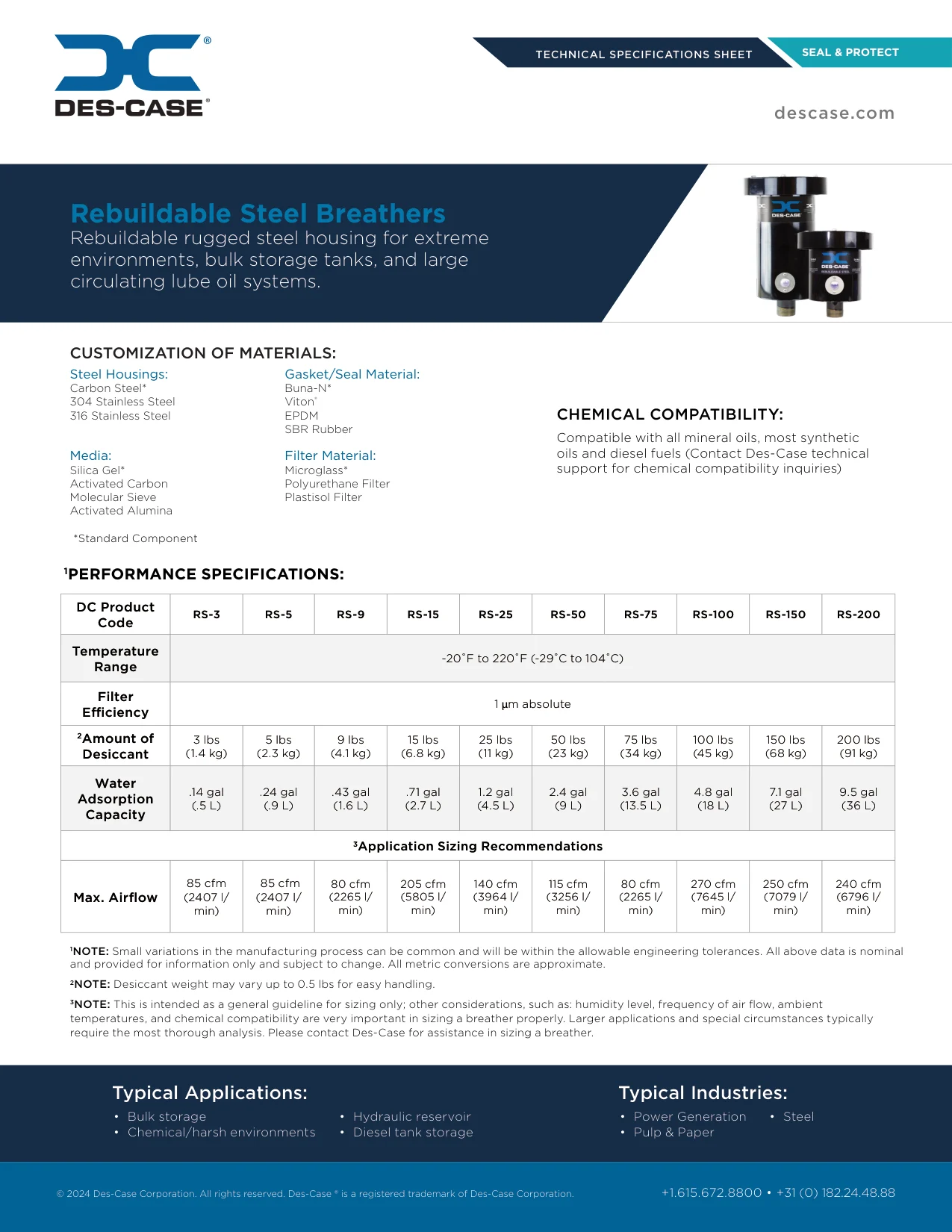
1PERFORMANCE SPECIFICATIONS:
| Product Code | Temp. Range | Filter Efficiency | Desiccant | Water Adsorption Capacity |
|---|---|---|---|---|
| DC-RS-3 | -20°F to 220°F (-29°C to 104°C) |
1 μm absolute | 3 lbs (1.4 kg) | .14 gal (.5 L) |
| DC-RS-5 | 5 lbs (2.3 kg) | .24 gal (.9 L) | ||
| DC-RS-9 | 9 lbs (4.1 kg) | .43 gal (1.6 L) | ||
| DC-RS-15 | 15 lbs (6.8 kg) | .71 gal (2.7 L) | ||
| DC-RS-25 | 25 lbs (11 kg) | 1.2 gal (4.5 L) | ||
| DC-RS-50 | 50 lbs (23 kg) | 2.4 gal (9 L) | ||
| DC-RS-75 | 75 lbs (34 kg) | 3.6 gal (13.5 L) | ||
| DC-RS-100 | 100 lbs (45 kg) | 4.8 gal (18 L) | ||
| DC-RS-150 | 150 lbs (68 kg) | 7.2 gal (27 L) | ||
| DC-RS-200 | 200 lbs (91 kg) | 9.6 gal (36 L) |
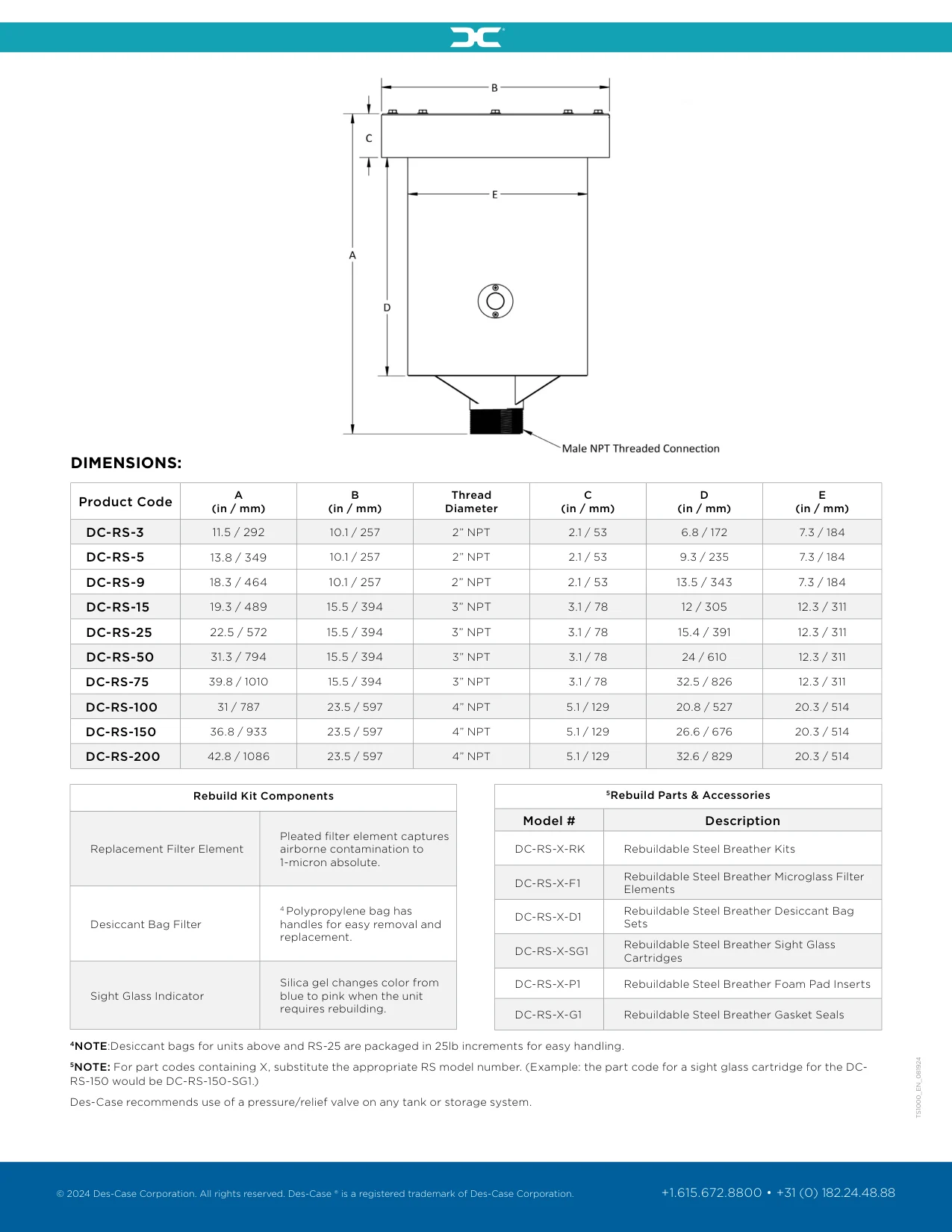
DIMENSIONS:
| Product Code | A (in / mm) | B (in / mm) | Thread Dia. C | D (in / mm) | E (in / mm) |
|---|---|---|---|---|---|
| DC-RS-3 | 11.5 / 292 | 10.1 / 257 | 2″ NPT | 2.1 / 53 | 6.8 / 172 |
| DC-RS-5 | 13.8 / 349 | 10.1 / 257 | 2″ NPT | 2.1 / 53 | 9.3 / 235 |
| DC-RS-9 | 18.3 / 464 | 10.1 / 257 | 2″ NPT | 2.1 / 53 | 13.5 / 343 |
| DC-RS-15 | 19.3 / 489 | 15.5 / 394 | 3″ NPT | 3.1 / 78 | 12 / 305 |
| DC-RS-25 | 22.5 / 572 | 15.5 / 394 | 3″ NPT | 3.1 / 78 | 15.4 / 391 |
| DC-RS-50 | 31.3 / 794 | 15.5 / 394 | 3″ NPT | 3.1 / 78 | 24 / 610 |
| DC-RS-75 | 39.8 / 1010 | 15.5 / 394 | 3″ NPT | 3.1 / 78 | 32.5 / 826 |
| DC-RS-100 | 31 / 787 | 23.5 / 597 | 4″ NPT | 5.1 / 129 | 20.8 / 527 |
| DC-RS-150 | 36.8 / 933 | 23.5 / 597 | 4″ NPT | 5.1 / 129 | 26.6 / 676 |
| DC-RS-200 | 42.8 / 1086 | 23.5 / 597 | 4″ NPT | 5.1 / 129 | 32.4 / 822 |
1NOTE: Small variations in the manufacturing process can be common and will be within the allowable engineering tolerances. All data is nominal and provided for information only and subject to change. All metric conversions are approximate.