Picture this: You’re 8,000 feet down on a $50,000-per-day drilling operation. The driller starts to pull pipe, and suddenly… nothing. The joint won’t budge. What started as routine pipe handling just became a catastrophic galling incident that will cost you days of rig time, a ruined drill string, and potentially hundreds of thousands in lost revenue.
This nightmare scenario plays out more often than you think. And the worst part? It’s completely preventable.
Every drilling engineer knows the drill collar connections and tool joints are the Achilles’ heel of any drilling operation. One seized connection, one galled thread, one improperly protected joint — and your entire operation grinds to a halt faster than you can say “twisted off downhole.”
The Hidden Killers Lurking In Every Thread Connection
Here’s what most drilling operations don’t realize until it’s too late: Thread failure isn’t just about torque. It’s about a perfect storm of metallurgical and chemical warfare happening at the microscopic level every time you make up a connection.
When steel meets steel under extreme pressure and temperature, three devastating processes kick into high gear:
Adhesive wear — Metal particles literally weld themselves to opposing surfaces, creating microscopic rough spots that compound with every makeup and breakout cycle.
Oxidative corrosion — Moisture and oxygen attack the base metal, creating pitting and surface irregularities that destroy thread integrity from the inside out.
Galling and seizing — The ultimate thread killer. Once it starts, you’re looking at cut-and-leave operations, fishing jobs, or complete drill string replacement.
And here’s the kicker: Traditional thread compounds make promises they can’t keep. They wash out in drilling mud. They break down under temperature. They contain lead and other environmental hazards that create regulatory nightmares.
Even worse, many compounds actually reduce joint efficiency by allowing over-torquing, which leads to thread deformation and premature failure. You think you’re protecting your investment, but you’re actually accelerating its destruction.
The cost? Industry studies show thread failures account for up to 40% of all drill string incidents. That’s millions in lost rig time, replacement equipment, and operational delays. All because the thread compound couldn’t do its job when it mattered most.
What if there was a better way?
The Copper-Based Solution That’s Saving Drill Strings Worldwide
Meet Jet-Lube Kopr-Kote — the drilling compound that’s rewriting the rules for thread protection in the oilfield.
This isn’t just another grease with fancy marketing claims. This is a precision-engineered metallurgical solution that addresses every single failure mode that destroys drill collar and tool joint connections.
While other compounds wash away or break down under pressure, Kopr-Kote’s unique copper flake technology creates a sacrificial barrier that actually gets stronger under compressive forces. The harder you press, the better it protects.
And unlike traditional compounds that can’t handle real-world drilling conditions, Kopr-Kote thrives in the harshest environments — from Arctic permafrost to Middle Eastern desert heat, from high-pH muds to under-balanced drilling operations.
“The proof is in the performance: NAM/Shell approved for under-balanced drilling. API RP 5A3 compliant. CEFAS OCNS Group B environmental rating. This isn’t marketing fluff — it’s third-party validation from the world’s most demanding drilling operations.”
Why Copper Flake Technology Dominates Every Alternative
Let’s talk about what makes Kopr-Kote’s formulation so devastatingly effective. It all comes down to the science of tribology — the study of friction, wear, and lubrication under extreme conditions.
The Copper Advantage: Pure copper flakes create a malleable metallic film between thread surfaces. Unlike solid lubricants that can be squeezed out under pressure, copper actually flows and conforms to microscopic surface irregularities, filling in imperfections and creating a perfectly smooth interface.
But copper alone isn’t enough. That’s why Kopr-Kote combines three distinct protective mechanisms in one formulation:
Copper flakes provide the primary anti-seize protection and controlled friction factor of 1.15 — exactly what you need for consistent makeup torque without over-torquing.
High-purity graphite delivers ultra-low friction during breakout operations, preventing the stick-slip action that can damage threads or cause sudden torque spikes that twist off connections.
Extreme-pressure additives activate under load to form chemical films that prevent metal-to-metal contact even when the base lubricant is displaced by drilling mud contamination.
The aluminum-complex grease base isn’t just a carrier — it’s engineered for superior adhesion and water resistance. While conventional greases wash away in drilling mud, this advanced thickener system maintains film strength and sticks to wet joints.
Here’s where the engineering gets really sophisticated: The dropping point of 450°F (232°C) means the grease structure remains intact even in the hottest downhole conditions. Compare that to conventional compounds that start breaking down at 250-300°F, and you’ll understand why Kopr-Kote keeps working when others fail.
The Numbers Don’t Lie: Performance Specs That Matter
When your operation is measured in millions of dollars and thousands of feet, specifications aren’t just numbers — they’re guarantees of performance when everything is on the line.
4-Ball Weld Point: 800 kgf. This isn’t a marketing number. This is the precise measurement of how much pressure it takes before metal-to-metal contact occurs. For reference, most drilling operations never exceed 200-300 kgf of contact pressure. You’ve got a safety margin that’s literally off the charts.
Oil Separation: Less than 3% at 212°F. While other compounds bleed out their lubricating oils under heat and pressure, Kopr-Kote maintains its protective film integrity. That 3% separation rate means 97% of the lubricant stays exactly where you need it — protecting your threads.
Penetration: 310-330 (ASTM D-217). This NLGI Grade 1 consistency gives you the perfect balance — soft enough to apply easily and flow into thread imperfections, yet firm enough to resist washout in drilling mud circulation.
Service Temperature: 0°F to 450°F (-18°C to 232°C). From Arctic drilling to geothermal applications, one compound handles your entire operational range. No more switching products based on temperature conditions.
But here’s the spec that really matters for drilling engineers: Friction Factor 1.15. This precise coefficient means you can calculate exact makeup torque every single time. No guesswork, no variability, no over-torquing that damages threads or under-torquing that allows connections to back off downhole.
The torque calculation is simple: Take your thread manufacturer’s recommended torque value and multiply by 1.15. That’s it. Consistent makeup torque, optimal joint efficiency, maximum thread life.
Environmental Protection That Actually Protects Your Operation
Here’s something most drilling operations discover the hard way: Environmental compliance isn’t just about avoiding fines. It’s about operational continuity and risk management.
Kopr-Kote’s lead-free formulation isn’t just environmentally responsible — it eliminates a major source of regulatory risk and worker safety concerns. No lead means no special handling requirements, no disposal complications, no OSHA exposure monitoring.
The CEFAS OCNS Group B environmental rating opens up offshore drilling opportunities that are off-limits to compounds with higher environmental impact ratings. More importantly, it demonstrates that superior performance doesn’t require environmental compromise.
DOT approval (CA2004080025) means simplified transportation and logistics. No hazmat restrictions, no special shipping requirements, no delays waiting for environmental permits.
And because it’s not classified as a marine pollutant, offshore operations can stock and use Kopr-Kote without the complex documentation and handling procedures required for more hazardous compounds.
Real-World Applications Where Performance Counts
Theory is nice, but drilling operations live and die by real-world performance. Here’s where Kopr-Kote proves its value day after day:
Drill Collar Operations: Heavy-wall drill collars create extreme contact pressures at thread connections. The copper flake technology distributes these loads evenly, preventing the stress concentrations that cause thread washout and connection failure. For demanding applications, check out the 10115 specification for optimal performance.
Tool Joint Protection: Where drill pipe meets the harsh realities of rotary drilling, tool joint threads take a beating from torque, vibration, and mud circulation. Kopr-Kote’s extreme-pressure additives activate under these conditions to maintain protection even when conventional lubricants fail.
Complete Drill String Systems: From surface to TD, every connection in your drill string benefits from consistent friction factor and anti-seize protection. The result? Predictable torque values, easier breakout operations, and extended thread life throughout the entire string.
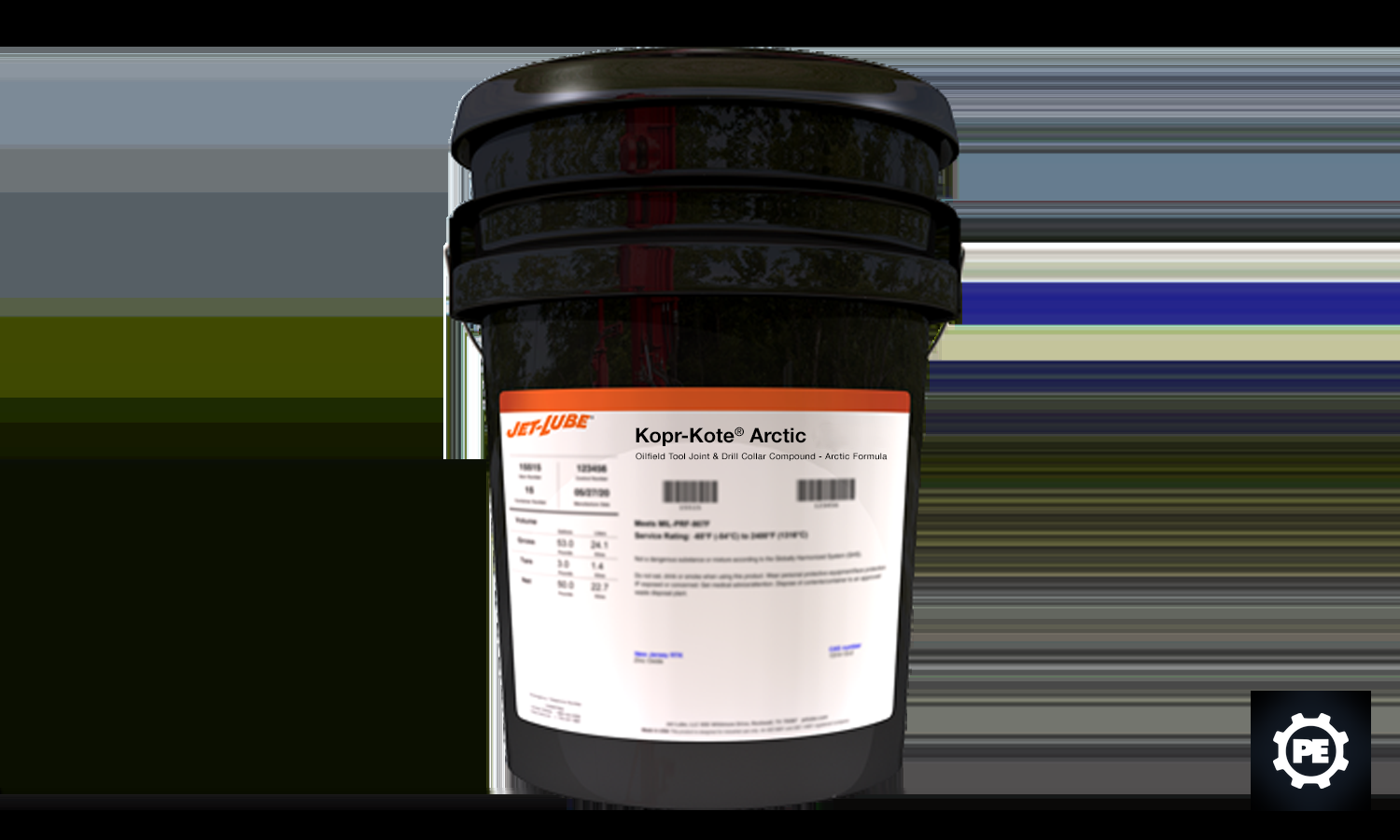
For extreme temperature applications, consider the KOPR-KOTE ARCTIC: Maximum Protection for Severe Drilling Conditions — engineered specifically for sub-zero operations where conventional compounds become too stiff to provide effective protection.
The full technical specifications and application guidelines are available in the complete KOPR-KOTE technical data sheet, but the bottom line is simple: One compound, multiple applications, consistent results.
When Standard Protection Isn’t Enough
Not every drilling operation is standard. Some environments and applications push thread compounds beyond their normal limits. That’s why Jet-Lube has engineered specific solutions for these challenging conditions.
Invert and High-pH Muds: These aggressive drilling fluids can attack conventional thread compounds and reduce their effectiveness. For these applications, the recommendation shifts to Jet-Lube EXTREME — a specialized formulation designed to resist chemical attack while maintaining superior anti-seize protection.
Wedge-Type Connections: These precision threads require specialized protection against wear and galling. NCS-30 ECF provides the specific wear protection these connections need to maintain their tight tolerances and sealing capability.
Friction Factor 1.0 Applications: Premium connections like HI-TORQUE, eXtreme Torque XT, and XT-M specify friction factor 1.0 for optimal performance. For these applications, Kopr EXT FF 1.0 delivers the exact friction characteristics required by the connection manufacturer.
This isn’t about selling more products — it’s about matching the right solution to the specific demands of your operation. Using the wrong compound can be worse than using no compound at all, because it creates a false sense of security while failing to provide adequate protection.
For a complete overview of available solutions, explore the full range of Jet-Lube Products designed for specific drilling challenges.
The Cost of Getting It Right Versus Getting It Wrong
Let’s talk numbers that matter to your bottom line. A typical thread compound application uses maybe $50-100 worth of product per drill string makeup. Compare that to the cost of a single thread failure:
Rig time for fishing operations: $50,000 per day minimum. Thread failure remediation typically takes 2-5 days. That’s $100,000-250,000 in rig time alone.
Replacement drill string sections: $50,000-500,000 depending on the size and grade of tubulars involved.
Lost production from delayed completion: Often measured in millions of dollars for commercial wells.
The math is brutal but simple: Superior thread protection costs pennies per foot drilled. Thread failures cost thousands of dollars per incident.
But here’s what makes Kopr-Kote’s value proposition even more compelling: It doesn’t just prevent catastrophic failures. It extends overall thread life, reduces makeup and breakout torque requirements, and enables faster tripping operations that save rig time on every well.
Industry studies show that proper thread compound selection and application can extend drill string life by 40-60%. On a $2 million drill string, that translates to $800,000-1,200,000 in extended asset value.
When you’re making decisions that impact millions of dollars in equipment and operational costs, can you afford to compromise on thread protection? The complete technical documentation in Korp Kote_SS_JL_12-17 provides the detailed specifications you need to make an informed decision.
Your Thread Protection Decision Starts Now
Every day you delay upgrading your thread protection is another day your drill string faces unnecessary risk. Another opportunity for a seized connection, a galled thread, or a catastrophic failure that could have been completely prevented.
Kopr-Kote isn’t just a drilling compound — it’s an insurance policy for your most expensive drilling assets. API approved, environmentally compliant, and proven in the world’s most demanding drilling operations.
The copper-based technology, extreme-pressure protection, and precision-engineered friction factor give you everything you need to protect your investment and maintain operational efficiency.
The choice is yours: Continue risking million-dollar drill strings with inferior thread compounds, or upgrade to the protection technology that’s setting the industry standard for reliability and performance.
Your threads — and your bottom line — will thank you.
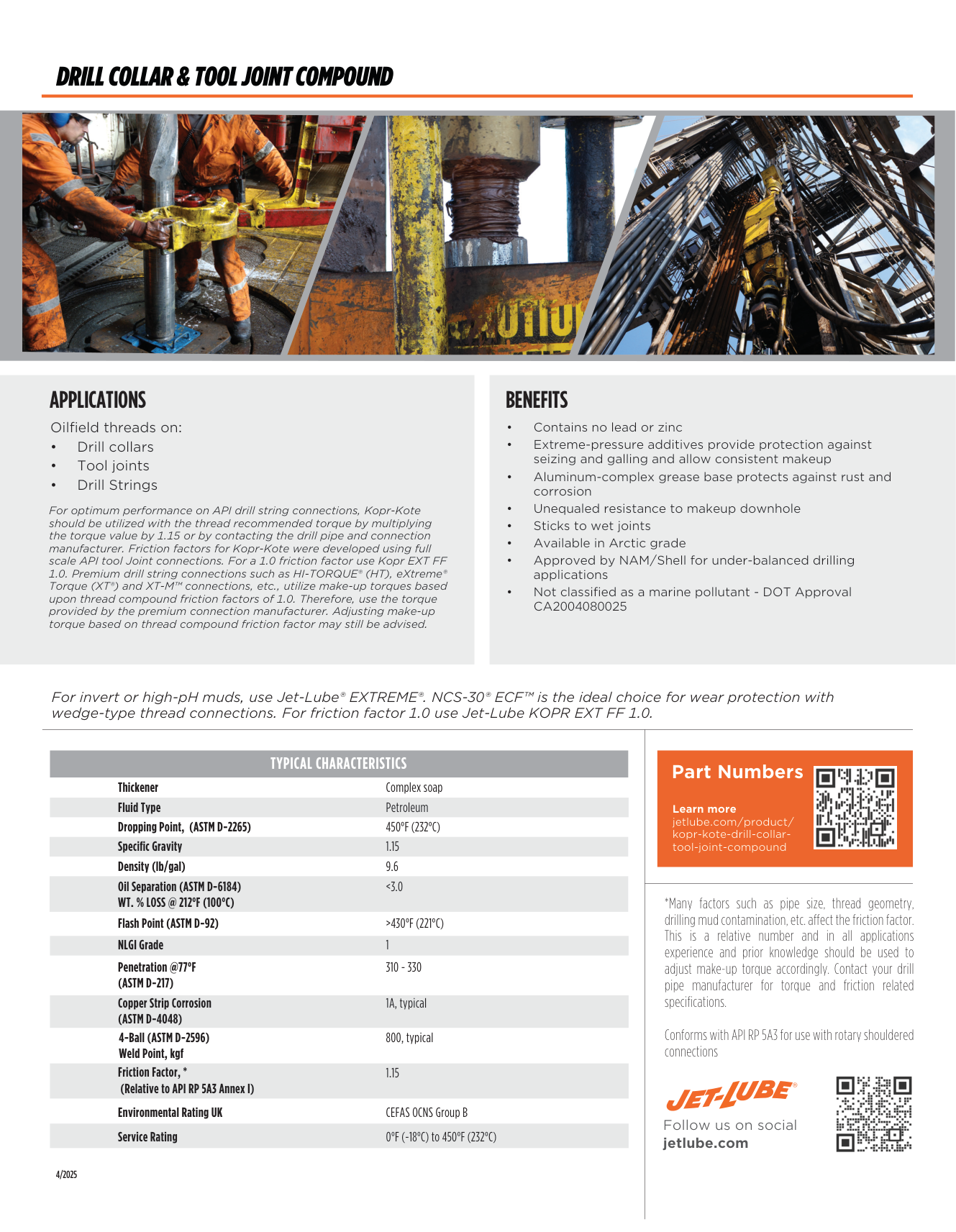
Kopr-Kote® Drill Collar & Tool Joint Compound
NLGI Grade 1 • Copper-Based • Lead-Free • API RP 5A3 Approved
Highly trusted copper-based drilling compound for drill collars, tool joints, and drill strings. The unique solids package — copper flake, graphite, and extreme-pressure additives — counteracts excessive circumferential makeup by increasing friction under compressive forces, preserving joint efficiency and preventing standoff or deformation.
Lead-Free • API RP 5A3 Compliant • CEFAS OCNS Group B (UK Environmental Rating) • DOT Approved (CA2004080025)
APPLICATIONS — OILFIELD THREADS ON:
- Drill collars
- Tool joints
- Drill strings
Note: For invert or high-pH muds, use Jet-Lube® EXTREME®. NCS-30® ECF™ for wear protection on wedge-type thread connections. For friction factor 1.0 use Jet-Lube KOPR EXT FF 1.0.
KEY BENEFITS:
- Contains no lead or zinc
- Extreme-pressure additives protect against seizing and galling
- Allows consistent makeup torque
- Aluminum-complex grease base protects against rust and corrosion
- Unequaled resistance to makeup downhole
- Sticks to wet joints
- Available in Arctic grade
- Approved by NAM/Shell for under-balanced drilling applications
- Not classified as a marine pollutant
TYPICAL CHARACTERISTICS:
| Property / Test Method | Value |
|---|---|
| NLGI Grade | 1 |
| Thickener | Complex Soap |
| Fluid Type | Petroleum |
| Dropping Point (ASTM D-2265) | 450°F (232°C) |
| Flash Point (ASTM D-92) | >430°F (221°C) |
| Specific Gravity | 1.15 |
| Density | 9.6 lb/gal |
| Oil Separation @ 212°F (ASTM D-6184), wt.% loss | <3.0 |
| Penetration @77°F (ASTM D-217) | 310–330 |
| Copper Strip Corrosion (ASTM D-4048) | 1A, typical |
| 4-Ball Weld Point, kgf (ASTM D-2596) | 800, typical |
| Friction Factor* (Relative to API RP 5A3 Annex I) | 1.15 |
| Service Rating | 0°F to 450°F (-18°C to 232°C) |
| Environmental Rating (UK) | CEFAS OCNS Group B |
| API Compliance | Conforms with API RP 5A3 for rotary shouldered connections |
*Many factors such as pipe size, thread geometry, and drilling mud contamination affect friction factor. Contact your drill pipe manufacturer for torque and friction-related specifications.
MAKE-UP TORQUE GUIDANCE:
For optimum performance on API drill string connections, multiply the thread-recommended torque value by 1.15, or contact the drill pipe and connection manufacturer. For premium connections (HI-TORQUE®, eXtreme® Torque XT®, XT-M™) that use friction factor 1.0 — use Kopr EXT FF 1.0 and apply the premium connection manufacturer’s specified torque.