Right now, as you’re reading this, moisture is creeping into your most critical equipment like a silent assassin. It’s seeping through breather caps, condensing in hydraulic reservoirs, and turning pristine lubricants into sludge-filled nightmares. And here’s the kicker: you probably won’t know it’s happening until it’s too late.
The maintenance manager at a major petrochemical plant learned this the hard way when his main gearbox seized up on a Tuesday morning. The cause? Moisture contamination that had been building for months, completely undetected. The repair bill? $73,000. The lost production time? Another $120,000.
But here’s what really stung: it was 100% preventable with a $200 breather.
Why Moisture Is Your Equipment’s Public Enemy #1
Listen, I’ve been in this industry long enough to see grown engineers cry over failed equipment. And moisture contamination is almost always the villain in these horror stories.
Here’s what happens when moisture invades your systems: First, it turns your expensive synthetic lubricants into a milky, worthless mess. Then it accelerates oxidation, creating acids that eat away at seals and gaskets. Finally, it provides the perfect breeding ground for bacteria and fungi that clog filters and corrode metal surfaces.
The numbers don’t lie: Studies show that moisture contamination reduces bearing life by up to 87%. That’s not a typo. Your $5,000 bearing that should last 5 years? With moisture contamination, you’re looking at replacing it every 8 months.
“We used to replace hydraulic pumps every 18 months. Since installing proper desiccant breathers, we’re at 4 years and counting on the same units.” – Plant Manager, Fortune 500 Manufacturing Company
But it gets worse. In high-humidity environments or wash-down applications, standard breathers are about as effective as a screen door on a submarine. Every temperature cycle, every pressure change, every cleaning cycle is an invitation for moisture to waltz right into your equipment.
And if you’re storing equipment, drums, or totes? Forget about it. Without proper protection, you’re basically paying premium prices for contaminated fluids.
Finally, A Breather That Actually Protects What Matters
Enter the Des-Case HydroGuard Series Breathers. These aren’t your grandfather’s breather caps. These are precision-engineered moisture elimination systems designed specifically for the toughest industrial environments.
The engineers at Des-Case looked at the moisture contamination problem and said, “What if we could create a breather that doesn’t just filter air, but actually strips moisture out of it?” The result is a breather that combines military-grade filtration with industrial-strength desiccant technology.
Here’s the genius part: The orange silica gel doesn’t just absorb moisture—it changes color from orange to white so you can see exactly when it needs attention. No more guessing. No more hoping. Just clear visual confirmation that your equipment is protected.
The Technical Specs That Matter (And Why They Should Matter To You)
Let me break down the specs that separate the HydroGuard from every other breather on the market, and more importantly, what each specification means for your bottom line.
3 Micron Absolute Filtration: This isn’t just a number on a spec sheet. This means particles down to 3 microns get stopped dead in their tracks. To put that in perspective, that’s smaller than bacteria. While your competition is letting microscopic contamination waltz into your systems, you’re maintaining laboratory-clean conditions.
Temperature Range: -20°F to 200°F (-29°C to 93°C): Whether you’re in the frozen wasteland of a Canadian winter or the blazing heat of a desert petrochemical plant, this breather keeps working. I’ve seen “universal” breathers crack at 150°F. The HydroGuard laughs at temperature extremes that would kill lesser breathers.
Check Valve Cracking Pressure: 0.1 psi: Here’s where the engineering really shines. That ultra-low cracking pressure means air flows freely when your equipment needs it, but moisture-laden air gets processed through the desiccant chamber. No bypassing. No shortcuts. Every cubic inch of air gets the full treatment.
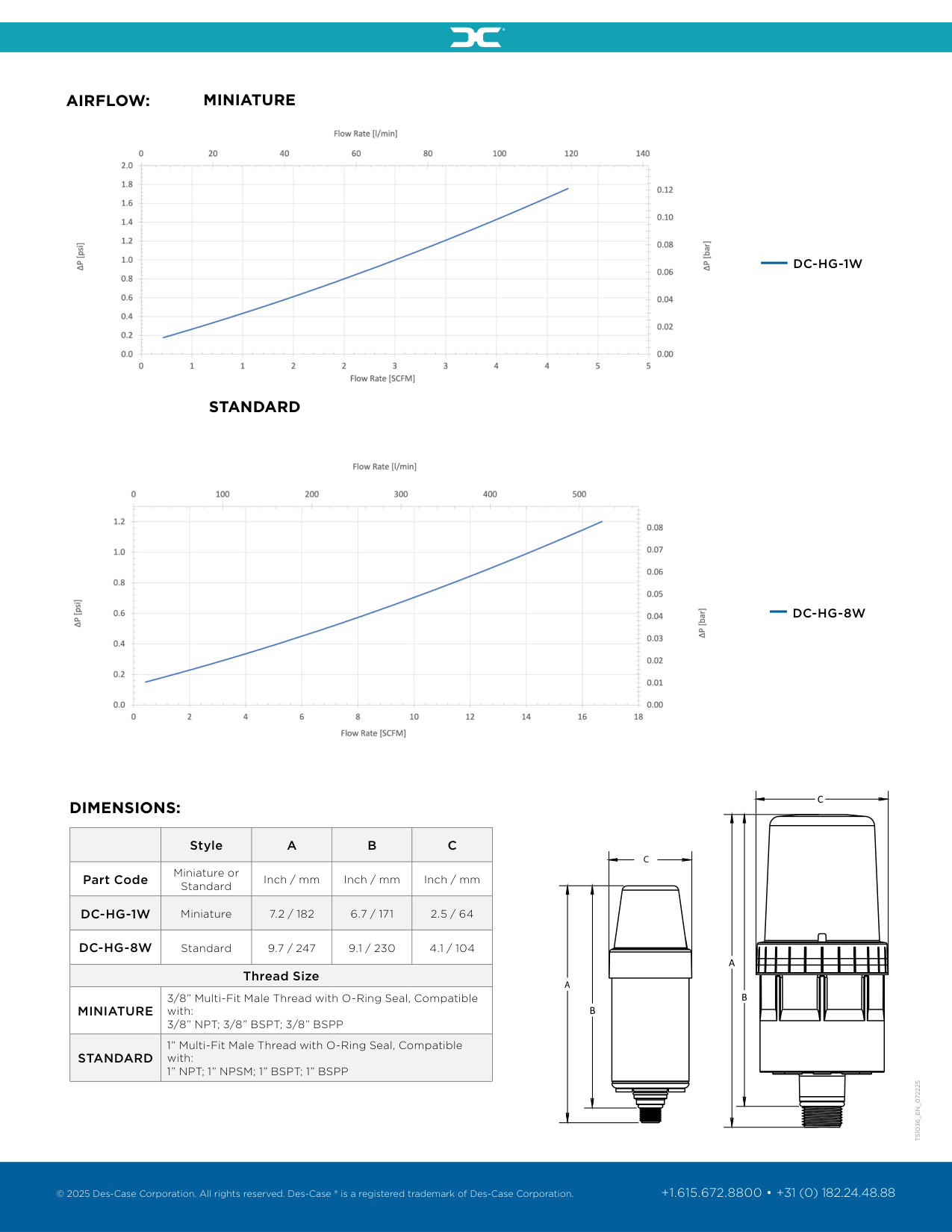
Now, let’s talk capacity. The DC-HG-1W holds 0.3 lbs of desiccant with a 1.5 fl oz water retention capacity. The DC-HG-8W steps it up to 0.7 lbs of desiccant and 4 fl oz capacity. What does this mean in real terms? The smaller unit handles up to 1 CFM airflow, perfect for smaller gearboxes and storage applications. The larger unit processes up to 14 CFM—enough for substantial transformers and high-flow hydraulic systems.
The difference between 1 CFM and 14 CFM capacity isn’t just about size—it’s about matching the breather to your application’s breathing requirements. Get this wrong, and you’re either over-engineering (wasting money) or under-protecting (risking failure).
Multi-Fit Threading: Here’s a feature that saves real money and real headaches. The 3/8″ version works with NPT, BSPT, and BSPP threads. The 1″ version handles NPT, NPSM, BSPT, and BSPP. Translation: No more custom adapters. No more “sorry, we don’t make that thread.” Just grab the right size and install.
REACH Compliance: This isn’t just regulatory box-checking. REACH compliance means you can install these breathers anywhere in the world without worrying about chemical restrictions or import issues. One product, global compatibility.
The orange-to-white color indication system deserves special mention. This isn’t just convenient—it’s revolutionary. Instead of changing desiccant on a schedule (whether it needs it or not), you change it based on actual conditions. In a low-humidity climate, you might go 18 months between changes. In a high-humidity wash-down environment, you might change it every 3 months. The breather tells you exactly when.
Where These Breathers Turn From Good Investment To Absolute Necessity
The HydroGuard Series really shows its worth in specific applications where standard breathers fail miserably.
Storage and Drum Applications: If you’re storing hydraulic fluids, lubricants, or chemicals in drums or totes, every temperature swing creates a breathing cycle. Without proper desiccant protection, you’re buying premium fluids and getting contaminated soup. The HydroGuard ensures your stored fluids stay as clean as the day you bought them.
High-Humidity and Wash-Down Environments: Pulp and paper mills, food processing plants, chemical wash-down areas—these are where ordinary breathers go to die. The HydroGuard thrives in these conditions, maintaining equipment integrity even when the ambient humidity is hitting 90%+.
For professionals looking at comprehensive moisture control solutions, understanding how silica gel moisture control saves your equipment from invisible destruction provides crucial context for why desiccant breathers aren’t optional—they’re essential.
When you’re sizing breathers for different applications, you’ll want to compare options like the Des-Case DC-VG-1 Desiccant Breather for standard applications, or consider rebuildable options like the Des-Case DC-R6015SBS Rebuildable Steel Breather for high-usage environments where replacement cost becomes a factor.
The Bottom Line: Protection That Pays For Itself
Look, I’m not going to sugarcoat this. Every day you operate critical equipment without proper moisture protection, you’re gambling with thousands of dollars in potential damage. The HydroGuard Series breathers eliminate that gamble.
At -20°F to 200°F operating range, with 3-micron absolute filtration and visual moisture indication, these breathers deliver protection that standard breather caps simply can’t match. Whether you need the compact DC-HG-1W for smaller applications or the high-capacity DC-HG-8W for demanding systems, you’re looking at protection that costs less than a single bearing replacement.
The question isn’t whether you can afford proper moisture protection. The question is whether you can afford to operate without it.
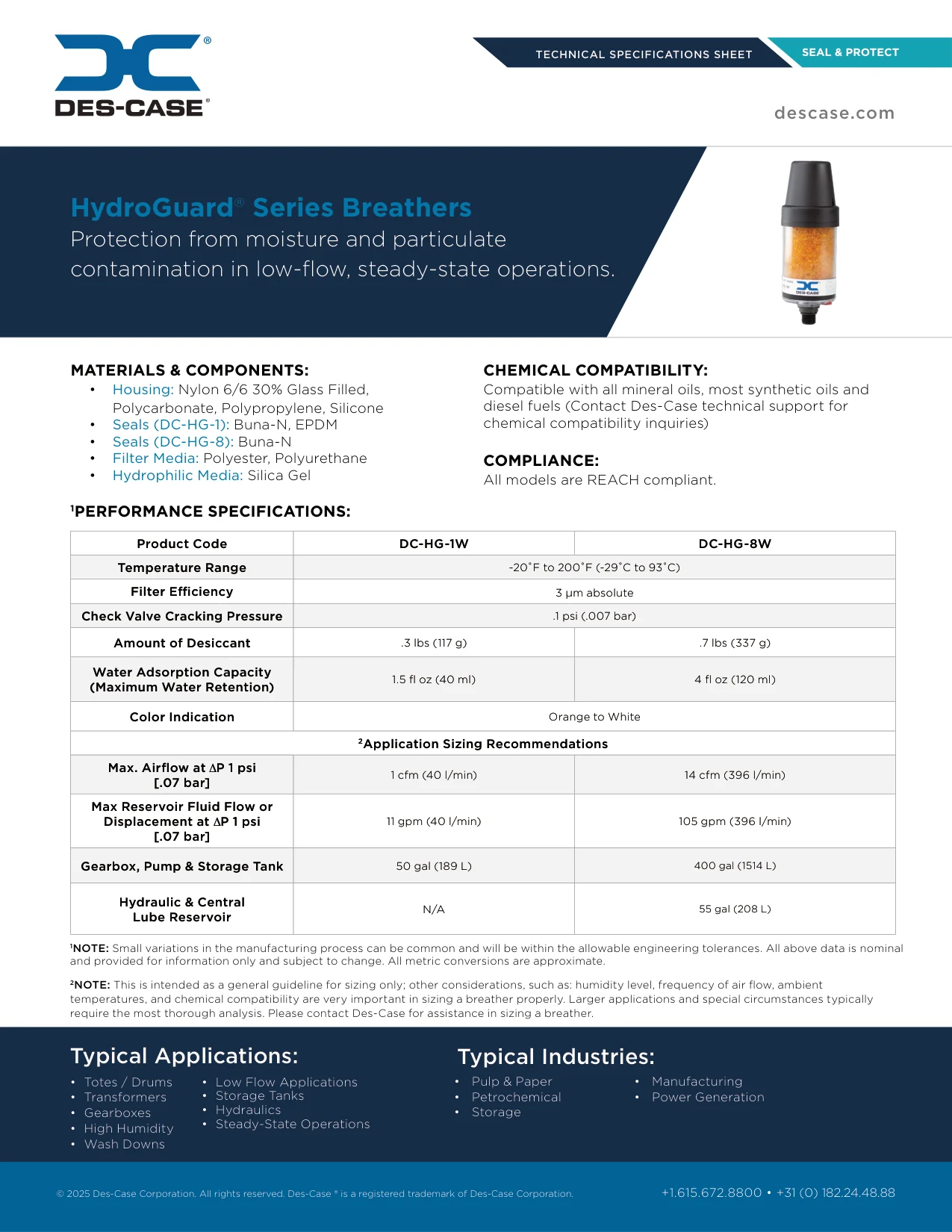
HydroGuard® Series Breathers
Orange Silica Gel Variant • DC-HG-1W / DC-HG-8W
Protection from moisture and particulate contamination in low-flow, steady-state operations. Ideal for high humidity, wash-down, and storage applications.
Color Indication: Orange to White • REACH Compliant
1PERFORMANCE SPECIFICATIONS:
| Specification | DC-HG-1W | DC-HG-8W |
|---|---|---|
| Temperature Range | -20°F to 200°F (-29°C to 93°C) | |
| Filter Efficiency | 3 μm absolute | |
| Check Valve Cracking Pressure | .1 psi (.007 bar) | |
| Amount of Desiccant | .3 lbs (117 g) | .7 lbs (337 g) |
| Water Adsorption Capacity (Max. Water Retention) | 1.5 fl oz (40 ml) | 4 fl oz (120 ml) |
| Color Indication | Orange to White | |
2APPLICATION SIZING RECOMMENDATIONS:
| Parameter | DC-HG-1W | DC-HG-8W |
|---|---|---|
| Max. Airflow at ΔP 1 psi [.07 bar] | 1 cfm (40 l/min) | 14 cfm (396 l/min) |
1NOTE: Small variations in the manufacturing process can be common and will be within the allowable engineering tolerances. All data is nominal and subject to change.
2NOTE: General guideline only. Consider humidity level, air flow frequency, ambient temperatures, and chemical compatibility. Please contact Des-Case for assistance.
Typical Applications:
- Storage / Totes / Drums
- Transformers
- Gearboxes
- High Humidity & Wash Downs
Typical Industries:
- Pulp & Paper
- Petrochemical
- Manufacturing
- Power Generation
DIMENSIONS:
| Part Code | Style | A (Inch / mm) | B (Inch / mm) | C (Inch / mm) |
|---|---|---|---|---|
| DC-HG-1W | Miniature | 7.2 / 182 | 6.7 / 171 | 2.5 / 64 |
| DC-HG-8W | Standard | 9.7 / 247 | 9.1 / 230 | 4.1 / 104 |
Standard Thread: 1″ Multi-Fit Male Thread with O-Ring Seal — Compatible with: 1″ NPT; 1″ NPSM; 1″ BSPT; 1″ BSPP